Crypto for Beginners: An Honest Guide
Crypto for beginners is full of hype in both directions: breathless promises and blanket dismissal. This guide takes a calmer path. It explains what crypto actually is, how Bitcoin and Ethereum differ, how wallets and exchanges work, the real risks and scams, and how to think about crypto as one small, speculative slice of a sensible portfolio.
Few topics attract more noise than cryptocurrency. For every person promising life-changing gains, another insists the whole thing is worthless. The truth for most people sits in between, and crypto for beginners is worth approaching with curiosity and caution in equal measure. You can understand it without believing the hype or the dismissal.
This guide to crypto for beginners is deliberately honest. It explains the technology and the legitimate uses, but it does not soft-pedal the volatility, scams, regulatory uncertainty, or energy debates. Crypto can lose value fast, and many projects fail entirely. By the end, you should be able to decide for yourself whether, and how much, it belongs in your plan.
- What crypto and blockchain actually are, in plain English
- How Bitcoin, Ethereum, and altcoins differ
- Wallets and exchanges, and the security trade-offs of each
- Why volatility matters, and what it means for a beginner
- That most crypto activity is a taxable event
- The common scams and how to recognise them
- How much crypto to own, and where it honestly fits in a portfolio
What crypto actually is
Cryptocurrency is digital money that runs on a blockchain rather than through a bank. The starting point for crypto for beginners is understanding that no central institution controls it; instead, a network of computers maintains a shared record. That design is the source of both its appeal and many of its risks.
Blockchain in plain English
A blockchain is a shared ledger copied across many computers. When a transaction happens, the network records it in a block, and once enough participants agree, that block is added permanently. No single party can quietly edit the history. For crypto for beginners, that is the core idea: a record kept by everyone rather than by one trusted middleman.
Why people find it compelling, and why to stay skeptical
Supporters value crypto for its independence from banks, its fixed or transparent supply rules, and its global, round-the-clock access. Those are real features. The honest counterpoint, central to crypto for beginners, is that this freedom comes without the protections of regulated finance: no chargebacks, limited recourse if funds are stolen, and prices that can swing violently. Both sides are true at once.
Where crypto came from
Bitcoin launched in 2009, in the aftermath of the financial crisis, proposing a form of money that did not depend on banks or governments to function. Thousands of other projects followed in the years since, some genuinely innovative, many not. Knowing this backdrop helps crypto for beginners see the field as an ongoing, unfinished experiment rather than a settled technology. It is young, it is evolving fast, and that youth is part of why both the opportunities and the risks remain unusually large.
Bitcoin vs Ethereum vs altcoins
Thousands of cryptocurrencies exist, but for crypto for beginners only a few categories really matter. Understanding the difference between Bitcoin, Ethereum, and the vast field of altcoins prevents you from treating wildly different assets as if they were the same thing.
Bitcoin: digital scarce money
Bitcoin was the first cryptocurrency and remains the largest and most established. It is designed as a scarce digital asset, often described as digital gold, with a capped supply. It is still highly volatile, but it has the longest track record. For crypto for beginners, Bitcoin is usually the starting point of any conversation, and our guide to what Bitcoin is explains it in depth.
Ethereum: a programmable blockchain
Ethereum is more than a currency; it is a platform that runs programs called smart contracts, which power many applications built on top of it. Its token, ether, is used to pay for activity on the network. Much of the wider ecosystem runs on Ethereum, so it is a key concept in crypto for beginners, and our guide to what Ethereum is explains it in depth.
Altcoins: everything else, mostly speculative
Altcoins are the thousands of other tokens, ranging from serious projects to outright jokes. Most are highly speculative, and a large share eventually fail or fade to nothing. A grounded approach to crypto for beginners regards altcoins with heavy skepticism and never assumes a small, unknown coin is the next big winner.
| Type | Core idea | Beginner note |
|---|---|---|
| Bitcoin | Scarce digital money, capped supply | Largest and oldest; still volatile |
| Ethereum | Programmable blockchain for apps | Powers much of the ecosystem |
| Altcoins | Thousands of other tokens | Mostly speculative; many fail entirely |
Wallets explained
A crypto wallet stores the keys that prove you own your coins. Wallets are where crypto for beginners gets practical, and where costly mistakes happen, because losing your keys can mean losing your funds permanently, with no helpline to call. Understanding the types is essential before you hold anything meaningful.
Hot vs cold wallets
A hot wallet is connected to the internet, making it convenient but more exposed to hacks. A cold wallet, such as a hardware device kept offline, is far harder to attack but less convenient for frequent use. In crypto for beginners, a common approach is small amounts hot, larger holdings cold.
Custodial vs non-custodial
With a custodial wallet, a company holds your keys for you, like a bank; it is convenient but you trust them entirely. With a non-custodial wallet, you hold your own keys and bear full responsibility. Each has trade-offs, and weighing them is a core decision in crypto for beginners.
Not your keys, not your coins
This well-worn phrase captures a real risk: if someone else holds your keys, you depend on their security and solvency. History includes exchanges that froze or lost customer funds. Crypto for beginners should take this seriously, deciding consciously how much to self-custody versus leave with a trusted, reputable platform.
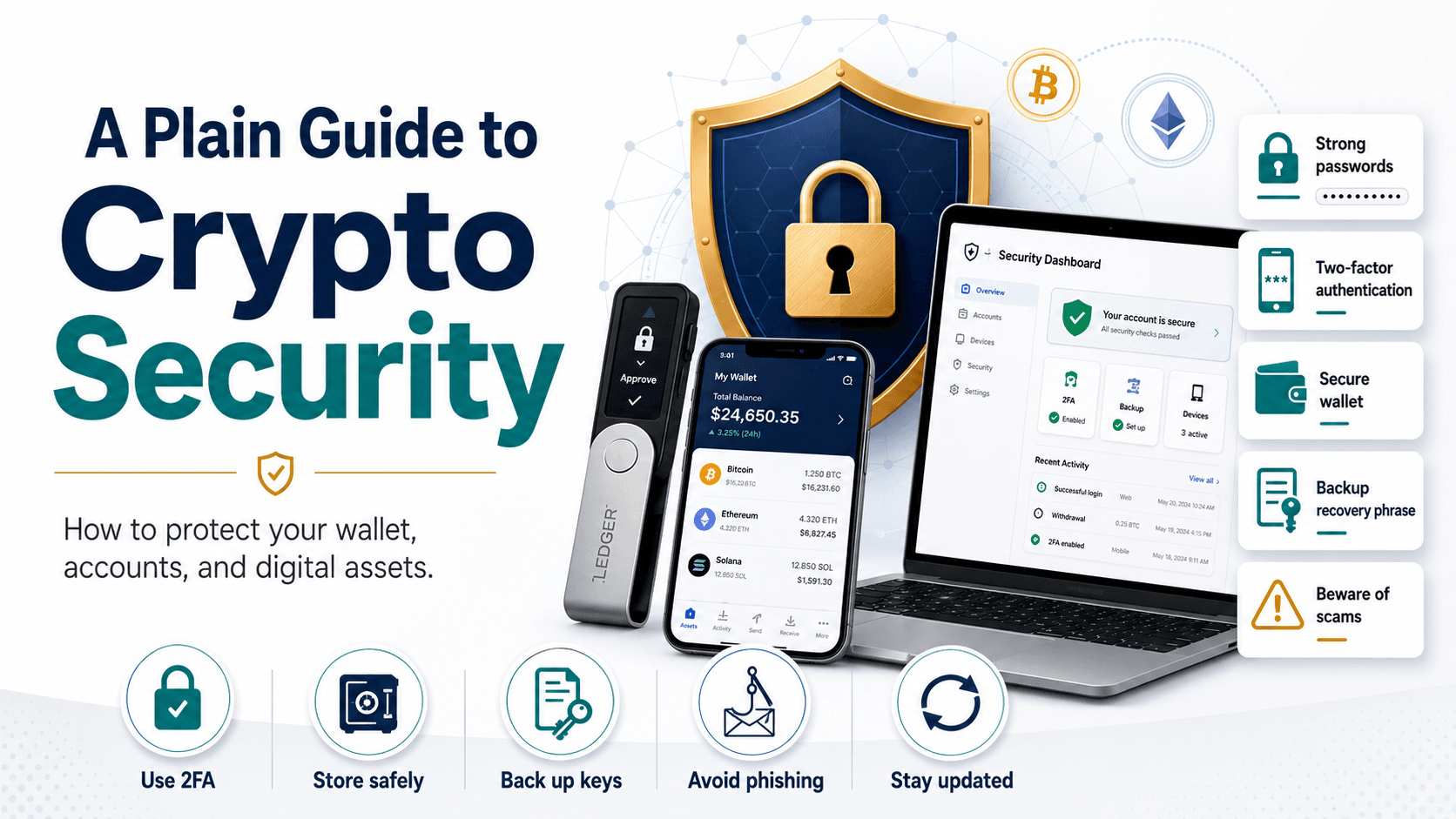
One rule sits above the rest: your recovery phrase, the list of words that can restore a wallet, must be kept offline and completely private. Anyone who sees it can take your funds, and no company can reset it for you if it is lost or stolen. Write it down on paper, store it somewhere secure, and never keep it in a photo, an email, or a cloud note where malware could reach it. Guarding that phrase is one of the most important habits in crypto for beginners.
Exchanges vs wallets
Beginners often confuse exchanges and wallets, but they do different jobs. Knowing the distinction is a small but important step in crypto for beginners, because it shapes how you buy, store, and protect anything you own.
What an exchange does
An exchange is where you convert regular money into crypto and back, and trade between coins. Reputable, regulated exchanges are the usual on-ramp for crypto for beginners. They are convenient, but leaving large balances on any exchange means trusting it with your keys, which carries the custodial risk described above.
Why you may want both
A sensible pattern is to buy on a trusted exchange, then move anything you intend to hold long term into your own wallet. The exchange handles buying and selling; your wallet handles secure storage. For crypto for beginners, separating those two roles reduces how much you rely on any single company staying safe.
Choosing a reputable exchange
Not all exchanges are equal, and the choice matters more than beginners expect. Favour established, regulated platforms with a long track record, transparent fees, and strong security practices, and be wary of obscure venues promising unusually generous rates or rewards. Check whether the exchange is registered with the relevant authorities in your country, and read independent reviews rather than its own marketing. For crypto for beginners, where you buy is a security decision as much as a convenience one, so it deserves careful thought rather than picking whatever advertises loudest.
Volatility and what it means
If there is one trait that defines crypto, it is volatility. Prices can rise or fall dramatically in days, sometimes hours. Any honest take on crypto for beginners has to put this front and centre, because it shapes how much you should risk and how you should feel when the value moves.
Crypto swings hard
Large drops are normal in crypto, not rare exceptions. Assets have lost most of their value in past downturns, and some never recovered. This is not a flaw the market will outgrow soon; it is a feature of a young, speculative asset class. Crypto for beginners means expecting turbulence rather than being shocked by it.
What that means for a beginner
Volatility is exactly why you should only commit money you can afford to lose entirely. Buying steadily over time, rather than a single lump sum, can soften the emotional swings. Dollar-cost averaging is one tool some use in crypto for beginners to avoid trying to time an unpredictable market.
CALCULATOR Crypto DCA Calculator See how spreading purchases over time would have smoothed your average cost through volatile markets.Crypto taxes
A point many newcomers miss: in many countries, crypto is taxable, and more activities trigger tax than people expect. Getting this right is a serious part of crypto for beginners, because unreported gains can lead to penalties down the line. Keep records of every transaction from the start.
Most crypto moves are taxable events
Selling crypto, swapping one coin for another, or spending it can all be taxable events in places like the US, generating capital gains or losses. Simply buying and holding usually is not. The exact rules vary by country, so confirm yours, but assume that activity creates a tax record within crypto for beginners.
Capital gains, mining, and staking
Profits from selling are typically taxed as capital gains, while rewards from mining or staking may be taxed as income when received. These rules differ widely between countries and change over time. If you are weighing tools to help, dedicated crypto tax software can import your transactions and calculate the gains automatically, while our comparison of AI tax software versus traditional preparation covers the broader options.
CALCULATOR Staking Rewards Calculator Estimate potential staking rewards, and remember those rewards may be taxable when you receive them.Common scams to recognise
Crypto’s lack of central oversight makes it fertile ground for fraud. Recognising the patterns is one of the most protective parts of crypto for beginners. According to the FTC, scammers increasingly demand payment in crypto precisely because transactions are hard to reverse.
Pump-and-dump and rug pulls
In a pump-and-dump, promoters hype a token to inflate its price, then sell, leaving latecomers with losses. In a rug pull, developers abandon a project and vanish with investors’ money. Both are common with obscure tokens, which is why crypto for beginners should be deeply wary of anything promising fast, outsized gains.
Phishing and fake support
Scammers impersonate exchanges, wallets, or support staff to trick you into revealing your keys or recovery phrase. No legitimate service will ever ask for your recovery phrase. Treating that phrase like the key to a vault, and never sharing it, is a non-negotiable rule in crypto for beginners.
If it sounds too good to be true
Promises that returns are certain, that your money will double, or that an investment carries no risk at all are always scams; no honest investment works that way. The same goes for celebrity giveaways and unsolicited investment tips. A healthy reflex in crypto for beginners is that the louder the promise, the faster you should walk away.
Slow down and verify
Almost every scam relies on urgency, pushing you to act before you have time to think. The simplest defence in crypto for beginners is to deliberately slow down. Verify website addresses character by character, double-check any wallet address you paste, and confirm anything unexpected through an official channel you located yourself rather than a link someone sent you. A few minutes of patient checking prevents the great majority of avoidable losses, because fraud depends on you moving fast and trusting too quickly.
How much crypto to actually own
Perhaps the most practical question in crypto for beginners is sizing: how much, if any, should you hold? The honest answer is modest. Crypto is speculative, so it belongs to the small, high-risk corner of a plan, never the foundation that your security depends on.
Only what you can afford to lose
The first rule is to risk only money whose total loss would not derail your life. Before buying any crypto, the steadier parts of your finances should be in place; our guide to personal finance basics covers the emergency fund and debt payoff that come first in any sensible plan.
A small slice of a diversified portfolio
Many cautious investors who choose to hold crypto keep it to a small percentage of their overall portfolio, so a crash hurts but does not ruin them. It sits alongside, not instead of, diversified long-term investing. If you are new to that foundation, our investing for beginners guide sets the context crypto for beginners should build on.
CALCULATOR Compound Interest Calculator Compare the slow, steady growth of diversified investing with the gamble of speculative bets.Stablecoins and DeFi
Two terms come up constantly, so crypto for beginners should at least recognise them, even without going deep. Both add useful context, and both carry their own risks that newcomers often underestimate in the excitement of something new.
What stablecoins are
Stablecoins aim to hold a steady value, usually pegged to a currency like the dollar, to provide a calmer place to park funds within crypto. They are useful, but not all are equally backed, and some have failed to hold their peg. In crypto for beginners, treat the word stable as a goal, not a promise.
DeFi in one paragraph
DeFi, or decentralised finance, refers to lending, borrowing, and trading run by code rather than banks. It can offer interesting services, but it is experimental, largely unregulated, and a frequent target of hacks and scams. For crypto for beginners, DeFi is better grasped from a safe distance until the foundations are solid.
If you do decide to explore further, our crypto tools can help you model the numbers behind any decision without the hype, which is exactly the spirit crypto for beginners should hold onto.
CALCULATOR HUB Crypto Calculators Model dollar-cost averaging, staking, and more, so any crypto decision rests on numbers rather than noise.Where crypto for beginners honestly fits
So where does this leave a newcomer? An honest summary of crypto for beginners is that it is an interesting, high-risk asset class that some people choose to hold in small amounts, fully accepting they might lose it all. It is not a retirement plan, and it is not free money.
A speculative satellite, not the core
Think of crypto as a small satellite orbiting a solid financial core of savings, diversified investing, and insurance. If it grows, good; if it vanishes, your life continues. Framing crypto for beginners this way keeps the excitement from crowding out the boring habits that actually build security.
Regulatory and environmental realities
Two honest caveats remain. Regulation is still evolving worldwide, so rules can change in ways that affect value and access. And some networks that use proof-of-work mining consume significant energy, a genuine environmental concern. A complete view of crypto for beginners holds these realities alongside the technology’s potential.
None of this means crypto is a scam or inherently worthless; it means it is genuinely uncertain. Reasonable, well-informed people disagree sharply about its long-term future, and that very disagreement is a signal to keep any position small and to avoid staking your security on the outcome. The honest stance for crypto for beginners is to stay curious but humble, and to let time and evidence, rather than hype or fear, shape how much you ever choose to commit.
This guide is educational content, not financial advice. Crypto is highly volatile and speculative; you can lose some or all of the money you put in, and returns are never assured. Regulation varies and is changing, and crypto generally lacks the protections of regulated banking. Only ever risk money you can afford to lose entirely, and consider speaking with a qualified, regulated financial professional before investing.
Frequently asked questions
Is crypto for beginners a good idea at all?
It depends on your finances and risk tolerance. Crypto is speculative, so it suits people who already have an emergency fund, manageable debt, and diversified investing in place, and who can afford to lose what they put in. For others, it is wiser to build that foundation first before exploring crypto for beginners.
How much money do I need to start?
Very little, since you can buy fractions of a coin. But the better question is how much you can afford to lose entirely, because that, not the minimum, should set your limit. In crypto for beginners, starting small while you learn is far wiser than committing money you need.
What is the safest way to store crypto?
For meaningful amounts, a cold, non-custodial wallet such as a hardware device offers strong protection, provided you safeguard your recovery phrase. Small amounts for active use can sit in a hot wallet. Never share your recovery phrase with anyone; protecting it is the bedrock of security in crypto for beginners.
Do I have to pay tax on crypto?
In many countries, yes. Selling, swapping, or spending crypto can trigger taxable gains, and mining or staking rewards may count as income. Buying and holding usually does not. Rules vary widely and change, so keep records of everything and confirm your local obligations; tax awareness is essential in crypto for beginners.
How do I avoid crypto scams?
Be deeply skeptical of any promise of certain or outsized returns, never share your recovery phrase, and stick to reputable, regulated platforms. Ignore unsolicited tips and celebrity giveaways. Most scams rely on urgency and greed, so slowing down and verifying is the strongest defence in crypto for beginners.
Should I buy Bitcoin or a cheaper altcoin?
A low price per coin does not mean a coin is cheap or a better deal; it reflects supply, not value. Most obscure altcoins are far riskier than established assets and many fail. For crypto for beginners, sticking to the largest, most established options reduces, though never removes, the risk.
Can crypto replace my retirement savings?
No. Crypto is far too volatile and unproven to anchor a retirement plan, and you could lose it entirely. It may, at most, be a small speculative slice for those who can afford the risk. Diversified, tax-advantaged investing remains the foundation that crypto for beginners should never replace.
Where can I learn more reliably?
Stick to neutral, authoritative sources rather than influencers with something to sell. Regulators such as the SEC’s Investor.gov and consumer bodies like the CFPB publish balanced guidance, and Investopedia explains the concepts clearly for crypto for beginners.
Putting crypto for beginners together
The honest version of crypto for beginners is calm and unglamorous: understand the technology, respect the volatility, secure your keys, expect to pay tax, watch relentlessly for scams, and size any position so a total loss would not hurt you. None of that is exciting, which is exactly why it works.
Build the boring foundation first. With an emergency fund, controlled debt, and diversified investing in place, a small, clear-eyed allocation to crypto becomes a considered choice rather than a gamble with money you need. That is the difference between speculating responsibly and being swept up in the noise that surrounds crypto for beginners.
Whatever you decide, keep learning from sources without an agenda, and let the steady parts of your finances carry the real weight. Crypto for beginners works best as a small, optional experiment on top of a plan that would be perfectly fine even if crypto did not exist at all.
Crypto for beginners comes down to honest expectations: it is a high-risk, speculative asset, not a shortcut to wealth. Learn how it works, secure your keys, plan for tax, stay alert to scams, and only ever risk money you can afford to lose. Keep it a small slice on top of a solid, diversified financial plan, and never the plan itself.
Educational content only, not financial advice. Ladabo publishes research-based guides to help you understand crypto for beginners and make your own informed decisions; we do not provide individual financial advice, and crypto is volatile, speculative, and can lose all its value. Read our review methodology and disclaimer for how this content is produced and its limits.
Last reviewed: June 2026