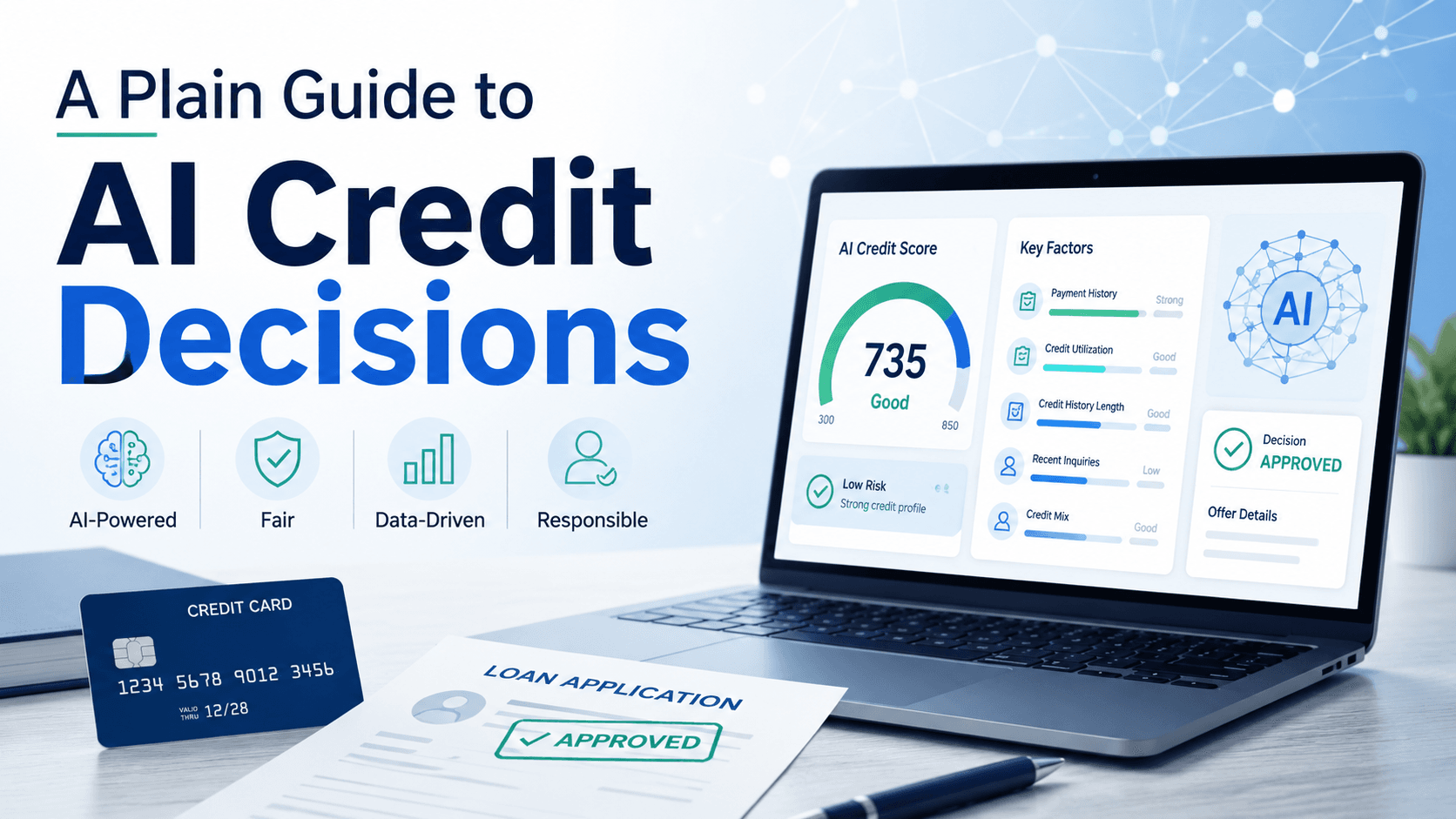
A Plain Guide to AI Credit Decisions
More and more lending decisions are shaped by artificial intelligence behind the scenes. This plain-English guide explains AI credit decisions, their benefits, and their real concerns.
When you apply for a loan, a credit card, or other financing, a decision is made about whether to approve you and on what terms. Increasingly, that decision is shaped, sometimes entirely, by artificial intelligence working quietly in the background. AI credit decisions promise faster, more consistent lending, but they also raise serious questions about fairness, transparency, and what happens when a machine gets it wrong. Understanding how AI credit decisions work, why lenders use them, and what concerns they raise is valuable for anyone who borrows, which is almost everyone.
This guide explains AI credit decisions in plain, general terms. It covers what they are, how they work, why lenders use them, the genuine concerns they raise around fairness and transparency, and what it can mean for you as a borrower. The aim is balanced understanding, not financial or legal advice, and the goal is to help you engage with a system that increasingly affects real financial outcomes in people’s lives.
- What AI credit decisions are
- How they generally work
- Why lenders use them
- The concerns around fairness and transparency
- What it can mean for you
- How to engage with the system
What AI credit decisions are
AI credit decisions are lending decisions, about whether to approve credit and on what terms, that are made or heavily influenced by artificial intelligence rather than solely by human judgement or simple fixed rules. Instead of a person weighing an application alone, software analyses data and produces an assessment of how risky lending to someone would be.
In practice, AI credit decisions sit on a spectrum. At one end, AI may simply assist a human who makes the final call; at the other, the decision may be largely automated, with little human involvement. Either way, the defining feature is that artificial intelligence is doing significant work in judging creditworthiness.
An evolution of credit scoring
AI credit decisions can be seen as an evolution of long-standing credit scoring, which already used data and formulas to assess borrowers. What is new is the sophistication: AI can consider far more data and find more complex patterns than traditional scoring, which is both its strength and a source of concern.
Often invisible to the borrower
One striking thing about AI credit decisions is that, as a borrower, you usually cannot see them happening. You submit an application and receive an answer, with the AI’s role hidden in between. This invisibility is part of why understanding the broad idea matters, since the process shaping the outcome is rarely explained.
How AI credit decisions work
Understanding roughly how AI credit decisions work demystifies a process that can feel like a black box. While the details vary and are often proprietary, the broad shape is consistent.
Analysing data about applicants
At their core, AI credit decisions rest on analysing data about an applicant, such as financial history and other information a lender holds or can access, to estimate the likelihood of repayment. The AI looks for patterns associated with borrowers who did or did not repay, and uses them to assess new applicants.
GUIDE Understanding Your Credit Score Credit scores are the foundation that AI credit decisions often build upon.Finding patterns and predicting risk
The heart of AI credit decisions is prediction: using patterns learned from data to estimate how likely a given applicant is to repay. This predictive assessment then informs whether credit is offered and on what terms. The power, and the risk, lies in how those patterns are learned and applied.
Producing a decision or recommendation
Finally, AI credit decisions produce an output, an approval, a rejection, particular terms, or a recommendation to a human reviewer. Depending on the lender, this may be acted on automatically or used to support a person’s judgement. Either way, the AI’s assessment carries real weight in the final result.
This guide is general educational content, not financial or legal advice. AI credit decisions are made by systems that can be flawed: they can reflect bias in their data, be opaque even to the lenders using them, and reach conclusions that are wrong or unfair for an individual. How these systems work, what data they use, and what rights you have vary by country and lender and change over time. If you believe a credit decision was unfair or incorrect, or you want to understand your rights, consult your lender, your country’s relevant authorities, and where appropriate a qualified professional, rather than relying on the general principles described here.
Why lenders use AI credit decisions
Lenders have adopted AI credit decisions for several practical reasons. Understanding their motivations helps explain why the technology has spread so quickly through lending.
Speed and scale
A major appeal of AI credit decisions is speed: they can assess applications almost instantly and handle huge volumes, which is why some lending now offers near-immediate answers. For lenders, this efficiency reduces cost and lets them serve many more applicants than manual review ever could.
Consistency
AI credit decisions can apply the same logic to every application, offering a consistency that human reviewers, with their varying moods and judgements, cannot always match. In principle this even-handedness is appealing, though as we will see, consistency is not the same as fairness if the underlying logic is itself flawed.
GUIDE Good Debt vs Bad Debt Understanding borrowing helps you navigate the lending these systems govern.Finding subtle patterns
Because they can analyse far more data than older methods, AI credit decisions may detect subtle patterns that improve predictions of who will repay. Lenders value this potential accuracy, though the same capacity to find hidden patterns is exactly what raises concerns when those patterns turn out to be unfair proxies.
Reaching more borrowers
Lenders also argue that AI credit decisions can extend credit to people who might be overlooked by rigid traditional methods, by drawing on a wider range of information to assess those with thin or unconventional financial histories. In principle, a more nuanced read of someone’s situation could open doors that a blunt, one-size-fits-all rule would keep shut.
This potential is genuine, but it cuts both ways and should be treated with care. The same systems that might include some previously excluded borrowers can, if poorly designed, exclude others unfairly through the very patterns they learn. Wider reach is a real argument for AI credit decisions, yet it is only a benefit when the fairness concerns discussed later are taken seriously rather than assumed away.
The concerns around AI credit decisions
For all their appeal, AI credit decisions raise genuine and serious concerns. These are not reasons to dismiss the technology outright, but they are reasons to view it critically rather than trust it uncritically.
Opacity and the “black box”
A central worry about AI credit decisions is opacity: the systems can be so complex that even those using them struggle to explain exactly why a particular decision was made. When an applicant is rejected and no one can clearly say why, that lack of transparency is troubling and makes errors hard to challenge.
Errors with real consequences
AI credit decisions can be wrong, and when they are, the consequences fall on real people, perhaps denied credit they should have received, or offered worse terms than they deserve. Because the process is automated and fast, mistakes can be made at scale, affecting many before anyone notices a problem.
Data quality matters enormously
AI credit decisions are only as good as the data behind them. If that data is inaccurate, incomplete, or unrepresentative, the decisions built on it can be flawed too. An error in the underlying information about someone can quietly produce an unfair outcome that is hard to trace back to its source.
Accountability can be unclear
Another concern around AI credit decisions is the question of who is responsible when something goes wrong. When a decision is produced by a complex system, possibly built by one party and used by another, it can be unclear where accountability lies. That ambiguity can leave an affected person unsure who to turn to, and can let mistakes go uncorrected.
Clear lines of responsibility matter precisely because the outcomes are consequential. A borrower wrongly denied credit deserves a path to redress, and that path depends on someone, the lender at minimum, owning the decision rather than deflecting to “the system.” Part of the broader push for oversight is about ensuring that automated decisions still come with human accountability attached.
Fairness and bias
Perhaps the most important concern about AI credit decisions is fairness. Because this issue is so consequential, it deserves its own focused discussion.
Bias can hide in the data
A serious risk is that AI credit decisions can absorb and repeat biases present in the data they learn from. If historical lending data reflects unfair patterns, an AI trained on it may reproduce those patterns, disadvantaging certain groups even without anyone intending it. The bias hides in the data rather than in an obvious rule.
GUIDE Financial Data Privacy The data behind AI credit decisions raises important privacy questions too.Proxies can be unfair
Even when sensitive characteristics are excluded, AI credit decisions can find other data that stands in for them, unfair proxies that produce discriminatory outcomes indirectly. This makes bias in lending genuinely hard to root out, because it can re-emerge through seemingly neutral information in subtle ways.
Why oversight matters
Because of these fairness risks, there is wide agreement that AI credit decisions need careful oversight, testing, and regulation to guard against discrimination. Many places are developing rules around automated decision-making in lending precisely because the stakes, people’s access to credit and fair treatment, are so high.
The push for explainability
Partly in response to these concerns, there is growing pressure for AI credit decisions to be explainable, so that a lender can say, in understandable terms, why an application was treated as it was. Explainability matters because a decision no one can account for is a decision no one can properly challenge or correct.
This is not merely a technical nicety; it is closely tied to fairness and accountability. If a person is turned down, being told the broad reasons gives them something to act on and a basis to question the outcome. The movement toward more transparent systems reflects a recognition that speed and accuracy alone are not enough when real lives and livelihoods are affected by the result.
What AI credit decisions mean for you
Beyond the theory, AI credit decisions have practical implications for you as a borrower. Knowing a few things can help you engage with the system more effectively.
Your data shapes the outcome
Because AI credit decisions rest on data, the accuracy of the information about you matters. Errors in your records can lead to unfair outcomes, which is why checking that the data held about you is correct, where you are able to, is a sensible and practical habit worth keeping up.
You may have rights
In many places, people have rights regarding automated decisions that significantly affect them, sometimes including the right to an explanation or to human review. These rights vary by country, but knowing they may exist means you can ask questions rather than simply accepting an AI credit decision you believe is wrong.
Questioning a decision
If you are affected by an AI credit decision you think is mistaken or unfair, you can often ask the lender for more information, request a review, or escalate to a relevant authority. Understanding that these systems are fallible empowers you to challenge an outcome rather than assume the machine must be right.
Stay informed as the rules evolve
Because the use of AI credit decisions and the rules around them are changing quickly, it is worth staying broadly aware of how the landscape develops where you live. New protections, requirements for explainability, and limits on automated decision-making are emerging in many places, and they directly affect your position as a borrower.
You do not need to track every detail, but a general awareness helps you recognise when you have grounds to ask questions or push back. The direction of travel in many regions is toward greater transparency and stronger rights for individuals, which is encouraging, but those protections only help if people know enough to invoke them when it counts.
Frequently asked questions
What are AI credit decisions in simple terms?
AI credit decisions are lending decisions, about whether to approve credit and on what terms, that are made or heavily influenced by artificial intelligence rather than by human judgement or simple fixed rules alone. Software analyses data to estimate how likely someone is to repay, then informs or makes the decision. They range from assisting a human reviewer to being largely automated.
How do AI credit decisions work?
They analyse data about an applicant, such as financial history and other information, to find patterns associated with repayment and estimate the risk of lending. That predictive assessment then produces an output, an approval, rejection, particular terms, or a recommendation to a human. The details are often proprietary, but the core is using learned patterns to predict creditworthiness.
How are AI credit decisions different from credit scores?
They are an evolution of traditional credit scoring, which already used data and formulas. The difference is sophistication: AI can consider far more data and detect more complex patterns than older scoring methods. That extra power can improve predictions, but it also makes the process harder to understand and raises new concerns about transparency and fairness that simpler scoring did not.
Can AI credit decisions be biased?
Yes, and this is one of the most serious concerns. If the data an AI learns from reflects unfair historical patterns, the system can reproduce them, disadvantaging certain groups even without anyone intending it. Bias can also re-emerge through seemingly neutral data that acts as a proxy for sensitive characteristics, which makes it genuinely difficult to root out.
What can I do if I think a decision was unfair?
You can often ask the lender for more information, request a human review, or escalate to a relevant authority. In many places people have rights regarding automated decisions that significantly affect them, sometimes including a right to an explanation or review. These rights vary by country, so checking what applies where you live, and consulting a professional if needed, is worthwhile.
Why are AI credit decisions often so hard to explain?
Because the systems can be highly complex, sometimes even those using them struggle to say exactly why a particular decision was reached, a problem often called the “black box.” This opacity makes errors hard to challenge, which is why there is growing pressure for explainability, so lenders can give understandable reasons for how an application was treated.
Are AI credit decisions regulated?
Increasingly, yes, though it varies by place. Because the stakes are high, access to credit and fair treatment, many regions are developing or strengthening rules around automated decision-making in lending, including requirements for oversight, fairness testing, and explainability. The landscape is evolving quickly, so the protections available to you depend on where you live and continue to change.
The bottom line on AI credit decisions
AI credit decisions are lending decisions shaped or made by artificial intelligence, an evolution of traditional credit scoring that uses far more data and finds more complex patterns to predict who will repay. Lenders value them for their speed, scale, consistency, and potential accuracy, and they increasingly sit, often invisibly, between your application and the answer you receive. For better and worse, this technology now plays a real part in who can borrow and on what terms.
The concerns are just as real as the benefits. These systems can be opaque even to those using them, they can make errors at scale, they depend heavily on the quality of their data, and, most seriously, they can absorb and repeat bias, producing unfair outcomes through hidden proxies. This is why oversight, regulation, and the push for explainability matter so much. As a borrower, your soundest response is to keep the data about you accurate, know that you may have rights to explanation or review, question decisions you believe are wrong, and stay aware as the rules evolve, treating these systems as powerful but fallible rather than beyond challenge.
This sits alongside the wider context in our credit score guide. For a neutral, broader reference on credit and finance concepts, Investopedia is a useful starting point, but for your rights and any decision affecting you, your lender, your local authorities, and a qualified professional are the sources that count.
AI credit decisions are lending decisions shaped by AI, using lots of data to predict repayment. Lenders value their speed, scale, and consistency, but they can be opaque, make errors at scale, and absorb bias that produces unfair outcomes. Keep your data accurate, know you may have rights to explanation or review, and question decisions you believe are wrong.
Educational content only, not financial or legal advice. Ladabo publishes research-based guides to help you understand AI credit decisions and make your own informed decisions; we do not provide individual financial or legal advice. AI systems can be flawed, biased, and opaque, and your rights vary by country. Read our review methodology and disclaimer for how this content is produced and its limits.
Last reviewed: June 2026