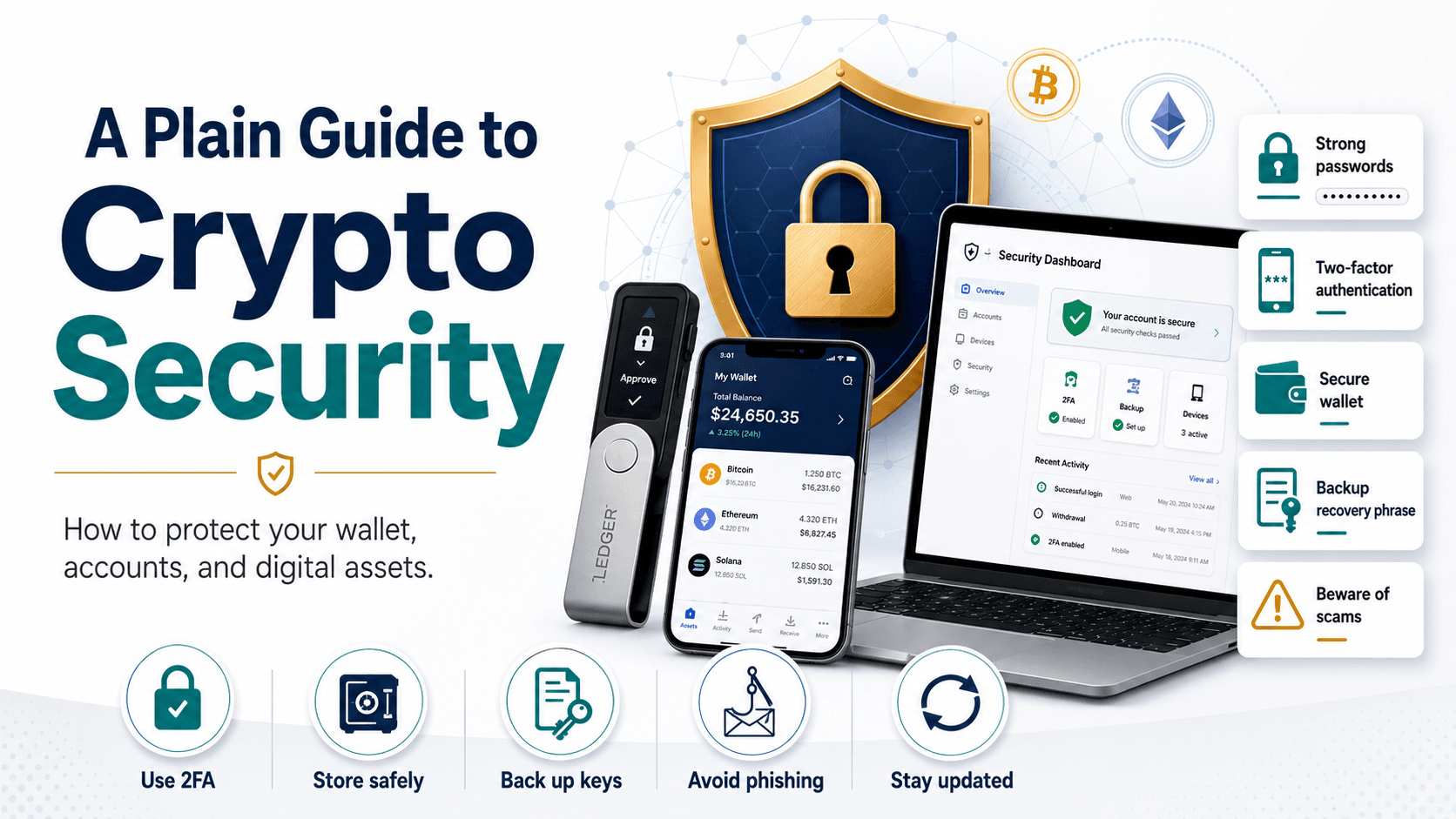
A Plain Guide to Crypto Security
In crypto, you are often your own bank, and that means you are your own security. This plain-English guide explains crypto security and how people lose, and protect, their assets.
In traditional finance, a bank stands between you and disaster: it can freeze a stolen card, reverse a fraudulent payment, or restore access to a forgotten account. In much of the crypto world, no such safety net exists. You are often your own bank, which means you are also your own security guard, and the consequences of a lapse can be permanent. This is why crypto security is not an optional extra but the very foundation of using crypto at all. Understanding how assets are lost, and how they are protected, matters enormously before risking anything.
This guide explains crypto security in plain, general terms. It covers what it really means, the central role of private keys and recovery phrases, how wallets and storage affect safety, the common threats people face, the habits that protect you, and the hard reality that mistakes are often irreversible. The aim is practical understanding, not specific product recommendations, and nothing here is investment advice or a suggestion that you should hold crypto at all.
- What crypto security really means
- The central role of keys and recovery phrases
- How wallets and storage affect safety
- The common threats people face
- The habits that protect you
- Why mistakes are often irreversible
What crypto security means
Crypto security is the set of practices and precautions that keep your crypto assets safe from theft, loss, and mistakes. Because crypto often lacks the institutional protections of traditional banking, much of the responsibility for keeping assets safe falls directly on the individual, which makes crypto security a deeply personal matter.
The core idea behind crypto security is that, in many setups, controlling your crypto comes down to controlling a secret piece of information. Whoever holds that secret controls the assets. This is empowering in principle, but it also means that if you lose the secret, or someone else gets it, the consequences can be immediate and permanent.
You are often your own bank
A phrase often heard in crypto is that you are your own bank. It captures something real: with no institution to call, the safety of your assets rests on your own crypto security. That independence appeals to many people, but it carries a heavy responsibility that newcomers frequently underestimate.
No safety net by default
Unlike a bank account, many crypto holdings come with no built-in recovery, no fraud department, and no way to reverse a mistake. This absence of a safety net is precisely why crypto security matters so much: the protections you might assume exist often simply do not, leaving prevention as the only real defence.
Crypto security and your keys
At the heart of crypto security sits one concept above all others: the private key, and the recovery phrase that often represents it. Understanding and protecting these is the single most important part of keeping crypto safe.
What a private key is
A private key is, in essence, the secret that proves ownership and allows crypto to be spent or moved. Whoever controls the private key controls the associated assets. This is why so much of crypto security comes down to keeping that key secret and safe, because it is, functionally, the asset’s lock and the only key to it.
GUIDE Understanding Crypto Wallets Wallets are how keys are managed, so they sit at the centre of crypto security.Recovery phrases
Many wallets give you a recovery phrase, a sequence of words that can restore access to your crypto. This phrase is extraordinarily sensitive: anyone who obtains it can take your assets, and anyone who loses it may lose access forever. Protecting it is among the most critical tasks in all of crypto security.
Never share, never lose
The twin rules at the core of crypto security are simple to state and hard to live by: never share your private key or recovery phrase with anyone, and never lose them. Legitimate services will not ask for them, and anyone who does is almost certainly trying to steal from you. Both halves of this rule matter equally.
This guide is general educational content, not financial, security, or technical advice, and nothing here is a recommendation to hold crypto or a guarantee of safety. In much of crypto there is no safety net: if your keys or recovery phrase are lost or stolen, assets are usually gone permanently, with no one to reverse the loss. Crypto is also extremely volatile and high-risk in its own right. No precaution removes all risk. Never share your keys or recovery phrase, never risk money you cannot afford to lose entirely, and consult qualified, independent professionals before making decisions.
Wallets and storage
How and where you store crypto has a large effect on its security. The choices around wallets and storage are some of the most consequential in crypto security, and they involve real trade-offs.
Hot versus cold storage
A common distinction in crypto security is between “hot” storage, connected to the internet and convenient but more exposed, and “cold” storage, kept offline and less convenient but harder for attackers to reach. Each suits different needs, and many people use a mix, keeping only small amounts in more exposed places.
Self-custody versus a platform
Another key choice is whether you hold your own keys (self-custody) or let a platform hold them for you. Self-custody puts crypto security entirely in your hands, for better and worse, while trusting a platform shifts some risk to it, including the risk that it fails, freezes access, or is hacked. Neither is free of danger.
GUIDE Crypto for Beginners Storage choices make more sense once you understand crypto from the ground up.Backups matter enormously
Because losing access can be as devastating as being hacked, backing up recovery information securely is a pillar of crypto security. A sensible backup, kept safe and private, protects against losing a device or forgetting details, but a careless backup can itself become the weak point an attacker exploits. How you back up matters as much as whether you do.
Convenience and safety pull in opposite directions
A recurring tension worth naming is that the easiest setups to use are often the least protected, while the safest are the most cumbersome. Keeping everything instantly accessible on a connected device is convenient but exposed; locking assets away offline is far harder for an attacker to reach but also slower and more awkward for you.
There is no single correct answer, only a balance suited to how much you hold and how often you need access. Many people resolve it by splitting their holdings, keeping a small, working amount somewhere convenient and the bulk in more protected storage. Recognising the trade-off, rather than pretending it does not exist, is what lets you make a deliberate choice instead of drifting into whichever option happened to be easiest.
The common threats
To protect yourself, it helps to know what you are protecting against. A handful of threats account for a large share of crypto losses, and recognising them is central to crypto security.
Scams and social engineering
Many crypto losses come not from sophisticated hacking but from people being tricked into handing over keys, recovery phrases, or access. Fake support staff, impersonation, romance scams, and fraudulent “opportunities” all aim to manipulate you. A huge part of crypto security is simply learning to recognise and resist these manipulations.
Phishing and fake sites
Phishing, where attackers create convincing fake websites, messages, or apps to capture your details, is rampant in crypto. A fraudulent site that looks identical to a real one can harvest your recovery phrase in seconds. Vigilance about exactly where you are entering sensitive information is a core crypto security habit.
Malware and device compromise
Malicious software on your phone or computer can steal keys, alter what you see, or capture what you type, undermining crypto security from inside your own device. Keeping devices clean, updated, and free of untrusted software is part of protecting the assets that depend on them.
The pressure of urgency
Across almost all of these threats runs a common thread: the deliberate creation of urgency. A message warns that your account is about to be frozen, that an offer expires in minutes, or that you must act now to avoid a loss. The aim is always the same, to push you into acting before you have had time to think clearly.
Recognising urgency itself as a warning sign is one of the most useful instincts you can develop. Almost nothing legitimate in this space genuinely requires an instant, unconsidered response, and the feeling of being hurried is far more often a manipulation than a real emergency. When something insists you must act immediately, that insistence is itself a reason to slow down.
Crypto security habits that protect you
Good crypto security is less about any single trick and more about consistent habits. A handful of practices, applied reliably, prevent the great majority of avoidable losses.
Guard the recovery phrase above all
If there is one habit at the centre of crypto security, it is treating your recovery phrase as the most sensitive thing you own: never typed into a website, never photographed into the cloud, never shared. Storing it safely offline and privately removes the single biggest target attackers pursue.
Verify before you act
A powerful crypto security habit is slowing down to verify: checking website addresses, confirming you are dealing with who you think, and being deeply suspicious of anything unexpected or urgent. Attackers rely on haste, so the simple discipline of pausing and checking defeats many of their tactics.
GUIDE What Is Blockchain? Understanding how crypto works makes good security habits far easier to apply.Use strong, layered protections
Beyond the recovery phrase, sensible crypto security includes strong, unique passwords, additional verification steps where available, and keeping devices and software updated. None of these alone is a complete defence, but layered together they make you a far harder target than someone relying on a single weak protection.
Start small and learn
A sensible habit, especially early on, is to keep involvement small while you learn, so that any mistake is a cheap lesson rather than a catastrophe. Crypto security is partly a skill that improves with careful experience, and there is no need to risk significant amounts before you are confident in the basics.
Why mistakes are irreversible
The hardest truth in crypto security is that many mistakes cannot be undone. This single fact shapes everything else and is what makes prevention so much more important than it is in traditional finance.
Transactions usually cannot be reversed
In much of crypto, once a transaction is made, it generally cannot be reversed. Send assets to the wrong place, or to a scammer, and there is typically no authority that can claw them back. This irreversibility is why crypto security emphasises care before acting, not damage control afterward.
Lost access can mean lost assets
If you lose your private key or recovery phrase with no backup, the assets they control may be permanently inaccessible, locked away with no way back in. Unlike a forgotten bank password, there is often no reset. This is among the starkest realities of crypto security and a leading cause of permanent loss.
Prevention is the only real protection
Because so little can be fixed after the fact, crypto security is overwhelmingly about prevention: getting things right the first time, every time. The mindset that serves people most effectively regards every action involving keys or transfers as something to double-check carefully, because the chance to correct a mistake usually will not come.
Accept that no setup is perfectly safe
A final, sobering point is that even careful crypto security cannot reduce risk to zero. Determined attackers, new kinds of fraud, human error, and the underlying volatility of crypto itself all remain. Good practices dramatically lower the odds of disaster, but anyone who believes they have made themselves completely safe has misunderstood the nature of the risk.
This is not a reason for despair, but for honesty and proportion. The sensible conclusion is to take security seriously, keep involvement within what you can genuinely afford to lose, and never let a stretch of good fortune breed the complacency that so often precedes a painful loss. Treating crypto security as an ongoing discipline, rather than a box ticked once, is what keeps the odds in your favour over time.
Frequently asked questions
What is crypto security in simple terms?
Crypto security is the set of practices that keep your crypto assets safe from theft, loss, and mistakes. Because crypto often lacks the institutional protections of banking, much of the responsibility falls on the individual. At its heart is protecting a secret, your private key or recovery phrase, since whoever controls that controls the assets, and there is usually no safety net if it is lost or stolen.
What is a private key or recovery phrase?
A private key is the secret that proves ownership and lets crypto be moved or spent; a recovery phrase is a sequence of words that can restore access to a wallet. Both are extraordinarily sensitive: anyone who obtains them can take your assets, and losing them with no backup can mean losing access forever. Protecting them is the most important part of crypto security.
Why does crypto have no safety net?
Much of crypto is designed without the intermediaries that, in traditional banking, can reverse fraud, freeze stolen funds, or restore access. That independence is intentional, but it means there is often no one to call when something goes wrong. This is exactly why crypto security stresses prevention so heavily: the protections people assume exist frequently simply do not.
What are the biggest threats to crypto security?
Many losses come from scams and social engineering, people being tricked into handing over keys or access, rather than sophisticated hacking. Phishing through fake sites and messages, and malware on your own devices, are also major threats. Recognising and resisting manipulation, and being careful where you enter sensitive information, prevent a large share of avoidable losses.
How can I keep my crypto safer?
Guard your recovery phrase above all, never sharing it, never entering it on a website, and never storing it carelessly online. Verify website addresses and be suspicious of anything urgent or unexpected, use strong unique passwords and extra verification where available, keep devices updated, and consider offline storage for larger amounts. Starting small while you learn keeps early mistakes cheap.
Can I recover crypto if I lose access or get scammed?
Usually not. In much of crypto, transactions cannot be reversed, so assets sent to a scammer or the wrong place are typically gone, and losing your key or recovery phrase with no backup can lock you out permanently. This irreversibility is why crypto security focuses on careful prevention rather than fixing problems after they happen.
Does good security make crypto safe?
No. Good crypto security dramatically lowers the odds of theft, loss, and mistakes, but it cannot make crypto safe. The assets remain extremely volatile and high-risk, attackers keep evolving, and human error is always possible. Sensible security is essential, but it should sit alongside only ever risking money you can genuinely afford to lose entirely.
The bottom line on crypto security
Crypto security is the foundation of using crypto safely, because in much of this world you are your own bank, with no fraud department, no reset button, and no one to reverse a mistake. At its centre is a single secret, your private key or recovery phrase, which must be kept private and never lost, since whoever holds it controls the assets. How you store crypto, hot or cold, self-custody or platform, and how carefully you back up shape your exposure further.
The main threats, scams and social engineering, phishing, and malware, target people more often than technology, which is why consistent habits matter most: guard the recovery phrase above all, verify before acting, layer your protections, and start small while you learn. Above all, remember that mistakes are usually irreversible, so prevention is the only real protection, and that even excellent security cannot make crypto safe. Take it seriously, keep involvement within what you can afford to lose entirely, and treat crypto security as an ongoing discipline rather than a one-time task.
This sits alongside the wider context in our crypto wallet guide. For a neutral, broader reference on crypto and finance concepts, Investopedia is a useful starting point, but for decisions involving your own money and security, qualified, independent professionals are the sources that count.
In much of crypto you are your own bank, with no safety net, so crypto security is essential. Its core is one secret, your private key or recovery phrase, that must be kept private and never lost. Guard it above all, verify before acting, layer protections, and remember mistakes are usually irreversible. Even good security cannot make crypto safe.
Educational content only, not financial advice. Ladabo publishes research-based guides to help you understand crypto security and make your own informed decisions; we do not provide individual financial, security, or technical advice, and nothing here is a recommendation to hold crypto or a guarantee of safety. Crypto is extremely volatile and high-risk, and no precaution removes all risk. Read our review methodology and disclaimer for how this content is produced and its limits.
Last reviewed: June 2026