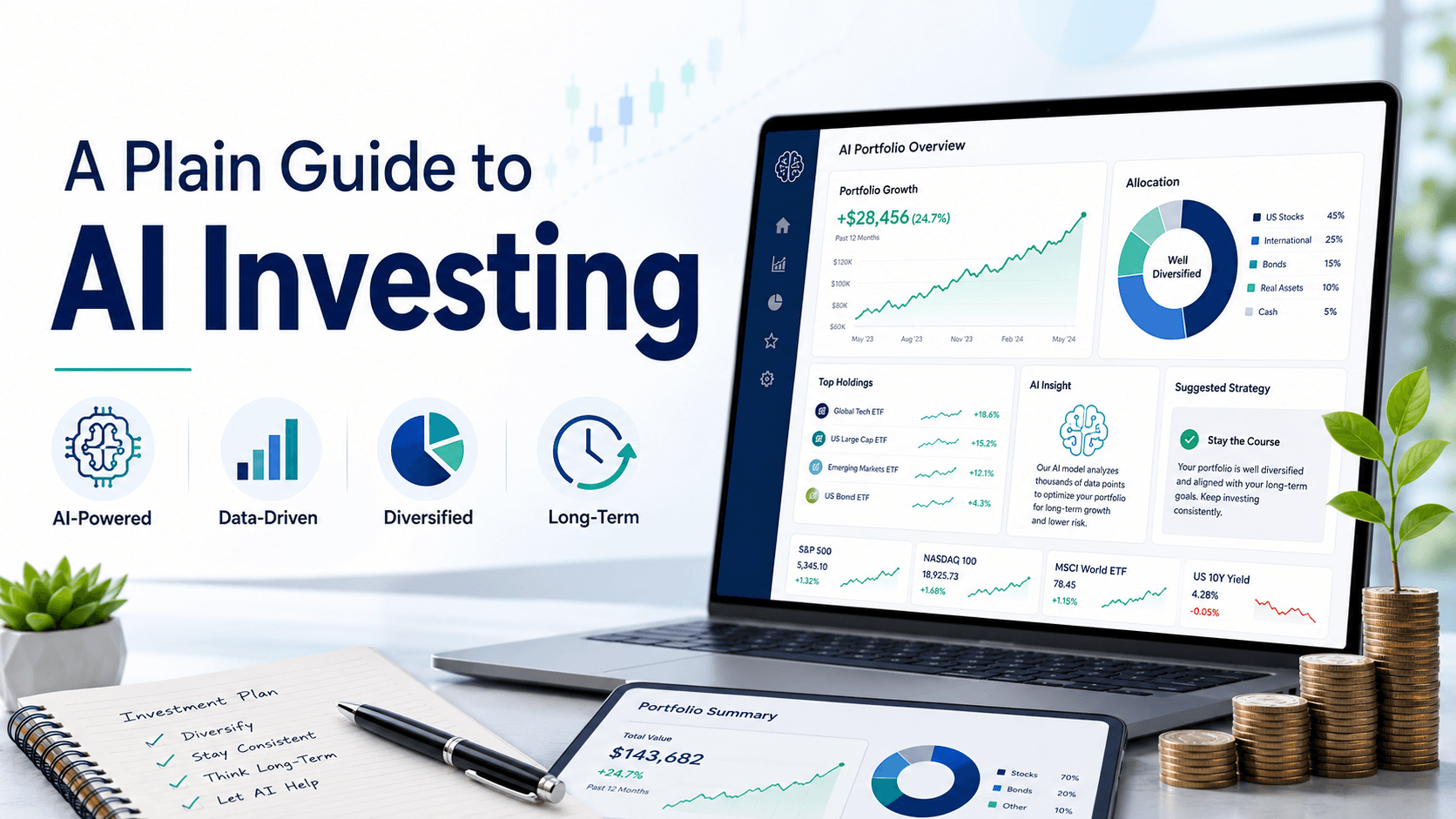
A Plain Guide to AI Investing
Tools that promise to invest your money using artificial intelligence are everywhere. This plain-English guide explains AI investing, its real uses, and the hype to be wary of.
Few combinations attract more excitement, and more marketing, than artificial intelligence and the promise of growing your money. A wave of tools now claims to invest smarter, faster, and more profitably using AI, and the pitch can be seductive: let an intelligent system handle the hard part and watch your wealth grow. The reality is more nuanced and far more cautionary. AI investing covers everything from genuinely useful automation to overhyped promises that can lose people money. Understanding what it really is, what it can and cannot do, and where the dangers lie matters enormously before trusting any tool with your savings.
This guide explains AI investing in plain, general terms. It covers what it is, the forms it takes, what it can do well, its real limitations, the hype and dangers to watch for, and how to approach it sensibly. The aim is balanced understanding, not investment advice, and nothing here is a recommendation to use any tool or to invest in anything; investing always carries risk, and AI does not remove it.
- What AI investing is
- The forms it takes
- What it can do well
- Its real limitations
- The hype and dangers to watch for
- How to approach it sensibly
What AI investing is
AI investing refers to using tools powered by artificial intelligence to help with investing decisions, from automatically managing a portfolio to analysing data and suggesting where to put money. Rather than a person making every choice alone, software plays a significant role in how investments are selected, managed, or monitored.
Like many things in this area, AI investing sits on a spectrum. At one end are tools that automate sensible, well-established strategies with little drama; at the other are systems that claim to predict markets and deliver outsized returns. These are very different propositions, and lumping them together under one exciting label is part of what makes AI investing so easy to misunderstand.
Automation, not magic
At its most grounded, AI investing is really about automation: using software to carry out and maintain an investing approach with less manual effort. This can be genuinely useful, but it is a far cry from the magic some marketing implies. Understanding AI investing starts with separating sober automation from extravagant promises.
It does not remove risk
Whatever form it takes, AI investing does not abolish the fundamental reality of investing: that it carries risk, and that returns are never assured. No tool, however clever, changes the fact that investments can fall as well as rise. Any pitch suggesting AI investing makes growth safe or certain should be treated with deep suspicion.
The forms AI investing takes
AI investing is not one thing, and the forms it takes vary enormously in how sensible or risky they are. Recognising the main categories helps you tell the reasonable from the reckless.
Automated portfolio management
A common and relatively grounded form of AI investing is automated portfolio management, where software builds and maintains a diversified portfolio based on your goals and risk tolerance, handling tasks like rebalancing. This automates well-established principles rather than trying to outsmart the market, which makes it among the more sensible applications.
GUIDE AI Financial Advisor A closer look at automated advice tools and where they fit.Analysis and research tools
Other AI investing tools focus on analysis, processing large amounts of data to surface information or insights an investor might use. These can be useful for research, though the insights they produce are still just inputs to a decision, not reliable predictions, and should be weighed rather than simply trusted.
Prediction and “beat the market” claims
At the riskier end, some AI investing is marketed as able to predict market movements and beat average returns. This is where caution must be greatest: markets are notoriously hard to predict, and bold claims of AI-powered outperformance are frequently exaggerated or simply false, and sometimes mask outright scams.
This guide is general educational content, not financial or investment advice, and nothing here is a recommendation to use any AI investing tool or to invest in anything. Investing always carries risk: you can lose money, and AI does not change that. Tools claiming to predict markets or deliver assured or outsized returns are frequently exaggerated, misleading, or fraudulent. AI systems can also be wrong, opaque, and biased. Never invest money you cannot afford to lose, be deeply sceptical of bold promises, and consult a qualified, independent financial professional before making any investment decision.
What AI investing can do well
Used realistically, AI investing genuinely can help with certain things. Recognising its legitimate strengths helps you benefit without falling for the hype.
Automating sound principles
The clearest benefit of AI investing is automating sensible, well-established practices, such as maintaining a diversified portfolio and rebalancing it over time. By handling these routine tasks consistently, the right tools can make disciplined investing easier, which is valuable precisely because it removes effort rather than promising miracles.
GUIDE Understanding Risk Tolerance Knowing your own risk tolerance matters before any tool invests for you.Lowering barriers to entry
AI investing tools can make investing more accessible, offering managed approaches to people who lack the time, knowledge, or confidence to manage a portfolio themselves. For someone who would otherwise not invest at all, a sensible automated tool can be a reasonable starting point, within the limits of understanding what it does.
Encouraging consistency and discipline
Because they run automatically, AI investing tools can support the consistency and discipline that good investing depends on, sticking to a strategy without the emotional swings that lead people to buy and sell at the wrong moments. Removing some of that human impulsiveness can be a genuine, if modest, advantage.
Reducing routine effort
Much of the day-to-day work of maintaining investments, monitoring, rebalancing, reinvesting, is repetitive and easy to neglect. AI investing can shoulder these routine chores, keeping a strategy on track without demanding constant attention. For many people, that quiet upkeep is more valuable than any clever insight, because it keeps a sensible plan running rather than drifting.
Helping manage emotion
One of the quieter strengths of well-designed automation is the way it can take some emotion out of the picture. Left to their own devices, people often act on fear when prices fall and on excitement when they rise, selling low and buying high, which is precisely the opposite of what tends to serve them well over the long run.
A system that simply follows an agreed plan does not panic or get greedy. It carries on doing the sensible, unglamorous thing through the ups and downs, which can spare an investor from some of their own worst instincts. This is a real and underrated benefit, though it is worth remembering that the plan itself still has to be a sound one, and that no automation can rescue a poor strategy from itself.
The real limitations
For all its uses, AI investing has serious limitations, and ignoring them is how people get hurt. Understanding them keeps your expectations realistic and your money safer.
It cannot predict the future
The most important limitation of AI investing is that no tool can reliably predict what markets will do. Markets are influenced by countless unpredictable factors, and no amount of data processing changes their fundamental uncertainty. Any AI investing tool implying it can foresee the future is overpromising, and that overpromise is a serious warning sign.
It can be wrong
Like all AI, AI investing tools can simply be wrong, drawing mistaken conclusions from data or behaving unexpectedly in conditions they were not prepared for. Because their output can look authoritative, errors are easy to trust. This is why human understanding and oversight remain essential rather than optional.
Past performance is not a promise
AI investing tools are often built on historical data, but markets change, and what worked before may not work in future. A strategy that looks impressive in the past can fail going forward. This well-known investing truth applies just as forcefully to AI, which cannot escape the limits of the data it learned from.
You may not understand what it is doing
A further limitation is that AI investing can be opaque, making choices for reasons that are not clear to the user. Handing money to a system whose decisions you cannot follow is risky, because you cannot judge whether it is behaving sensibly or assess what might go wrong until it already has.
This opacity matters more with money than with many other tools, because the stakes are your savings. The healthiest stance is to be cautious about any AI investing tool you cannot understand at least in broad terms, what approach it follows, what it can and cannot do, and what risks it carries. If a tool’s workings are a complete mystery, that is a reason for caution, not blind trust.
The hype and the dangers
Nowhere in personal finance is hype thicker than around AI investing, and nowhere is scepticism more valuable. The dangers here are real and have cost people dearly.
Exaggerated and false promises
A great deal of AI investing marketing makes claims that are exaggerated or simply untrue, promising returns that no legitimate tool can assure. Because the technology sounds impressive and complex, these claims can be persuasive. Treating bold promises of AI-powered profits with deep suspicion is one of the most protective habits you can have.
Outright scams
The excitement around AI investing has been a gift to fraudsters, who use the buzzwords to lend credibility to scams. Schemes promising assured or extraordinary returns through mysterious “AI” are a classic and dangerous trap. If something sounds too good to be true, in AI investing it almost always is.
GUIDE Financial Data Privacy AI investing tools handle sensitive data, raising privacy questions too.Pressure and urgency
Many of the riskiest AI investing pitches rely on pressure: urgent language, fear of missing out, and insistence that you must act now. Legitimate investing rarely requires haste, so pressure to commit quickly is itself a warning sign. The discipline of refusing to be hurried defeats many of the tactics used to part people from their money.
The allure of complexity
Part of what makes this area so ripe for misuse is that complexity itself can be persuasive. When a pitch is dense with technical language and impressive-sounding jargon, it can feel authoritative, and many people are reluctant to question something they do not fully understand for fear of seeming naive. Fraudsters and aggressive marketers know this and exploit it deliberately.
The healthy response is to flip that instinct around: if you cannot understand how something is supposed to work, that is a reason for caution, not a reason to trust it. Genuine, reputable services can usually explain in plain terms what they do and what the risks are. A wall of impenetrable jargon, especially when paired with bold promises, is far more often a red flag than a sign of sophistication.
Approaching AI investing sensibly
The sensible approach to AI investing is grounded scepticism: open to its genuine uses, firmly resistant to its hype. A few principles keep you on the safe side.
Be deeply sceptical of big claims
The single most valuable habit with AI investing is treating bold claims with deep suspicion. No tool can reliably beat the market or assure returns, so any pitch suggesting otherwise should raise alarm rather than excitement. Healthy scepticism is your strongest protection in this hype-filled space.
Understand before you trust
Before letting any AI investing tool handle your money, understand what it actually does, what approach it follows, what it costs, and what risks it carries. A tool you cannot understand in broad terms is one to approach with great caution. Clarity about what you are signing up for is essential, not optional.
Never risk what you cannot lose
Because all investing carries risk and AI removes none of it, never put money into AI investing that you cannot afford to lose. This basic rule of investing applies with full force here, and it is especially important given how easily the technology’s hype can tempt people to over-commit.
Seek independent, professional guidance
For any significant investing decision, independent and qualified financial advice is worth far more than the confident marketing around AI investing. A good professional considers your whole situation in a way no general tool can, and can help you judge whether a given tool is sensible for you, or whether to steer clear entirely.
It is also worth remembering that the people promoting AI investing tools often profit when you sign up, which gives them every reason to emphasise the upside and downplay the risks. Independent guidance, with no stake in selling you a particular product, offers a balance that marketing never will. Combining your own understanding with impartial professional input is the surest way to engage with this area without being swept along by the enthusiasm surrounding it.
Frequently asked questions
What is AI investing in simple terms?
AI investing means using tools powered by artificial intelligence to help with investing, from automatically managing a portfolio to analysing data and suggesting where to put money. It ranges from grounded automation of sensible strategies to risky systems claiming to predict markets. At its most useful it is really automation, not magic, and it never removes the fundamental risk that investments can fall as well as rise.
Can AI investing beat the market?
No tool can reliably beat the market or predict its movements, because markets are influenced by countless unpredictable factors that no amount of data processing can foresee. Claims of AI-powered outperformance are frequently exaggerated, misleading, or outright fraudulent. Treating any such promise with deep suspicion is one of the most protective habits you can have in this hype-filled area.
Is AI investing safe?
It is not inherently safe, because all investing carries risk and AI removes none of it. You can lose money, AI tools can be wrong or opaque, and the space is full of exaggerated claims and outright scams. Some grounded tools that automate sensible strategies have legitimate uses, but no AI investing makes growth safe or returns assured. Never invest money you cannot afford to lose.
What are robo-advisors and automated portfolios?
These are among the more grounded forms of AI investing, where software builds and maintains a diversified portfolio based on your goals and risk tolerance, handling tasks like rebalancing automatically. Rather than trying to outsmart markets, they automate well-established principles, which makes them more sensible than tools promising prediction, though they still carry the normal risks of investing.
How can I spot an AI investing scam?
Be deeply suspicious of promises of assured or extraordinary returns, pressure to act quickly, fear-of-missing-out language, and tools whose workings are a complete mystery. Fraudsters use “AI” as a buzzword to lend credibility to schemes. If something sounds too good to be true, it almost certainly is. Verify independently and consult a qualified professional before committing any money.
Does AI investing remove the risk of investing?
No. Whatever its form, AI investing does not abolish the fundamental reality that investing carries risk and returns are never assured. No tool, however clever, changes the fact that investments can fall as well as rise. Any pitch suggesting AI makes growth safe or certain should be treated with deep suspicion, as it contradicts a basic and unavoidable truth about investing.
Should I use AI investing tools?
This guide cannot tell you that, and nothing here is a recommendation. Some grounded tools that automate sensible strategies have legitimate uses, while many overhyped or fraudulent ones are most sensibly avoided entirely. Understand what a tool does, be sceptical of bold claims, never risk money you cannot afford to lose, and seek independent, qualified financial advice before making any significant decision.
The bottom line on AI investing
AI investing spans a wide range, from grounded tools that automate sensible, well-established strategies like maintaining and rebalancing a diversified portfolio, to risky systems that claim, often falsely, to predict markets and deliver outsized returns. At its most useful it is really about automation and discipline, lowering barriers, reducing effort, and removing some emotional impulsiveness, rather than any kind of magic. Crucially, it never removes the fundamental risk that investments can fall as well as rise.
The dangers are as real as the benefits. No tool can reliably beat the market, AI can be wrong and opaque, past performance is no promise, and the space is thick with exaggerated claims, pressure tactics, and outright scams that exploit the technology’s hype. The sensible approach is grounded scepticism: be deeply suspicious of bold promises, understand any tool before trusting it, never invest what you cannot afford to lose, and seek independent, qualified financial advice for decisions that matter. Used carefully and with realistic expectations, the grounded end of AI investing can have a place; chased for its hype, it can cost you dearly.
This sits alongside the wider context in our AI financial advisor guide. For a neutral, broader reference on investing concepts, Investopedia is a useful starting point, but for any decision involving your own money, an independent, qualified financial professional is the source that counts.
AI investing ranges from grounded automation of sensible strategies to risky tools claiming to predict markets. At its most useful it is automation and discipline, not magic, and it never removes investing’s risk. No tool reliably beats the market, and the space is full of hype and scams. Be sceptical of bold claims, never risk what you cannot lose, and seek independent advice.
Educational content only, not financial advice. Ladabo publishes research-based guides to help you understand AI investing and make your own informed decisions; we do not provide individual financial or investment advice, and nothing here is a recommendation to use any tool or to invest in anything. Investing carries risk, AI does not remove it, and the space contains exaggerated claims and scams. Read our review methodology and disclaimer for how this content is produced and its limits.
Last reviewed: June 2026