What Is a Blockchain? A Plain Guide
A blockchain is simpler than the jargon suggests: a shared record that no single party controls. This plain-English guide explains what a blockchain is, how it works, what it actually enables, and where the hype outruns reality.
Few words are thrown around as loosely as blockchain. It is praised as world-changing and dismissed as a gimmick, often in the same breath, and the technical descriptions rarely help a newcomer. Underneath the noise, the idea is genuinely simple: a blockchain is a shared record of transactions, copied across many computers, that no single person or company controls. This guide explains what a blockchain actually is, how it works step by step, what it makes possible, and the real limitations the hype tends to skip — so you can judge it for yourself.
- What a blockchain actually is, in plain English
- How blocks, hashes, and chaining fit together
- How a network agrees on the record (consensus)
- How a blockchain differs from an ordinary database
- What blockchains genuinely enable
- The real limitations behind the hype
What a blockchain is
A blockchain is a shared digital ledger — a record of transactions — that is copied across many computers rather than kept in one central place. Because everyone on the network holds the same copy, no single party owns the record or can quietly rewrite it.
The name describes the structure. Transactions are bundled into groups called blocks, and each new block is linked to the one before it, forming a chain that runs back to the very first entry. That linking is what makes it so hard to tamper with, as we will see.
The official NIST overview describes a blockchain as an immutable, distributed ledger maintained without a central authority. If crypto itself is new to you, our crypto for beginners guide sets the wider context this blockchain guide builds on.
A helpful mental image is a shared notebook that thousands of people each keep an identical copy of. Whenever someone writes a new line, everyone updates their copy to match, and the rules of the notebook make it nearly impossible to erase or fake an earlier line. A blockchain is essentially that notebook, run by software across the internet rather than by people with pens.
How a blockchain works
Strip away the jargon and it works in a few clear steps. Understanding them is most of what you need to follow any crypto conversation.
Blocks and transactions
When people send transactions, the network gathers them into a block. Each block holds a batch of recent transactions plus some housekeeping data, including a timestamp and a reference to the block before it. Once a block is accepted, it becomes a permanent part of the record.
The size and timing of blocks vary from one network to another, but the principle is constant: bundle recent activity, seal it, and move on. Each sealed block becomes a fixed page in the shared history that later blocks build upon.
Hashing and the chain
Every block is run through a cryptographic hash — a kind of digital fingerprint — and each new block includes the previous block’s fingerprint. Change anything in an old block and its fingerprint changes, which breaks every block after it. This chaining is why the chain is described as tamper-evident: altering history is not impossible in theory, but it is glaringly obvious and astonishingly hard in practice.
Copies everywhere
Because the whole record is copied across many computers, there is no single machine to hack or switch off. To rewrite the record, an attacker would need to overpower a huge share of the network at once. That distribution is the quiet source of its resilience.
Put the three steps together and the picture is complete: transactions are batched into a block, the block is fingerprinted and linked to the last one, and the result is copied to every participant. Repeat that endlessly and you get a growing, shared history that everyone can check but no one can quietly edit.
How a blockchain reaches agreement
If thousands of computers each hold a copy, how do they agree on which new block is valid? That problem — reaching agreement without a central referee — is solved by a consensus mechanism, and it is the real innovation at the heart of the technology.
Proof of work
The original approach, used by Bitcoin, is proof of work. Computers compete to solve a hard mathematical puzzle, and the winner gets to add the next block. The puzzle is deliberately costly, which makes cheating expensive — but it also consumes significant energy, the basis of a common criticism.
The clever part is that honest behaviour is simply the cheapest strategy: it costs far less to play by the rules and collect the reward than to attack a network large enough to matter. Security comes from economics as much as from code.
Proof of stake
A newer approach, proof of stake, replaces the puzzle with a stake: participants lock up some of their own cryptocurrency for the right to add blocks, and lose it if they misbehave. It achieves agreement with a tiny fraction of the energy, which is why many newer networks favour it. Either way, the goal is the same: let a leaderless network agree on one shared truth.
Consensus is the part that sounds abstract but matters most. Without it, every computer could claim a different version of events, and the record would be worthless. By making it expensive or risky to lie, a blockchain turns a crowd of strangers who do not trust each other into a system that nonetheless agrees on a single, shared history.
How a blockchain differs from a database
A fair question is why not just use a normal database. The honest answer is that for most tasks, a database is simpler, faster, and cheaper — the technology earns its keep only in specific situations.
That nuance gets lost in marketing, where it is sometimes presented as an upgrade to everything. It is not. It is a particular answer to a particular problem — shared record-keeping among parties who do not trust each other — and outside that problem its costs usually outweigh its benefits.
An ordinary database has an owner who can edit or delete records and must be trusted to do so honestly. It removes that single owner: the record is shared, append-only, and agreed by the network, so participants who do not fully trust each other can still rely on the same record. That trade is the whole point.
The cost of that trustlessness is real. It is slower and more resource-hungry than a centralised database, and it adds complexity. So the useful test is simple: if a trusted party could just keep the records, a database is usually the right fit. It shines when no such trusted party exists.
This is why so much sober analysis lands on the same conclusion: it is a specialised tool, not a universal upgrade. When several parties who do not trust one another need to share one record that none can secretly alter, it is genuinely useful. When a single trusted operator would do, it mostly adds cost and complexity for little gain.
Public vs private blockchains
Not every blockchain is open to the world. They broadly split into two kinds, and the difference matters for what they are good at.
A public blockchain, like the ones behind major cryptocurrencies, is open: anyone can join, read the record, and take part in validating it. A private or permissioned blockchain restricts who can participate, and is typically run by a company or a group of organisations that want a shared record among known parties rather than a fully open one.
A rough analogy: a public blockchain is like a noticeboard in a town square that anyone can read and add to, while a private one is more like a shared document inside a company. Both keep an agreed record, but they answer very different questions about who is allowed to take part.
Public chains maximise openness and censorship-resistance; private chains trade some of that for speed and control. Neither is universally better — they suit different jobs, and much of the business interest in the technology centres on the permissioned variety.
What a blockchain enables
The technology is widely known for cryptocurrency, but it underpins a few distinct things worth recognising.
Cryptocurrency
The original and still dominant use is digital money: the network lets people transfer value directly, without a bank in the middle, while the network keeps the record honest. Every coin transaction you make is ultimately an entry on a blockchain.
This is also why crypto transactions feel different from a bank transfer: there is no central institution to reverse a mistake or freeze an account. The upside is independence; the downside is that the responsibility, and the risk, sits squarely with you.
Smart contracts
Some blockchains can run small programs called smart contracts — code that executes automatically when conditions are met, such as releasing funds once both sides deliver. They power much of what people call decentralised finance, though they are only as reliable as the code behind them.
Other records
Beyond money, the technology can in principle track ownership of digital items, supply-chain steps, or other records where many parties want one shared, tamper-evident log. Some of these uses are genuinely promising; others are solutions in search of a problem, which is where healthy skepticism helps.
A simple filter helps when you hear a new claim: ask whether the use genuinely needs many distrustful parties sharing one tamper-evident record. If it does, the technology may add real value. If a single company could just keep the data, the mention is often marketing rather than substance.
Blockchains, wallets, and keys
Here is where the technology meets you directly. The record shows what each address owns, but it is your keys that prove an address is yours and let you move what sits there.
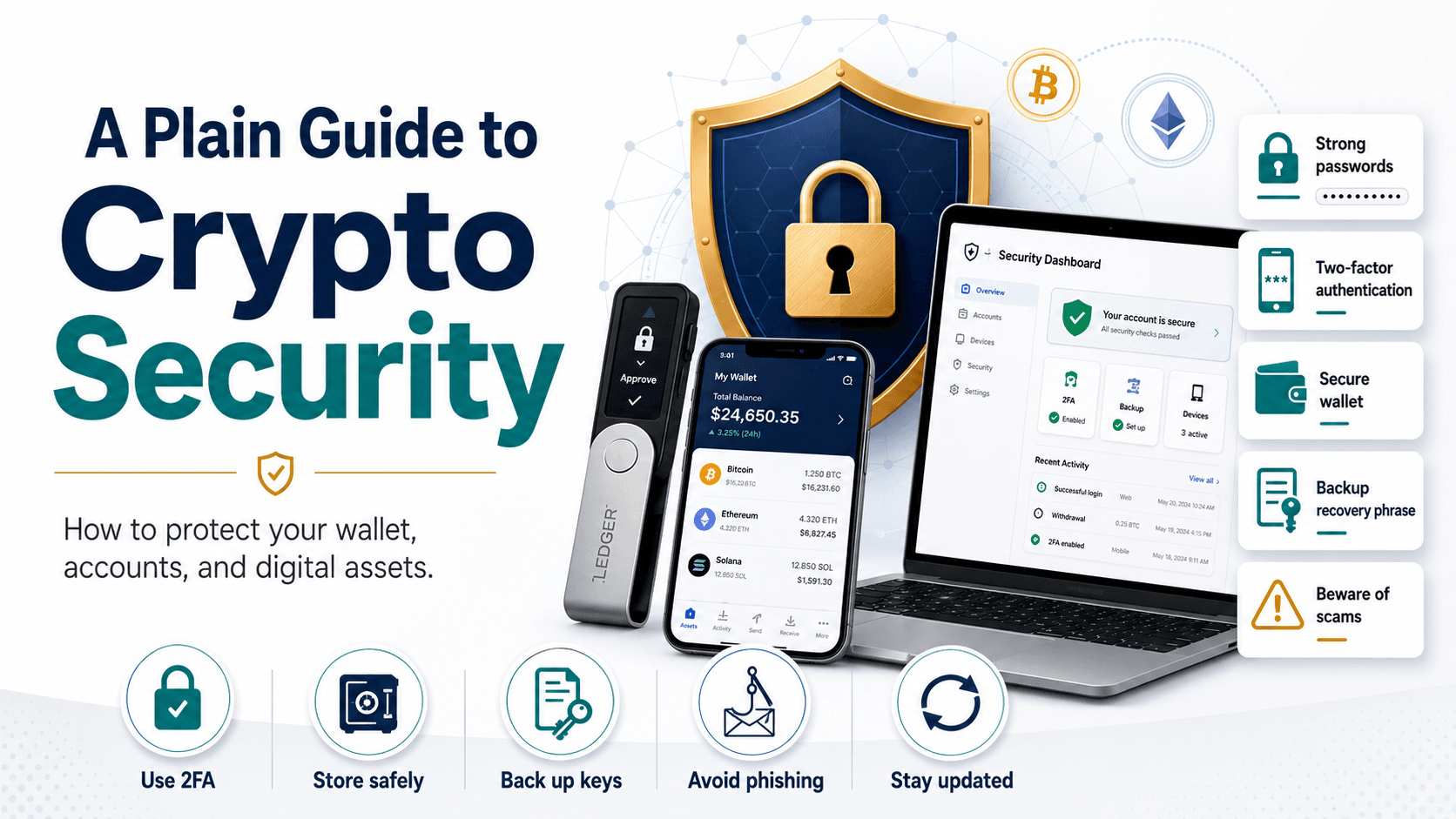
This is exactly why a crypto wallet matters: the coins never leave the blockchain, but the wallet holds the keys that authorise your transactions on it. Lose those keys and the entry still exists on the chain — you simply lose the ability to move it. Our guide to crypto wallets explains how that key management works in practice.
It is also worth remembering that a public blockchain is, by design, transparent: balances and transactions are visible to anyone, even when the names behind addresses are not. That openness is a feature for trust, and something to keep in mind for privacy.
In everyday use, then, you never touch the blockchain directly. Your wallet talks to it on your behalf: it reads your balance from the shared record and, when you approve a transaction with your keys, broadcasts it to the network to be added. The chain keeps the truth; the wallet is your door to it.
Limitations and criticisms
An honest guide has to cover where the technology falls short, because the hype rarely does. The technology is real, but it is not magic.
Speed and scale
Agreeing across a whole network is slower than a single database updating its own records, so many blockchains struggle to handle large volumes of transactions quickly. A great deal of engineering effort goes into easing this, with mixed results.
Energy use
Proof-of-work networks consume substantial electricity, a genuine environmental concern that proof of stake aims to address. It remains one of the most cited criticisms of the technology.
The trajectory matters here: newer networks increasingly favour the lower-energy approach, and the heaviest-consuming designs are no longer the only option. The criticism is real, but it applies more to some networks than to the whole field.
Hype and misuse
Plenty of projects bolt a blockchain onto problems that a plain database would solve better, riding the buzzword rather than the substance. And because transactions are usually irreversible and largely unregulated, the space attracts scams. Both the FTC and the CFTC warn that fraudsters exploit confusion about the technology, so a healthy dose of skepticism is part of understanding it.
None of this means the idea is worthless — only that it is narrow. A technology can be genuinely important for a handful of problems and wildly oversold for everything else at the same time, and that is roughly where things stand. Keeping both truths in view is the mark of understanding it well.
This guide is educational and general — it is not financial, investment, or technical advice. Blockchain-based assets are volatile and risky, the technology is evolving, and much of the surrounding market is lightly regulated. Nothing here is a recommendation to buy, hold, or build anything. For decisions that affect your money, do your own research and consider a qualified professional.
Blockchain FAQ
What is a blockchain in simple terms?
A blockchain is a shared record of transactions, copied across many computers, that no single party controls. Transactions are grouped into blocks, each linked to the one before it, forming a chain that is very hard to alter without the whole network noticing.
Is a blockchain the same as Bitcoin?
No. A blockchain is the underlying technology; Bitcoin is one cryptocurrency built on a blockchain. Many other cryptocurrencies and applications use their own blockchains. Think of blockchain as the engine and Bitcoin as one car that runs on it. Our guide to what Bitcoin is covers the coin itself in depth.
Why is a blockchain hard to hack?
Two reasons. Each block carries a fingerprint of the previous one, so changing old data breaks the chain visibly. And the record is copied across many computers, so there is no single point to attack — rewriting it would mean overpowering a huge share of the network at once.
What is the difference between a blockchain and a database?
A database has an owner who can edit it and must be trusted. A blockchain spreads the record across a network with no single owner, so mutually distrustful parties can share one record. That comes at the cost of speed and efficiency, so a database is usually better unless trust is the problem.
What does a blockchain actually do?
It maintains a shared, tamper-evident record without a central authority. That enables cryptocurrency, smart contracts, and other shared logs where many parties want one trusted record. It is powerful for specific problems and unnecessary for many others.
What is the difference between proof of work and proof of stake?
Both are ways for a network to agree on the next block. Proof of work has computers solve costly puzzles, which is secure but energy-hungry. Proof of stake has participants lock up cryptocurrency instead, achieving agreement with far less energy.
Are blockchains private?
Public blockchains are transparent: anyone can see balances and transactions, though the real names behind addresses usually are not shown. Private or permissioned blockchains limit who can see and take part. So a public blockchain offers pseudonymity, not true privacy.
Is blockchain only useful for cryptocurrency?
No, but crypto is its most established use so far. Smart contracts, certain supply-chain and record-keeping uses, and digital ownership are other applications. Many proposed uses, though, would work just as well with an ordinary database, so the technology is not a fit for everything.
The bottom line on blockchains
A blockchain is a shared, tamper-evident record that a network maintains together, with no one in charge. That single idea — agreement without a central authority — is what makes it powerful, and also what makes it slower and heavier than a normal database. Knowing both halves lets you cut through the hype in either direction.
For most people, that is the right level to understand it at. You do not need to follow the cryptography to use crypto sensibly, any more than you need to understand engine timing to drive — but knowing that a blockchain is a shared, leaderless ledger tells you what it can and cannot reasonably promise.
A blockchain is a shared ledger copied across many computers, with transactions grouped into linked blocks that are hard to alter. A consensus mechanism lets the network agree without a central referee. It shines when no trusted middleman exists, and is overkill when one does. It powers cryptocurrency and smart contracts, but it is slower than a database, can be energy-hungry, and attracts hype and scams. Understand both its strengths and its limits.
If you take one thing from this guide, let it be that a blockchain replaces a trusted middleman with a network that agrees — nothing more mystical than that. For the wider picture, read our crypto for beginners guide and our guide to crypto wallets, which shows how you actually interact with the chain. Last reviewed: June 2026.
Continue exploring Ladabo
Pick what’s most useful for you next
Educational content only. This blockchain guide is general education, not personalised financial, investment, or technical advice. The technology and its uses are evolving, and blockchain-based assets are volatile and often lightly regulated. Ladabo may earn commissions when you sign up to tools via our affiliate links, but our guidance reflects research and established principles, not commission rates. For decisions specific to your circumstances, do your own research and consult a qualified professional. Review methodology · Full disclosure.