What Is a Crypto Wallet? A Plain Guide
A crypto wallet does not actually hold your coins — it holds the keys that control them. This plain-English guide explains what a crypto wallet really is, the hot-versus-cold and custodial-versus-self-custody choices, and how to keep one secure.
The phrase sounds simple, but it hides the single most important idea in crypto. A crypto wallet does not store your coins the way a leather wallet holds cash — your coins live on the blockchain. What a crypto wallet actually stores are the keys that prove the coins are yours and let you move them. Get that one idea right and everything else, from security to backups to choosing a wallet, falls into place. This guide explains how a crypto wallet works, the main types, and the security habits that keep your funds yours.
- What a crypto wallet actually stores (hint: not coins)
- How keys and your recovery phrase work
- Hot versus cold, and custodial versus self-custody
- The main types of crypto wallet
- How to keep a crypto wallet secure
- How a crypto wallet connects to your taxes
What a crypto wallet is
A crypto wallet is a tool that stores your keys and lets you send, receive, and manage cryptocurrency. The crucial twist is that the coins themselves are never inside it. They exist as records on the blockchain; your crypto wallet simply holds the credentials that prove those records belong to you.
Think of the blockchain as a vast public ledger and your crypto wallet as the keyring that unlocks your entry on it. The wallet is what you use to authorise a transaction, which the network then records. Lose the wallet’s keys and you lose the ability to move the coins, even though they still sit on the ledger.
That distinction explains nearly every rule that follows. If crypto itself is new to you, our crypto for beginners guide sets the wider context this crypto wallet guide builds on.
It helps to picture the parts. There is the blockchain, the shared ledger that records who owns what; there are your keys, which prove an entry is yours; and there is the crypto wallet, the software or device that stores those keys and turns them into a usable app. The coins never leave the ledger — only the right to move them passes through your wallet.
How a crypto wallet works
Under the hood, a crypto wallet manages a pair of linked keys and, usually, a recovery phrase. Understanding these three things is most of what you need.
Public and private keys
Your public key, often shown as a wallet address, is like an account number you can share so others can send you crypto. Your private key is the secret that authorises spending from that address. Anyone who holds the private key controls the funds, which is why a crypto wallet’s whole job is to guard it.
Your recovery phrase
Most wallets also give you a recovery phrase — a list of ordinary words that acts as the master backup of your private keys. With it, you can restore your crypto wallet on a new device if the old one breaks or is lost. Without it, and without the keys, the funds are unreachable. Equally, anyone who learns your recovery phrase can take everything, so it matters more than any password.
One way to hold the idea: the public key is the letterbox anyone can post to, the private key is the only key that opens it, and the recovery phrase is the spare key hidden somewhere safe. A crypto wallet’s entire purpose is to keep the second and third of those out of the wrong hands, while letting you use the first freely.
Hot vs cold crypto wallets
The first big choice is whether your crypto wallet is connected to the internet. That single factor trades convenience against security.
A hot wallet stays online — a phone app, a desktop program, or an exchange’s built-in wallet. It is convenient for frequent use and small amounts, but being connected means a larger attack surface. A cold wallet keeps your keys offline, on a dedicated hardware device or even on paper, which is far harder for a remote attacker to reach but less convenient for day-to-day spending.
Many people use both: a hot wallet for small, active balances and a cold wallet for longer-term holdings they rarely touch. Matching the wallet’s warmth to how you actually use the funds is one of the most practical decisions you can make.
Warmth is not a verdict on quality, only on exposure. A reputable hot wallet is perfectly fine for everyday sums; the point is simply that anything permanently online carries more risk than something kept offline. The size and patience of the balance, not the brand, should guide which kind you reach for.
Custodial vs self-custody
The second big choice is who actually holds your keys: you, or a company on your behalf. This is the distinction behind the well-known crypto saying, “not your keys, not your coins.”
With a custodial wallet — typically on an exchange — a company keeps your keys and recovery details for you. That is convenient and offers a familiar “forgot password” safety net, but it means you are trusting that company’s security and solvency. With a self-custody (non-custodial) wallet, you alone hold the keys. That gives you full control and removes reliance on a third party, but it also means the responsibility for backups and security is entirely yours.
Neither is universally right. Custody suits beginners and active traders who value convenience; self-custody suits those who want full control and are comfortable safeguarding their own recovery phrase.
A useful halfway habit is to start custodial while you learn the ropes, then graduate to self-custody as your confidence and your balance grow. There is no rule that you must pick one approach forever, and many people move along that path as their needs change and the stakes rise.
Types of crypto wallet
Those two choices combine into a handful of common crypto wallet types. Most people end up using more than one.
Hardware wallets
A hardware wallet is a physical device that keeps your keys offline and signs transactions without exposing the keys to your computer. It is the usual choice for securing larger, long-term holdings, combining cold storage with reasonable ease of use.
Software wallets
A software crypto wallet is a mobile or desktop app you control yourself. It is convenient and free, sitting in the hot, self-custody corner — well suited to everyday amounts and regular transactions, as long as the device itself is kept secure.
Exchange and web wallets
An exchange or web wallet is the custodial, hot option built into a trading platform. It is the simplest place to start, but the keys are held by the provider, so it is generally a strong option for trading rather than for storing significant sums long-term.
How to keep a crypto wallet secure
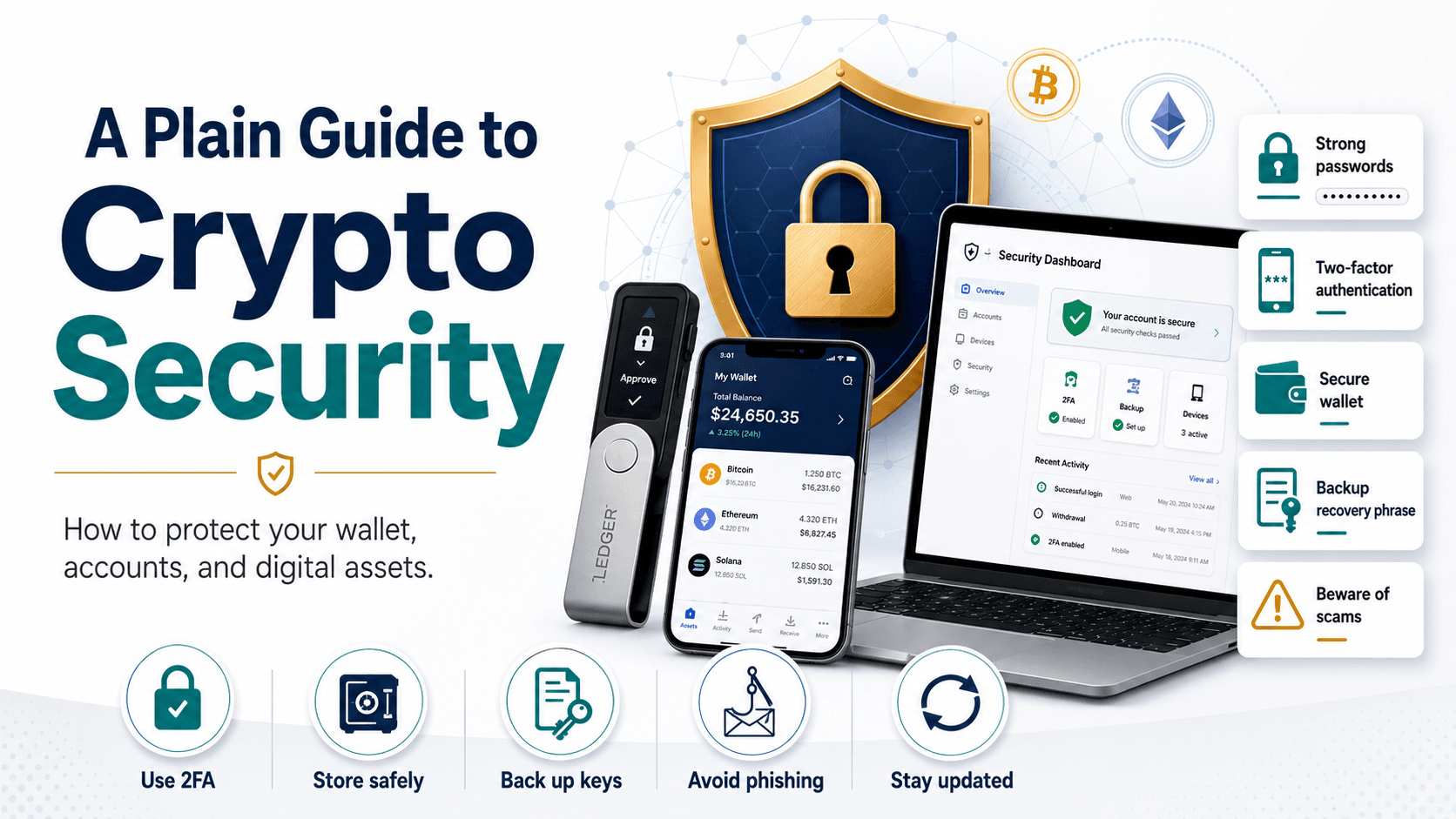
Because a crypto wallet is really a keychain, security comes down to protecting the keys and the recovery phrase. Crypto transactions are usually irreversible, so prevention is everything — there is rarely a way to claw funds back.
Guard your recovery phrase
Your recovery phrase is the master key to your crypto wallet. Write it down and store it offline somewhere safe; avoid keeping it in a screenshot, a cloud note, or anywhere connected to the internet. Never share it. No legitimate wallet, exchange, or support agent will ever ask you to type or send your recovery phrase.
Watch for scams
Scammers frequently target crypto holders precisely because transactions cannot be reversed. The FTC warns that fraudsters often tell people to send crypto to a wallet address “for safekeeping,” or impersonate officials and support staff. Treat any unexpected request to move crypto, scan a payment QR code, or reveal wallet details as a red flag. The FBI and CFTC publish similar warnings worth reading before you transact.
Use the right tool for the amount
For significant, long-term holdings, a hardware crypto wallet kept offline is the sensible default. Keep only what you actively use in a hot wallet, and double-check every address before sending, since a mistyped or wrong address usually cannot be undone.
Treat security as a routine, not a one-off. Keep the device that holds your crypto wallet updated, be wary of public networks and unsolicited links, and revisit where your recovery phrase is stored from time to time. The individual habits are simple; it is doing them consistently that actually protects you.
This guide is educational and general — it is not financial, investment, tax, or security advice. Cryptocurrency is volatile and can lose value, transactions are typically irreversible, and self-custody puts the responsibility for security entirely on you. Nothing here is a recommendation to buy, hold, or use any particular asset or wallet. For decisions that affect your money, do your own research and consider a qualified professional.
Choosing the right crypto wallet
There is no single right answer, only the right fit for how you use crypto. A few honest questions point you to it.
How much are you holding, and for how long? Larger, long-term balances lean toward a cold, self-custody crypto wallet; small, active amounts suit a convenient hot wallet. How often do you transact? Frequent traders value the speed of a hot or exchange wallet, while long-term holders prioritise security. And how comfortable are you taking full responsibility for your own recovery phrase? If that prospect feels daunting, a reputable custodial option is a reasonable starting point.
Whichever you choose, favour well-established, reputable wallets, keep your software updated, and never let convenience talk you out of basic security. The right crypto wallet is the one whose trade-offs match your real habits, not the one with the longest feature list.
It also pays to start simple. You can always add a hardware wallet or a second app later as your holdings grow; what you cannot easily do is recover funds lost to a setup you never really understood. Begin with what you can manage confidently today, and expand deliberately.
Your crypto wallet and taxes
A crypto wallet is also where your tax record begins, and this catches many people out. In most places, selling, swapping, or spending crypto can be a taxable event — and simply moving coins between your own wallets usually is not, though it still needs tracking.
The catch with a self-custody crypto wallet is that no exchange is necessarily summarising your activity for you. The responsibility to record every transaction, with dates and values, falls on you. This is exactly where crypto tax software earns its place: it connects to your wallets and exchanges, imports the history, and works out the gains and losses. Our reviews of AI crypto tax tools compare the main options for turning messy wallet history into a clean tax figure.
Good record-keeping from the start saves real pain later. Whenever you move funds in or out of a wallet, a quick note of the date and value turns tax season from an archaeology project into a simple import-and-check, and it makes any software you use far more accurate.
Common crypto wallet mistakes
Most crypto losses come from a short list of avoidable errors rather than anything exotic. Knowing them is most of the protection.
Losing the recovery phrase
If you lose your recovery phrase and your device, the funds in a self-custody crypto wallet are gone for good — there is no reset button. Backing it up safely, in more than one secure place, is the single most important habit.
Storing the phrase digitally
Saving a recovery phrase in a photo, an email, or a cloud note puts the master key to your crypto wallet within reach of anyone who breaches that account. Keeping it offline removes that whole category of risk.
Leaving everything on an exchange
An exchange wallet is convenient, but holding large, long-term balances there means trusting the platform’s security and solvency. Many people move significant holdings to a self-custody crypto wallet they control once the amounts grow.
Rushing a transaction
Sending to a wrong address, or falling for a “send it here for safekeeping” message, usually cannot be undone. Slowing down to verify the address and the request is a small habit that prevents the most painful crypto wallet mistakes.
A common thread links these errors: each one involves trusting the wrong place or moving too quickly. A wallet rewards a calm, deliberate routine — verify the address, back up the phrase, and never act under pressure — far more than it rewards speed, cleverness, or chasing the newest thing.
Crypto wallet FAQ
What is a crypto wallet in simple terms?
A crypto wallet is a tool that stores the keys used to access and move your cryptocurrency. The coins live on the blockchain, not in the wallet; the wallet holds the credentials that prove the coins are yours and let you authorise transactions.
Does a crypto wallet actually hold my coins?
No. Your coins are records on the blockchain. A crypto wallet stores the public and private keys that control those records. This is why protecting your keys and recovery phrase matters far more than the wallet app or device itself.
What is the difference between a hot and cold crypto wallet?
A hot crypto wallet is connected to the internet and convenient for frequent use; a cold one keeps your keys offline and is far harder for a remote attacker to reach. Many people use a hot wallet for small amounts and a cold wallet for long-term holdings.
What does “not your keys, not your coins” mean?
It means if a company holds your keys for you (custodial), you are trusting that company rather than truly controlling the coins. With a self-custody crypto wallet you hold the keys yourself, gaining full control but also full responsibility for security and backups.
What happens if I lose my recovery phrase?
With a self-custody crypto wallet, losing both your recovery phrase and your device usually means the funds are permanently unreachable — there is no reset option. This is why backing up the phrase safely, offline, and in more than one place is essential.
Is a hardware wallet worth it?
For larger or long-term holdings, a hardware crypto wallet is a strong option because it keeps your keys offline while still letting you transact. For small, everyday amounts, a reputable software wallet is often enough. Match the tool to how much you hold and how often you use it.
Do I owe tax on moving crypto between my own wallets?
Generally, moving crypto between wallets you own is not itself a taxable event, but selling, swapping, or spending it often is, and rules vary by country. Either way, keep records of every transaction. Crypto tax software can import your wallet history and handle the calculations.
Can someone steal crypto from my wallet?
Yes, if they obtain your private keys or recovery phrase, which is why guarding them is everything. Most thefts come from scams, phishing, or a phrase stored carelessly online — not from the blockchain itself being broken. Treat any request for your phrase as fraud.
The bottom line on crypto wallets
A crypto wallet is better understood as a keychain, not a money pouch. The coins stay on the blockchain; the wallet guards the keys that command them. Once that clicks, the security rules stop feeling arbitrary: protect the recovery phrase, match the wallet type to how you use your funds, and treat any request for your phrase as a scam.
A crypto wallet stores your keys, not your coins. Your recovery phrase is the master key — keep it offline, in more than one safe place, and never share it. Use a hot wallet for small, active amounts and a cold one for long-term holdings. Custodial means convenient but trusting a third party; self-custody means full control and full responsibility. And keep records, because your wallet activity drives your crypto taxes.
If you take one thing from this guide, let it be that whoever controls the recovery phrase controls the crypto — so guarding yours is the whole game. For the wider picture, read our crypto for beginners guide, and when tax season comes, our crypto tax tool reviews can turn your wallet history into a clean figure. Last reviewed: June 2026.
Continue exploring Ladabo
Pick what’s most useful for you next
Educational content only. This crypto wallet guide is general education, not personalised financial, investment, tax, or security advice. Cryptocurrency is volatile and risky, and the principles here are general — specific products, rules, and tax treatment vary by country and over time. Ladabo may earn commissions when you sign up to tools via our affiliate links, but our guidance reflects research and established principles, not commission rates. For decisions specific to your circumstances, do your own research and consult a qualified professional. Review methodology · Full disclosure.