What Is an Index Fund? A Beginner’s Guide
An index fund is the closest thing investing has to a sensible default for beginners. This plain-English guide explains what an index fund is, how it works, why it is so popular, the risks to understand, and how to start — without jargon or hype.
Ask experienced investors what a beginner should buy, and a surprising number give the same answer: a low-cost index fund. It is not exciting, and that is rather the point. An index fund quietly spreads your money across hundreds or thousands of companies at very low cost, without anyone trying to outguess the market. This guide explains what an index fund actually is, how it works, how it differs from actively managed funds and from ETFs, the real risks involved, and how a beginner can start. None of this is financial advice — investing always carries risk — but understanding the basics puts you in control.
- What an index fund is, in plain English
- How an index fund actually works
- How index funds differ from actively managed funds
- The difference between an index fund and an ETF
- The genuine risks and limits to understand
- How a beginner can start, step by step
What an index fund is
An index fund is a fund that aims to copy a market index rather than beat it. A market index — such as a broad national or global stock index — is simply a list that measures the performance of a group of companies. It holds those same companies, in roughly the same proportions, so its return tracks the index closely before fees.
According to Investor.gov, the SEC’s investor-education site, an index fund follows a passive strategy designed to achieve approximately the same return as a particular index, primarily by holding the securities of the companies in that index. There is no manager trying to pick winners; the fund just mirrors the index.
That single idea — match the market instead of trying to outsmart it — is what makes an index fund distinctive. When you buy one, you are buying a tiny slice of every company in the index at once, which is why a single fund like this can give a beginner instant diversification. Most index funds track stocks, though bond index funds exist too — our guide to stocks and bonds explains how the two asset classes differ. If investing is brand new to you, our investing for beginners guide sets the wider context this index fund guide builds on.
How an index fund works
The mechanics of an index fund are refreshingly simple, which is part of the appeal. Understanding them removes most of the mystery around investing.
It tracks an index
The fund picks an index to follow, then buys the securities in that index so its holdings mirror it. When companies enter or leave the index, the fund adjusts to match. Your money rises and falls roughly in line with the whole index, not with any single company’s fortunes.
This is also why the news about one company matters far less to you than it would if you owned that company alone. A bad quarter at a single business barely registers when it is one of hundreds you hold through the fund, and that smoothing effect is much of the point of diversification.
It is passively managed
Because the fund simply copies an index, there is no team of analysts making active bets. This passive approach means far less buying and selling inside the fund. As Investor.gov notes, that usually translates into fewer transaction costs, more favorable tax treatment, and lower fees than an actively managed fund — a quiet advantage that compounds over time.
You own a slice of everything in it
When you buy a share, you own a small piece of every company the fund holds. A single broad-market fund can represent hundreds or thousands of companies, so your fortunes are tied to the market as a whole rather than to a handful of stocks you happened to choose.
Index fund vs actively managed fund
The clearest way to understand index investing is to compare it with its opposite: the actively managed fund. The difference comes down to one question — is someone trying to beat the market, or just match it?
An actively managed fund employs a manager who picks investments in an attempt to outperform the market. That effort costs money, which is passed on as higher fees, and it introduces the risk that the manager’s choices lag the market. An index fund makes no such attempt; it tracks the index at low cost. The trade-off is that it will never beat the market — by design, it aims only to match it.
The reason index funds have become so widely recommended is that, after fees, many actively managed funds struggle to beat their benchmark index consistently over the long term. Lower costs and broad diversification are the dependable edge these funds offer, rather than the hope of outperformance.
| Feature | Index fund | Actively managed fund |
|---|---|---|
| Goal | Match the index | Beat the index |
| Management | Passive | Active manager picks |
| Fees | Typically low | Typically higher |
| Trading inside fund | Minimal | Frequent |
It is worth being clear about the trade-off, though. Choosing to match the market means accepting its falls as well as its rises, and giving up any chance of beating it. For most long-term beginners that is a sensible bargain, but it is a deliberate choice rather than a free win. And because no one is making active bets on your behalf, there is no manager whose judgement you are relying on — for better or worse.
Why index funds are popular
Index funds have gone from niche to mainstream for a few solid, unglamorous reasons. None of them involves beating the market — and that is precisely why they suit beginners.
Low fees
Because the fund is passively managed, its running costs are usually low, and fees are one of the few things in investing you can control. Over decades, the gap between a low-fee passive fund and a high-fee active fund can quietly add up to a meaningful difference, since every amount paid in fees is money no longer compounding for you.
Instant diversification
A single broad fund spreads your money across a huge number of companies, so no single failure sinks you. Diversification is one of the few genuine free lunches in investing, and a single fund delivers it in one purchase. The SEC’s guidance on diversification explains why spreading risk this way matters.
Simplicity
You do not need to research individual companies, time the market, or follow the news to own one. That simplicity makes it far easier to start and, crucially, to stick with — and consistency over years matters more than cleverness in any single one.
Index fund vs ETF: what’s the difference?
A common point of confusion is the relationship between an index fund and an ETF. The short answer: they overlap. An index fund can be structured as a traditional mutual fund or as an exchange-traded fund (ETF), so many ETFs are index funds, and many of these funds are ETFs.
The practical difference is how you buy and hold them. A traditional index mutual fund is priced once a day and bought directly from the fund provider, which suits regular automatic investing. An ETF version trades on an exchange throughout the day like a stock, which suits investors who want intraday flexibility. For a long-term beginner, the structure matters less than the fund being broad and low-cost.
In other words, “index fund” describes the strategy — passively tracking an index — while “mutual fund” and “ETF” describe the wrapper it comes in. Both wrappers can hold the same underlying index, so do not let the labels intimidate you.
The risks and limits of index funds
An index fund is not magic, and an honest guide has to be clear about that. It carries real risks, and understanding them is part of investing responsibly.
You can still lose money
It rises and falls with its market. When the whole market drops, your fund drops with it — it offers no protection from a downturn. Investing is never free of risk, and you can get back less than you put in. It spreads risk across many companies, but it cannot remove it.
It will not beat the market
By design, it aims to match the index, not exceed it. If your goal is to outperform, this is the wrong tool. Most beginners are better served by matching the market cheaply than by chasing returns, but it is an honest limit worth naming.
Not all index funds are broad
Some funds track narrow indexes — a single sector, country, or theme — and these are far less diversified than a broad-market fund. A narrowly focused fund concentrates risk rather than spreading it, so check what a fund actually tracks before assuming it is well diversified.
Fees and tracking still vary
Not every passive fund is equally cheap or equally accurate. Two funds tracking the same index can charge different fees and follow it with slightly different precision. The differences are usually small, but over decades even a small fee gap matters, so it is worth comparing costs before committing.
This guide is educational and general — it is not financial advice, and nothing here is a recommendation to buy any particular investment. All investing carries risk, including the loss of the money you invest, and past performance never assures future results. How much to invest, which funds suit you, and how they fit your tax situation depend on your circumstances. For decisions about your own money, consider speaking with a qualified, regulated financial professional.
How to start with index funds
Starting is simpler than most beginners expect. The hardest part is usually psychological, not practical. Here is the broad shape of how people begin — adapt it to your own country and situation.
Step 1: Cover the basics first
Before investing, it is wise to clear high-interest debt and build a cash buffer. An emergency fund means you will not be forced to sell your investments at a bad time to cover a surprise bill. Investing is for money you can leave alone for years.
Step 2: Open the right account
Open an investment account, ideally a tax-advantaged one if your country offers it — such as a retirement or tax-sheltered account. The tax saving is a reliable boost, so these are usually worth filling before a standard taxable account when you buy an index fund.
Step 3: Choose a broad, low-cost fund
For a first fund, a broad-market option covering a wide range of companies is a common starting point, with low fees as a key thing to compare. Breadth and cost matter more than picking the “perfect” fund, which does not exist.
Step 4: Invest regularly and hold
Set up a regular, automatic contribution and leave it alone. Investing a fixed amount on a schedule removes the temptation to time the market, and holding through the ups and downs is how these funds tend to reward patient investors over the long term. Time in the market beats timing the market — the principle behind dollar-cost averaging.
Where index funds fit your wider plan
An index fund is a tool, not a whole financial plan, and it works well as one piece of a sensible order of operations. Putting it in the right place matters as much as choosing it.
The usual sequence is: cover essential costs, clear high-interest debt, build an emergency fund, then invest for the long term — and that long-term investing is where a broad fund shines. Trying to invest before the foundation is set is fragile, because a single emergency can force you to sell at the worst moment. Our personal finance basics guide walks through that full sequence.
The order matters because investing rewards money you can leave untouched. Cash you might need within a few years generally does not belong in the market at all, where a downturn could strike just when you need to withdraw. A common rule of thumb is that money you will need soon should stay in cash or near-cash, while money for the distant future can ride out the market’s swings.
Within investing itself, a fund like this pairs naturally with tax-advantaged accounts and a long time horizon. The longer you can leave the money invested, the more the low fees and compounding work in your favour. It is not a get-rich-quick scheme; it is a get-rich-slowly one, and that is its strength.
How AI investing tools use index funds
Many beginners now reach an index fund through an app rather than a traditional broker, and AI-driven investing tools have made the process even simpler. They are worth understanding as a route in.
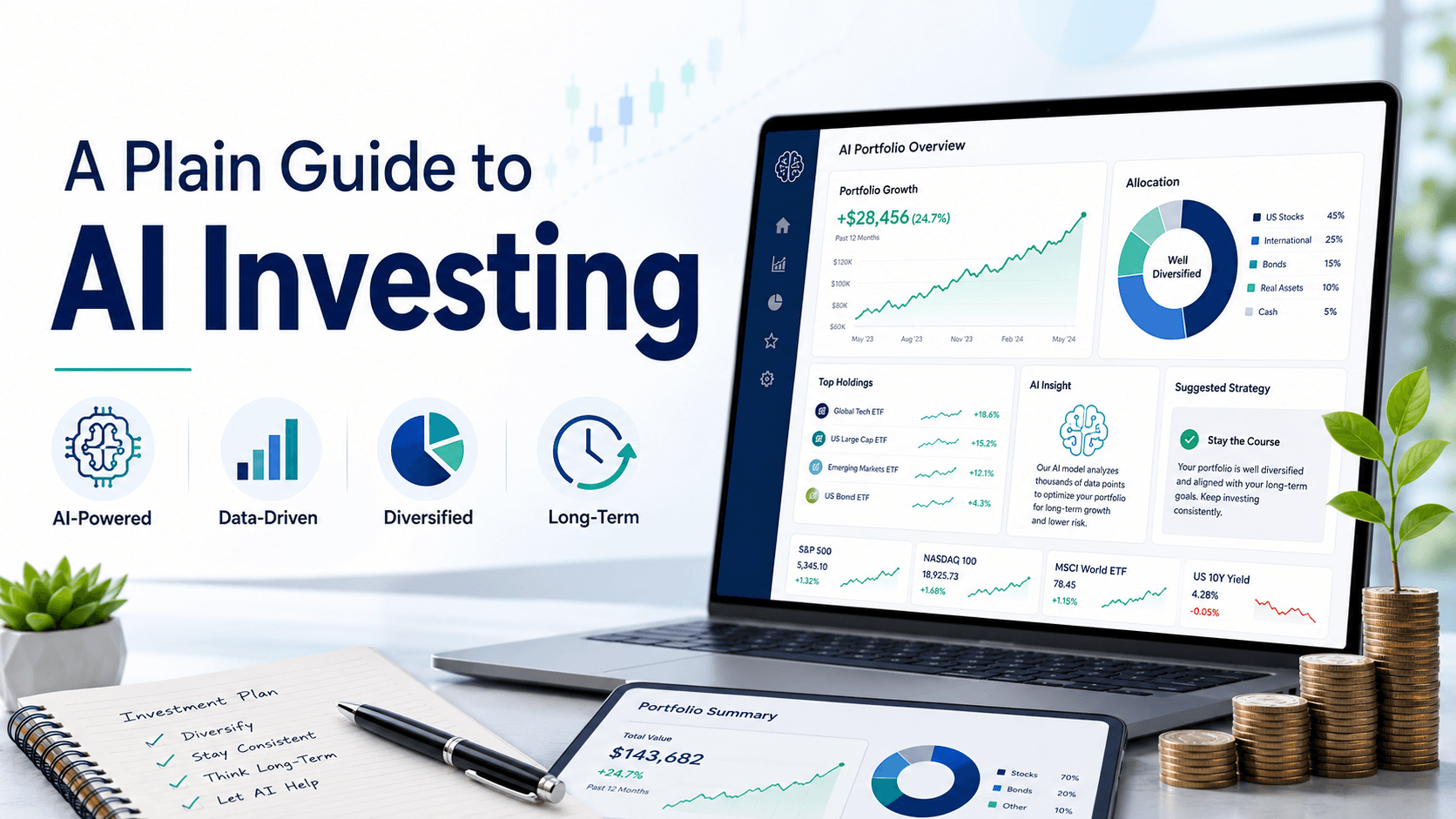
Robo-advisors and AI investing tools typically build a diversified portfolio of low-cost index funds or ETFs for you, based on your goals and risk tolerance, then handle the rebalancing automatically. For someone who wants the benefits of an index fund without choosing and managing funds themselves, that hands-off approach can lower the barrier to starting. The trade-off is usually a small management fee on top of the fund costs.
The convenience is real, but it is not free, and it is worth knowing exactly what you pay. Read the fee schedule, confirm what the underlying holdings are, and make sure the automation suits how involved you want to be before committing to any platform. A good platform is transparent about both its own fee and the costs of the funds it holds.
These tools do not change what an index fund is — they just package it conveniently. If you want to compare the options, our AI investing tool reviews cover the main robo-advisors and platforms honestly. As always, understand what you are buying and what it costs before committing.
Index fund FAQ
What is an index fund in simple terms?
An index fund is a fund that copies a market index instead of trying to beat it. It holds the same companies as the index, so its return tracks the whole market closely before fees. Buying one gives you a small slice of many companies at once, which spreads your risk.
Are index funds a good investment for beginners?
Many experienced investors consider a broad, low-cost index fund a sensible starting point for beginners, because it offers diversification, low fees, and simplicity. That said, it is not advice for your situation, and all investing carries risk. Match the choice to your goals, time horizon, and comfort with risk.
What is the difference between an index fund and an ETF?
“Index fund” describes a passive strategy; “ETF” describes a structure. An index fund can be a traditional mutual fund or an ETF. The main practical difference is that an ETF trades on an exchange through the day, while a mutual fund is priced once daily. Both can track the same index.
Can you lose money in an index fund?
Yes. An index fund falls when its market falls, and you can get back less than you invested. It spreads risk across many companies but cannot remove market risk. This is why an index fund suits money you can leave invested for years, not money you may need soon.
Why are index funds cheaper than active funds?
Because an index fund is passively managed — it copies an index rather than paying analysts to pick investments. That means far less trading inside the fund and lower running costs, which, as Investor.gov notes, usually results in lower fees than an actively managed fund.
Do index funds beat the market?
No — an index fund is designed to match the market, not beat it. Its appeal is that, after fees, many active funds struggle to beat their benchmark consistently, so matching the market cheaply is often a dependable long-term result rather than a disappointing one.
How much do I need to start investing in an index fund?
It varies by provider and country, and many platforms now let you start with a modest amount and add to it regularly. The exact figure matters less than starting early and investing consistently, since time in the market is what lets an index fund compound.
Are index funds safe?
No investment is fully safe. An index fund is generally considered lower-risk than betting on individual stocks because it is diversified, but it still rises and falls with the market and can lose value. “Diversified” is not the same as “safe,” and you should never invest money you cannot afford to lose.
The bottom line on index funds
An index fund is the rare investment that is both beginner-friendly and respected by experts. By tracking the whole market at low cost instead of trying to beat it, it delivers broad diversification and simplicity — the two things new investors most need — without demanding expertise or constant attention.
An index fund tracks a market index passively, at low cost, giving instant diversification. It will not beat the market, and it can lose value in a downturn — but for long-term, hands-off investing, that trade-off suits most beginners. Cover your essentials and emergency fund first, favour broad and low-cost funds, invest regularly, and hold for the long term.
If you take one thing from this guide, let it be the order of operations: get the foundation right, then let a broad, low-cost index fund do the slow, quiet work of building wealth over years. For the full sequence, read our personal finance basics guide and our investing for beginners guide. This guide is educational only and not financial advice. Last reviewed: June 2026.
Continue exploring Ladabo
Pick what’s most useful for you next
Educational content only. This index fund guide is general financial education, not personalised financial or investment advice, and not a recommendation to buy any specific investment. All investing carries risk, including loss of capital; past performance does not assure future results. Ladabo may earn commissions when you sign up to tools via our affiliate links, but our guidance reflects research and established principles, not commission rates. For decisions specific to your circumstances, consult a qualified, regulated financial professional. Review methodology · Full disclosure.