What Is an ETF? A Beginner’s Guide
An ETF lets you buy a whole basket of investments in a single trade, like a stock. This plain-English guide explains what an ETF is, how it works, how it compares with an index fund and a mutual fund, the risks, and how a beginner can start.
If you have read anything about investing lately, you have met the three letters ETF. They turn up everywhere, often alongside index funds, and the two are easy to confuse. The short version: an ETF is a basket of investments that trades on a stock exchange, so you can buy a slice of hundreds of companies in one go, at low cost, with the ease of buying a single share. This guide explains what an ETF actually is, how it works, how it differs from an index fund and a mutual fund, the real risks, and how to begin. None of it is financial advice — investing always carries risk — but the basics are simpler than the jargon suggests.
- What an ETF is, in plain English
- How an ETF actually works and trades
- How an ETF differs from an index fund
- How an ETF differs from a traditional mutual fund
- The main types of ETF and the genuine risks
- How a beginner can start, step by step
What an ETF is
ETF stands for exchange-traded fund. It is a single fund that holds a basket of investments — often hundreds or thousands of stocks or bonds — and trades on a stock exchange just like an ordinary share. When you buy one share of such a fund, you own a small slice of everything inside that basket.
The two halves of the name tell you most of what you need. “Fund” means it pools money from many investors to buy a diversified collection of assets. “Exchange-traded” means you buy and sell it on the open market through the day, at a live price, rather than dealing directly with the fund company. That combination — a diversified fund you can trade like a stock — is the whole idea.
For a beginner, the appeal is that one purchase gives you instant diversification across an entire market or sector. Instead of researching and buying dozens of individual shares, you buy a single fund that already holds them. If investing is new to you, our investing for beginners guide sets the wider context this ETF guide builds on.
How an ETF works
The mechanics sound technical, but the parts that matter to a beginner are simple. Understanding them removes the mystery and helps you avoid a couple of common pitfalls.
It holds a basket of assets
Each fund owns a defined collection of investments — for example, all the companies in a broad market index. Your single share represents proportional ownership of that whole basket, so your money rises and falls with the basket as a group rather than with any one company.
It trades on an exchange all day
Unlike a traditional fund priced once a day, it trades throughout market hours at a live price that moves with supply and demand. You can buy or sell whenever the market is open, which gives flexibility — though for a long-term investor that intraday trading is a convenience, not a reason to trade often.
Price versus underlying value
The fund has an underlying value based on the assets it holds, and a market price set by trading. For large, popular funds these usually stay very close together. With niche or thinly traded funds the gap can widen, which is one reason beginners are generally steered toward big, broadly held funds.
For everyday investing this rarely matters: stick to large, popular funds and the price you pay will track the underlying value closely. It only becomes a real concern with obscure or specialist products, which beginners have little reason to touch.
ETF vs index fund: clearing up the confusion
This is the question that trips up almost every beginner, so it is worth being precise. An ETF and an index fund are not opposites, and they are not mutually exclusive. They describe different things.
“Index fund” describes a strategy — passively tracking a market index instead of trying to beat it. “ETF” describes a structure — a fund that trades on an exchange. The two overlap constantly: a great many of them are index funds, and a great many index funds are ETFs. You can also have an index fund that is a traditional mutual fund, or an ETF that is actively managed rather than indexed.
So the honest answer to “ETF or index fund?” is that it is often a false choice — many products are both at once. The questions that actually matter are whether the fund is broadly diversified, whether it is low-cost, and whether the structure suits how you invest. Our index fund guide covers the strategy side in depth, while this guide focuses on the structure.
| Term | What it describes | Example |
|---|---|---|
| Index fund | A strategy (track an index) | Can be a mutual fund or an ETF |
| ETF | A structure (trades on an exchange) | Can be index-based or active |
| The overlap | An index-tracking ETF | Both at once — very common |
The takeaway is to stop treating it as a rivalry. When you compare two funds, look past the labels and ask the questions that change your returns: how broadly is it diversified, what does it cost each year, and does its trading style fit your habits. A fund’s breadth and cost are visible in its fact sheet; the wrapper is just how it is delivered.
ETF vs mutual fund
The clearer comparison is between an ETF and a traditional mutual fund, because here the difference is real and structural. Both pool money to buy a diversified basket; the difference is how you buy and hold them.
A traditional mutual fund is priced once a day after markets close, and you buy or sell it directly from the fund provider at that single daily price. It trades on an exchange all day at a live price, like a stock. For regular, automatic investing the once-a-day simplicity of a mutual fund can be convenient; for flexibility and often lower minimums, the ETF structure appeals.
These funds are also frequently more tax-efficient in taxable accounts, because of how shares are created and redeemed behind the scenes, which tends to trigger fewer taxable events inside the fund. For a long-term, low-cost investor the two are far more alike than different — both can hold the same underlying index cheaply.
The main types of ETF
Not every fund is the broad, cheap, diversified kind that suits beginners. They come in several flavours, and knowing the difference protects you from buying something narrower or riskier than you intended.
Broad-market funds
These track a wide index covering a whole national or global market in one holding. For most beginners this is the sensible starting point, because a single broad fund delivers maximum diversification at minimal cost.
Bond and income funds
These hold baskets of bonds rather than shares, offering steadier income and acting as a cushion when stock markets fall. They are a common way to add stability to a portfolio as a goal draws nearer.
Sector, country, and thematic funds
These focus narrowly — a single industry, country, or trend. They are far less diversified than a broad-market fund and concentrate risk rather than spreading it. They can have a place, but they are not the low-risk default that broad funds are. As the SEC’s guidance on diversification notes, a narrowly focused fund may not give you the spread of risk you expect.
Active and specialty funds
Some funds are actively managed, with a manager making choices rather than tracking an index, and these usually charge more. Others use complex or leveraged strategies aimed at experienced traders. Neither is the simple, low-cost default a beginner needs, so read the description carefully and be sure you understand what you are buying.
Why ETFs are popular
ETFs have grown enormously for a handful of practical reasons. None of them is about getting rich quickly, which is exactly why they suit patient, long-term investors.
Low cost and diversification
A broad fund spreads your money across a large number of holdings in a single, low-cost purchase. Diversification is one of the few genuine free lunches in investing, and these funds deliver it cheaply. Because fees compound against you over time, the low running costs of a broad fund are a quiet, lasting advantage.
Flexibility and accessibility
Trading like a share makes a fund easy to buy through almost any brokerage, often with a low minimum. You can start small, add regularly, and see a live price whenever you check. According to Investor.gov, the SEC’s investor-education site, these funds offer benefits such as professional management, diversification, and a low minimum investment.
Tax efficiency
In a taxable account, the structure tends to generate fewer taxable events inside the fund than a comparable traditional fund, which can leave more of your return compounding for you. The advantage is smaller inside tax-advantaged accounts, but it is a genuine plus of the structure.
Taken together, these qualities explain the popularity without any hype: cheap, diversified, easy to access, and reasonably tax-friendly. None of that promises a profit, but it stacks the everyday odds in a long-term investor’s favour over time.
The risks and limits of ETFs
An ETF is a tool, not a guarantee, and an honest guide has to be clear about the risks. Understanding them is part of investing responsibly.
You can still lose money
A fund rises and falls with whatever it holds. When the market drops, your fund drops with it — the structure offers no protection from a downturn. Investing is never free of risk, and you can get back less than you put in. Diversification spreads risk across many holdings, but it cannot remove it.
Narrow funds concentrate risk
The flexibility that makes these funds appealing also makes it easy to buy something far riskier than a broad-market fund. A single-sector or single-country fund can swing sharply, so always check what a fund actually holds before assuming it is well diversified.
The temptation to over-trade
Because the fund trades all day, it is easy to treat long-term investments like short-term bets, buying and selling on impulse. That habit tends to hurt returns through costs and bad timing. The structure rewards investors who buy broadly and then leave it alone, not those who tinker.
This guide is educational and general — it is not financial advice, and nothing here is a recommendation to buy any particular investment. All investing carries risk, including the loss of the money you invest, and past performance never assures future results. Which funds suit you, how much to invest, and how they fit your tax situation depend on your circumstances. For decisions about your own money, consider speaking with a qualified, regulated financial professional.
How to start with ETFs
Starting is simpler than the jargon implies. The hardest part is usually getting going; the rest is patience. Here is the broad shape — adapt it to your own country and situation.
Step 1: Cover the basics first
Before investing, it is wise to clear high-interest debt and build a cash buffer. An emergency fund means a surprise bill will not force you to sell at a bad moment. Investing is for money you can leave alone for years.
Step 2: Open the right account
Open an investment or brokerage account, ideally a tax-advantaged one if your country offers it, such as a retirement or tax-sheltered account. The tax saving is a reliable boost, so these are usually worth using before a standard taxable account.
Step 3: Choose a broad, low-cost fund
For a first holding, a broad-market ETF covering a wide range of companies is a common starting point, with low fees as a key thing to compare. Breadth and cost matter far more than picking the “perfect” fund, which does not exist.
Step 4: Invest regularly and hold
Set up a regular, automatic contribution and resist the urge to trade. Investing a fixed amount on a schedule removes the temptation to time the market, and holding through the ups and downs is how a broad fund tends to reward patient investors. Time in the market beats timing the market.
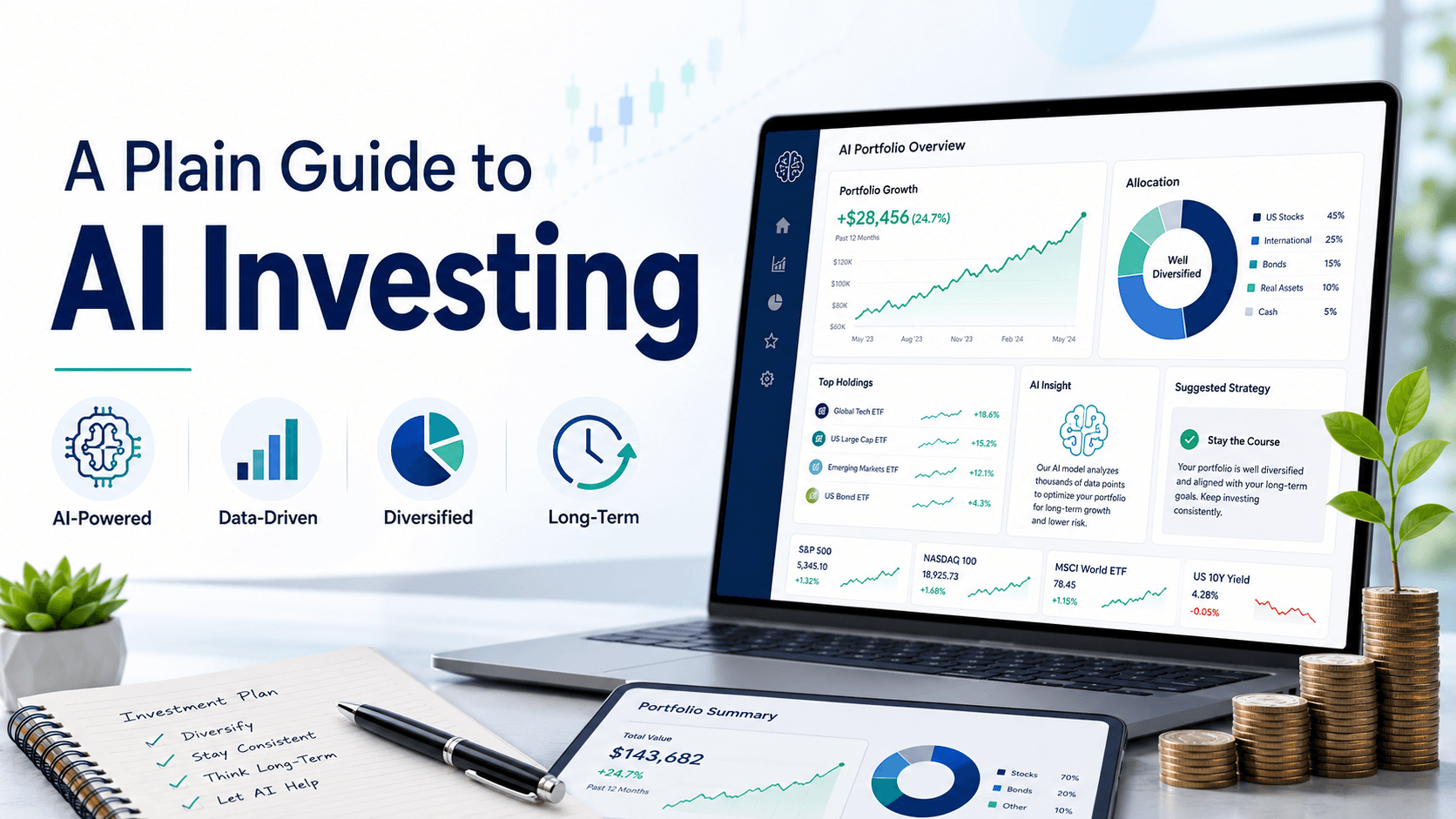
How AI investing tools use ETFs
Many beginners now reach their first fund through an app rather than a traditional broker, and AI-driven investing tools have made the process even simpler. They are worth understanding as a route in.
Robo-advisors and AI investing tools typically build a diversified portfolio of low-cost ETFs for you, based on your goals and tolerance for risk, then rebalance it automatically. For someone who wants the benefits of an ETF without choosing and managing funds themselves, that approach lowers the barrier to starting. The trade-off is usually a small management fee on top of the fund costs.
One sensible habit applies whether you invest yourself or through a tool: pick a broad, low-cost core and keep contributing to it, rather than chasing whatever fund is trending. A plan you stick to beats a clever one you abandon, and automation makes that discipline almost effortless.
These tools do not change what an ETF is — they simply assemble and maintain a basket of them for you. The convenience is real, but it is not free, so read the fee schedule and confirm what the underlying holdings are before committing. If you want to compare options, our AI investing tool reviews cover the main platforms honestly.
ETF FAQ
What is an ETF in simple terms?
An ETF, or exchange-traded fund, is a single fund that holds a basket of investments and trades on a stock exchange like a share. Buying one share gives you a small slice of everything in the basket, so you get instant diversification from a single, low-cost purchase.
What is the difference between an ETF and an index fund?
“Index fund” is a strategy — tracking an index passively. “ETF” is a structure — a fund that trades on an exchange. They overlap: many of them are index funds, and many index funds are ETFs. The terms answer different questions, so a fund can easily be both at once.
Is an ETF a good investment for beginners?
Many experienced investors consider a broad, low-cost ETF a sensible starting point, because it offers diversification, low fees, and easy access. That said, it is not advice for your situation, and all investing carries risk. Match the choice to your goals, time horizon, and comfort with risk.
Can you lose money in an ETF?
Yes. A fund falls when its holdings fall, and you can get back less than you invested. Diversification spreads risk across many holdings but cannot remove market risk. This is why a broad fund suits money you can leave invested for years, not money you may need soon.
How is an ETF different from a mutual fund?
A traditional mutual fund is priced once a day and bought from the fund provider; an ETF trades on an exchange all day at a live price. ETFs often have lower minimums and can be more tax-efficient in taxable accounts. Both can hold the same underlying index cheaply.
Are ETFs safe?
No investment is fully safe. A broad ETF is generally considered lower-risk than betting on individual stocks because it is diversified, but it still rises and falls with its market and can lose value. Narrow, single-theme funds are riskier, so check what a fund actually holds.
How much do I need to start investing in an ETF?
It varies by provider and country, and many platforms now let you start with a modest amount and add to it regularly, sometimes via fractional shares. The exact figure matters less than starting early and investing consistently, so compounding has time to work.
Should I pick an ETF or an index fund?
Often you do not have to choose, because many funds are both. Focus instead on whether the fund is broadly diversified and low-cost, and whether trading intraday (ETF) or once daily (mutual fund) suits how you invest. The wrapper matters less than breadth and cost.
The bottom line on ETFs
An ETF gives a beginner something genuinely useful: a whole diversified market in a single, low-cost, easy-to-buy package. The structure is flexible and tax-efficient, and for long-term investing a broad fund delivers the two things that matter most — diversification and low cost — without demanding expertise.
An ETF is a basket of investments that trades like a share, giving instant, low-cost diversification. It can lose value in a downturn, and narrow funds carry extra risk — but for long-term investing, a broad, low-cost fund suits most beginners. Cover your essentials and emergency fund first, favour broad and cheap, invest regularly, and resist the urge to trade.
If you take one thing from this guide, let it be the order of operations: get the foundation right, then let a broad, low-cost fund do the slow, quiet work of building wealth over years. For the full picture, read our index fund guide and our investing for beginners guide. This guide is educational only and not financial advice. Last reviewed: June 2026.
Continue exploring Ladabo
Pick what’s most useful for you next
Educational content only. This ETF guide is general financial education, not personalised financial or investment advice, and not a recommendation to buy any specific investment. All investing carries risk, including loss of capital; past performance does not assure future results. Ladabo may earn commissions when you sign up to tools via our affiliate links, but our guidance reflects research and established principles, not commission rates. For decisions specific to your circumstances, consult a qualified, regulated financial professional. Review methodology · Full disclosure.