AI Tax vs Traditional Tax 2026: Decision Guide
A decision guide synthesising 9 individual reviews and comparisons across the Ladabo AI tax software cluster. This guide maps the four real filing paths — AI-native software, AI-bolted-on mainstream, genuinely free software, traditional CPA — and explains which path fits which filer.
This decision guide cuts through the noise around AI tax software to show you what each path actually delivers, what each costs honestly, and exactly how to match the path to your filing complexity. The framework builds on 9 standalone reviews and comparisons in our cluster — research-based throughout, not personal product testing.
This decision guide covers the four real filing paths (AI-native, AI-bolted-on, free, traditional CPA), the leading platforms in each (with reviews linked), how to compare them on actual cost and value, where AI tax software falls short of human CPAs, the regulatory considerations nobody explains, EU and UK alternatives, a practical 6-step framework for picking the right path, and clear answers to the questions every filer asks.
What “ai tax vs traditional tax” actually means
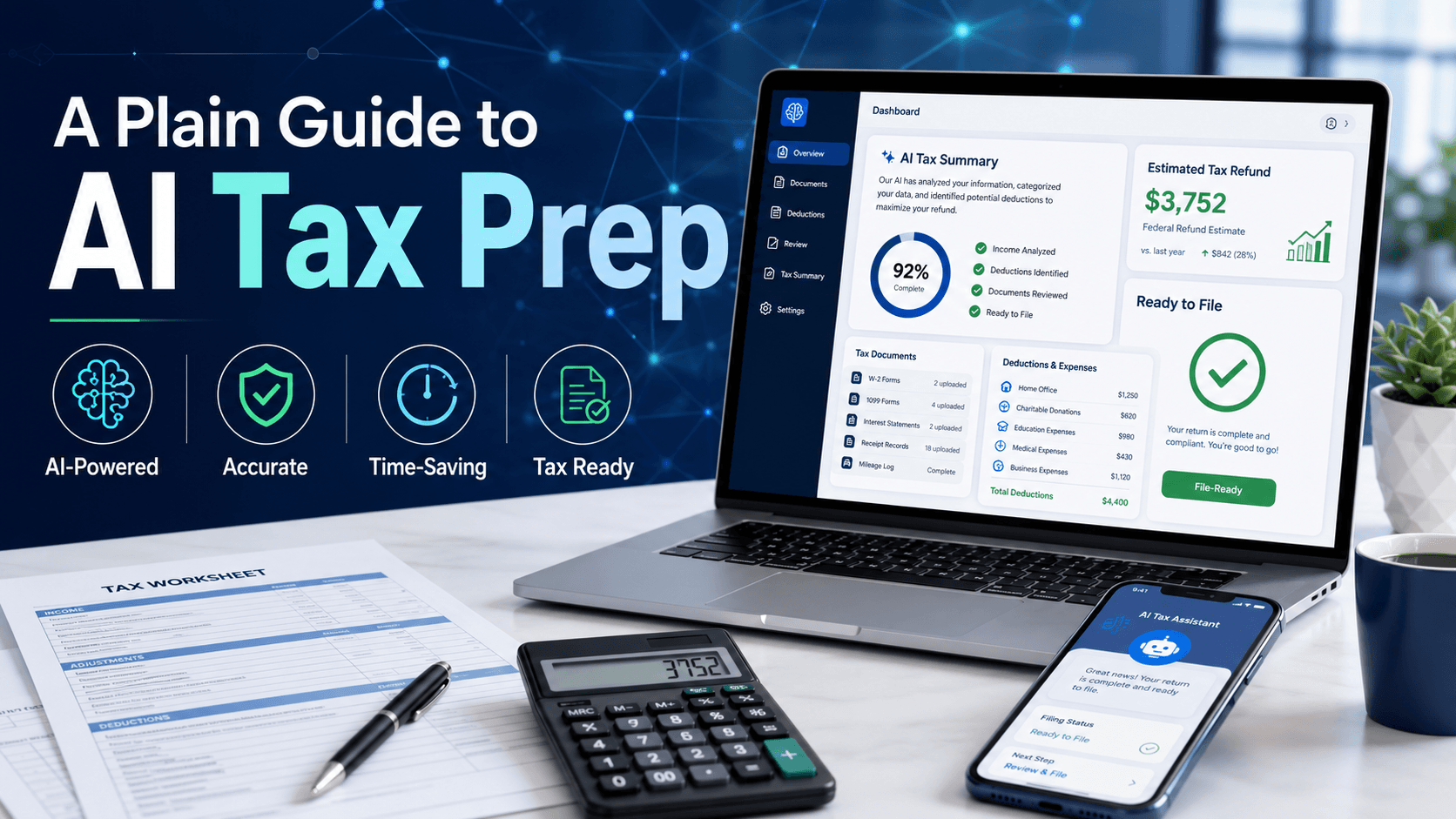
The ai tax vs traditional tax framing covers two genuinely different approaches to filing US income tax. AI tax software uses machine learning, natural language processing, and predictive analytics to discover deductions, categorise expenses, and verify returns. Traditional tax preparation uses a human Certified Public Accountant or Enrolled Agent who interviews you, reviews documents, and files returns based on professional judgment.
The decision matters because picking the wrong path costs money — either through unused capability (paying a CPA for a W-2 return Cash App Taxes would handle free) or through missed optimisation (filing complex business income through AI software when a CPA would have caught a $5,000 deduction).
How AI tax software actually works
Modern AI tax software combines three underlying technologies. Pattern recognition algorithms analyse bank and credit card transactions to identify deductible business expenses (Keeper, FlyFin lead this category). Natural language interfaces let users describe their situation conversationally rather than navigating form-by-form (Intuit Assist in TurboTax, AI Tax Assist in H&R Block). Predictive verification flags potential errors or missed credits before filing. Most AI tax software in the ai tax vs traditional tax market combines two or three of these — understanding which type each platform uses matters because each comes with different trade-offs.
How traditional tax preparation actually works
A traditional CPA or Enrolled Agent (EA) meets with you (in person or virtually), reviews your tax documents and prior-year returns, asks questions about your business and financial situation, identifies applicable deductions and credits based on professional judgment, prepares the return, and represents you with the IRS if questions arise. Per the IRS’s official guidance on choosing a tax professional, both CPAs and EAs are credentialed to represent taxpayers before the IRS at all administrative levels — a meaningful advantage in the comparison if audit risk is non-trivial.
Why the ai tax vs traditional tax distinction matters
The decision is fundamentally about complexity matching. Simple returns (W-2 only, standard deduction, single state) genuinely don’t need a CPA — AI tax software or even genuinely free software covers the use case at a fraction of the cost. Complex returns (multiple business entities, K-1 partnerships, foreign income, large rental portfolios) genuinely benefit from CPA judgment — AI tax software handles the mechanics but misses the strategic optimisations a human professional catches. Most filers sit between these poles, and that’s where the decision gets interesting.
The four real filing paths in the landscape
The decision is rarely binary. There are four distinct filing paths, each suited to different complexity profiles. Picking the right path is the most important decision in the framework.
| Path | What it is | Effective cost | Leading examples |
|---|---|---|---|
| Path 1: AI-native software | Software built from scratch around AI deduction discovery | $192-$348/year | Keeper (4.4/5), FlyFin (4.2/5) |
| Path 2: AI-bolted-on mainstream | Traditional tax software with AI layers added | $225-$308 effective | TurboTax SE (4.0/5), H&R Block SE (3.8/5) |
| Path 3: Genuinely free software | No-AI free filing including Schedule C | $0 | Cash App Taxes (3.9/5) |
| Path 4: Traditional CPA / EA | Human professional preparation | $400-$1,500/year | Local CPAs, online services |
Why these four paths and not five
The framework also touches a fifth option — DIY paper filing without software — but in the 2026 landscape, paper filing is genuinely obsolete for any return more complex than a single W-2. The IRS still accepts paper returns, but processing delays (often 6-12 weeks vs 1-3 weeks for e-filed returns) and the error rate without software validation make paper filing strictly inferior to free software for the same use case. The decision in practice is between these four genuine paths.
The cluster maps every path
The Ladabo AI tax software cluster covers each path through dedicated reviews and comparisons. Path 1 (AI-native) is covered by our Keeper review, FlyFin review, and the Keeper vs FlyFin head-to-head. Path 2 (AI-bolted-on) is covered by the TurboTax SE review, H&R Block SE review, and TurboTax vs H&R Block comparison. Path 3 (free) is covered by the Cash App Taxes review. Path 4 (CPA) is covered by reference rather than direct review — there’s no single “CPA product” to review, but the framework includes CPA as a real alternative.
Honest cost comparison across all four paths
The ai tax vs traditional tax cost comparison reveals a spread of $0 to $1,500+ depending on path. The headline cost matters less than the value-per-dollar at your specific complexity level — paying $400 for a CPA on a simple W-2 return is overpayment; paying $192 for AI software on a multi-entity business return is underpayment.
| Filer profile | Path 1 (AI-native) | Path 2 (Bolted-on) | Path 3 (Free) | Path 4 (CPA) |
|---|---|---|---|---|
| W-2 only, single state | $192 (overpaying) | $120-$200 | $0 (optimal) | $200-$400 (overpaying) |
| Simple Schedule C | $192 (good fit) | $248-$308 | $0 (good fit) | $400-$600 |
| Complex Schedule C, multi-state | $192-$348 (good fit) | $280-$380 | N/A (single-state only) | $500-$800 |
| Rental properties (1-3 units) | $192-$348 | $280-$380 (broader forms) | Possible but limited | $600-$900 |
| Multiple business entities | Insufficient depth | $308+ (limited) | N/A | $800-$1,500 (optimal) |
| K-1 partnerships, foreign income | Insufficient depth | Insufficient depth | N/A | $1,000-$2,000 (optimal) |
The cost-per-value framing
The ai tax vs traditional tax cost comparison shows a clear pattern: each path has a complexity sweet spot. Below the sweet spot, the path overpays for unused capability. Above the sweet spot, the path underdelivers on optimisation. The decision is fundamentally about identifying your complexity level honestly and matching to the appropriate path.
The hidden cost: missed deductions
Beyond the visible price, the decision has hidden costs in missed deductions. AI-native software (Keeper, FlyFin) typically identifies $3,000-$8,000 in additional Schedule C deductions for freelancers with $50,000-$150,000 in gross self-employment income — beyond what bolted-on mainstream tools catch. CPAs typically identify $5,000-$15,000 in additional optimisations for complex business filers — beyond what AI software catches. In the framework, the cheapest path is rarely the lowest-cost option once missed deductions are priced in.
Path 1: AI-native software (Keeper, FlyFin)
The decision often resolves to Path 1 for freelancers and self-employed filers with meaningful deductible expenses. AI-native software is built from scratch around AI deduction discovery — the AI is the core product, not an overlay.
Keeper: year-round deduction tracking
Keeper ($192/year) connects to your bank accounts and credit cards via secure aggregators and categorises transactions throughout the year. The AI flags business-deductible expenses based on category, merchant pattern, and user feedback over time. By tax season, you have a structured list of validated deductions rather than facing a year of statements to review manually. Keeper rates 4.4/5 in our research — the highest score in the software category. Read our full Keeper review.
FlyFin: AI + CPA hybrid
FlyFin ($192-$348/year depending on tier) uses similar AI-driven deduction discovery to Keeper but emphasises the human CPA expert layer more prominently. The Standard tier ($348/year) includes full CPA review of your return before filing — a meaningful safeguard for first-time Schedule C filers or filers with unusual situations. In the framework, FlyFin Standard ($348) is roughly equivalent in price to a basic CPA filing ($400-$500), but the workflow is AI-driven with CPA verification rather than CPA-driven from the start. FlyFin rates 4.2/5. Read our full FlyFin review.
When AI-native software earns its cost
AI-native tools in the landscape earn their cost for freelancers with $5,000+ in deductible business expenses. AI-driven deduction discovery typically identifies $3,000-$8,000 in additional deductions vs bolted-on mainstream tools, translating to $750-$2,000 in additional tax savings at typical effective rates. Against $192-$348 cost, AI-native paid tools pay for themselves at any meaningful Schedule C income level. The deduction discovery improves over time as the AI learns your spending patterns.
Path 2: AI-bolted-on mainstream (TurboTax SE, H&R Block SE)
The decision resolves to Path 2 for filers who specifically want mainstream brand assurance or broader form coverage than AI-native tools provide. AI-bolted-on mainstream software adds AI layers (Intuit Assist, AI Tax Assist) to traditional tax engines that predate the AI.
TurboTax Self-Employed and Intuit Assist
TurboTax Self-Employed ($248-$308 effective) remains the mainstream brand leader despite the 2022 FTC settlement and 2024 final order. The Intuit Assist AI layer added in 2023-2024 provides conversational guidance and basic deduction prompts. The underlying TurboTax engine is genuinely sophisticated — broad form coverage, strong audit support (Premium tier), QuickBooks integration. In the framework, TurboTax SE earns its premium for users who specifically need Intuit ecosystem integration or who value mainstream brand recognition. TurboTax SE rates 4.0/5. Read our full TurboTax SE review.
H&R Block Self-Employed and AI Tax Assist
H&R Block Self-Employed ($225-$285 effective) competes with TurboTax SE on roughly equivalent terms with one structural differentiator: approximately 9,000 in-person H&R Block offices across the US. For users who want the option of walking into an office mid-flow, H&R Block SE delivers what no other path in the landscape offers. AI Tax Assist provides similar conversational guidance to Intuit Assist. H&R Block SE rates 3.8/5. Read our full H&R Block SE review.
Where bolted-on mainstream falls short
Bolted-on mainstream tools in the framework charge $225-$308 effective for AI layers that are genuinely shallower than AI-native alternatives like Keeper and FlyFin (both $192). The premium buys brand recognition, broader form coverage, and (for H&R Block) in-person backup — not deeper AI. For pure freelancer Schedule C filing with deduction discovery as the primary need, AI-native tools deliver more value at lower cost.
Path 3: Genuinely free software (Cash App Taxes)
The decision resolves to Path 3 — Cash App Taxes free — for the largest subset of US filers. The free path covers W-2 only filers, simple Schedule C freelancers in single states, capital gains filers, and rental income filers using standard deductions.
What Cash App Taxes actually covers
Cash App Taxes (owned by Block Inc., previously Credit Karma Tax before the 2020 acquisition) is genuinely free for federal and one state return — including Schedule C self-employment income, Schedule D capital gains, Schedule E rental income, and most common credits. No upgrade prompts mid-flow. No “free” headline that becomes paid when you add a 1099. Cash App Taxes rates 3.9/5 in our research. The structural limits in the framework are real: single-state filing only, no live human support, no in-person offices, less polished interface than paid mainstream tools. Read our full Cash App Taxes review.
Why the free path matters in the landscape
The free path matters because most US filers don’t need paid software. W-2 only filers with standard deductions, simple Schedule C freelancers in single states, and renters using standard deductions can complete their returns through Cash App Taxes free with the same accuracy as paid alternatives. The framework rewards using the cheapest path that fully covers your situation — paying $192-$308 for capability you won’t use is wasted money.
Where Cash App Taxes falls short
The Cash App Taxes single-state limitation is the structural constraint of the free path in the framework — multi-state filers need different software. No support for non-resident state returns. No live phone support. No audit defence. No AI-driven deduction discovery for freelancers with complex expense patterns. Some complex situations (foreign income, K-1 partnerships with complex allocations) push beyond what the free product handles smoothly.
Path 4: Traditional CPA or Enrolled Agent
The decision resolves to Path 4 for complex returns where AI software falls short of human professional judgment. CPAs and EAs deliver expertise, judgment, and IRS representation that no AI tax tool currently matches.
What CPAs and EAs actually deliver
Certified Public Accountants (CPAs) are state-licensed accounting professionals who can handle tax preparation, audit defence, financial planning, and broader accounting services. Enrolled Agents (EAs) are federally licensed tax specialists who focus specifically on taxation and can represent clients before the IRS. Per the IRS’s official Enrolled Agent information, EAs hold the highest credential the IRS awards. In the framework, both CPAs and EAs deliver professional judgment AI software cannot replicate.
When CPAs and EAs earn their cost
Traditional CPAs and EAs in the framework earn their cost for filers with: multiple business entities, K-1 partnerships with complex allocations, foreign income (FBAR/FATCA filing), large rental portfolios (4+ properties or partnership-owned real estate), significant investment trading activity, major life transitions (business sale, divorce, inheritance), or audit defence needs. Full-service CPA fees typically range $400-$1,500 for individual returns and $1,000-$2,500+ for complex business filings. The optimisation value typically exceeds the fee differential for these complexity profiles.
Online CPA services in 2026
The CPA market has evolved beyond local in-person practices. Online CPA services (Bench, Pilot, 1-800Accountant, Taxfyle) deliver remote CPA preparation at often lower costs than traditional local practices. In the framework, online CPAs represent a hybrid path — human expertise delivered via software-mediated workflow. For filers comfortable with remote service, online CPAs often deliver better value than local equivalents. The trade-off is loss of in-person relationship and local-tax-specific knowledge.
When AI tax software genuinely beats a CPA
The decision favours AI tax software over traditional CPAs in several specific situations — more than most filers realise.
Simple returns where CPA expertise is wasted
For W-2 only filers with standard deductions, paying a CPA $200-$400 is purely overpayment. The CPA brings expertise that doesn’t apply — the return has no optimisation potential beyond what free software handles correctly. The decision for simple filers is unambiguous: Cash App Taxes free does everything a CPA would do for these returns, faster, at zero cost.
Freelance deduction discovery
For Schedule C freelancers, AI-native software (Keeper, FlyFin) often discovers $3,000-$8,000 in additional deductions a CPA would miss because the CPA reviews your return annually while the AI categorises transactions continuously throughout the year. In the framework, AI’s year-round expense tracking captures deductions human professionals miss during compressed tax-season review windows.
Cost-per-deduction-discovered ratio
AI-native software ($192-$348/year) typically discovers $3,000-$8,000 in deductions for moderate-complexity freelancers — a cost-per-deduction ratio of $0.04-$0.12. CPA preparation ($600-$900) for the same filer typically captures the same baseline deductions plus 1-2 additional ones — a cost-per-marginal-deduction ratio of $300-$900. The math favours AI-native tools for freelance deduction discovery decisively.
Year-round deduction tracking
AI-native tools categorise expenses continuously, providing real-time visibility into deductible expenses throughout the year. Traditional CPAs typically engage only at tax time, reviewing summaries of expenses you’ve already categorised. The framework favours AI when year-round visibility matters more than year-end optimisation — which is true for most active freelancers.
When a CPA still wins in the decision
Despite AI’s advantages, the decision still favours traditional CPAs in specific situations where human judgment, representation, or strategic planning matters more than algorithmic efficiency.
Multi-entity business structures
Multiple LLCs, S-corp elections, complex partnership structures with K-1 distributions, and entity-level tax planning require professional judgment AI software cannot replicate. The decision for multi-entity filers is unambiguous — CPA preparation is the only viable path. AI tools handle the mechanics but miss the strategic optimisations that determine total tax liability.
Foreign income and FBAR/FATCA
Foreign earned income exclusion (Form 2555), Foreign Bank Account Reports (FBAR/FinCEN 114), Foreign Account Tax Compliance Act (FATCA/Form 8938), and foreign tax credits require specialised expertise. The framework favours CPAs with international expertise for any filer with foreign income, foreign accounts above reporting thresholds, or expatriate status. The penalty for FBAR non-compliance alone ($10,000-$100,000+) makes professional preparation cheap insurance.
Audit defence and IRS representation
If the IRS audits your return, only CPAs, EAs, and attorneys can represent you. AI tax software (even with paid audit-support tiers like TurboTax Premium) provides documentation assistance but cannot represent you before the IRS. The decision for filers with audit-likely returns (large deductions relative to income, complex Schedule C, foreign accounts) often justifies engaging a CPA proactively rather than DIY filing.
Major life transitions and strategic planning
Business sales, real estate transactions above $250k, divorce settlements, inheritance receipt, retirement timing decisions, and major life transitions benefit from CPA strategic planning. The framework rewards CPA engagement when the question is “what should I do” rather than “how do I file what I did.” AI software handles the second question well; CPAs handle the first.
Rental property portfolios above 3 units
Multi-property rental portfolios, partnership-owned real estate, and real estate professional status determinations require sophisticated tax planning. The decision for serious real estate investors typically favours CPAs over AI tools — passive activity loss rules, depreciation strategies, and 1031 exchange planning exceed what consumer AI tax software handles.
How to pick: 6-step framework for the decision
This 6-step framework synthesises the decision logic across all four paths. Most filers can identify their optimal path in under 10 minutes by working through these steps.
Assess your filing complexity honestly
The decision starts with honest self-assessment. W-2 only with standard deduction = simple. Schedule C with bank-statement deductions = moderate. Rental property + Schedule C = elevated. Multiple business entities + K-1s + investment trading = complex. Foreign income + multi-state + estate considerations = very complex. Match your complexity level to the path it suits, not the path you’d prefer.
Check the genuinely free option first
If your situation is simple or moderate, Cash App Taxes covers it free including Schedule C. Most US filers in the landscape don’t realise they qualify for genuinely free filing. Verify against Cash App Taxes’ single-state and form-coverage limits before committing to a paid path.
For Schedule C, evaluate AI-native paid software
If you’re a freelancer with $5,000+ in deductible expenses, AI-native tools (Keeper, FlyFin) in the framework pay for themselves through discovered deductions. The $192-$348 cost typically yields $750-$2,000 in additional tax savings. AI-bolted-on mainstream (TurboTax SE, H&R Block SE) charges more for less AI depth — pick it only for specific ecosystem reasons.
For complex returns, default to CPA
Multi-entity business structures, K-1 partnerships, foreign income, large rental portfolios, or major life transitions justify CPA preparation regardless of cost. The decision for complex situations is not close — CPA judgment and IRS representation outweigh AI capability. Budget $800-$2,000 annually for full-service CPA preparation at this complexity level.
Consider the hybrid for the middle complexity tier
Filers with $100k+ income and moderate-to-elevated complexity often benefit most from the hybrid in the framework: AI-native software for filing ($192-$348) plus fee-only CPA on retainer ($300-$600/year) for advisory questions. Total cost $492-$948/year — meaningfully less than full-service CPA while preserving CPA judgment where it matters most.
Re-evaluate annually as complexity changes
The right path in the decision changes over time. A simple W-2 filer who starts freelancing should move from Cash App Taxes to AI-native software. A freelancer who incorporates and adds business partners should move from AI software to CPA preparation. Don’t lock yourself into the path you chose three years ago — match the current path to current complexity.
EU and UK alternatives — ai tax vs traditional tax outside the US
All four paths in this decision guide are US-specific. The platforms (Cash App Taxes, Keeper, FlyFin, TurboTax SE, H&R Block SE) and the CPA/EA credentials are US-only. International filers should consider locally-regulated alternatives.
UK alternatives
UK filers should consider TaxScouts (online AI + accountant hybrid, £119-£169 for self-assessment returns), GoSimpleTax (DIY filing software, £55-£65), or HMRC’s official Self Assessment online portal (free but no AI assistance). For complex returns, UK Chartered Accountants typically charge £300-£800 for self-employment returns and £800-£2,500 for limited company returns. The framework still applies in the UK with different specific platforms.
EU alternatives
EU filers face country-specific tax systems with very different software landscapes. Taxfix (Germany, AI-driven mobile filing, €40 per return) is the leading AI tax software in Germany. Impôt en ligne (France’s official portal, free) covers most individual French filers. Indipendente or Fattureincloud (Italy) cover self-employed Italian filers. The regulatory frameworks differ significantly — MiFID II for investment income, country-specific business income treatments — and the decision must account for local tax efficiency vehicles (PEA in France, Riester/Rürup in Germany, ISA in UK).
The international gap
The landscape is meaningfully thinner outside the US. US platforms benefit from market scale (largest individual filing market globally) and regulatory clarity (clear IRS forms framework). EU and UK markets have local tax preparation services but with less AI depth and higher prices. For non-US filers, the cleanest framing in the decision: default to your country’s official free portal for simple returns, use the leading local AI tool for moderate complexity, engage a local Chartered Accountant or equivalent for complex returns.
AI tax vs traditional tax FAQ
Can AI tax software completely replace a CPA?
For simple returns, yes — AI tax software handles W-2 only, simple Schedule C, and standard-deduction situations as well as or better than CPA preparation, at a fraction of the cost. For complex returns (multi-entity, K-1 partnerships, foreign income, large rentals), no — CPA judgment and IRS representation provide value AI cannot replicate. The decision is fundamentally about complexity matching: AI replaces CPAs for simple-to-moderate complexity, complements CPAs for elevated complexity, and falls short of CPAs for high complexity.
How much does a CPA typically cost for an individual return in 2026?
Simple individual returns: $200-$400. Schedule C freelancer returns: $400-$700. Returns with rental properties or K-1 income: $600-$1,000. Multi-entity business returns or foreign income returns: $1,000-$2,000+. The ai tax vs traditional tax cost comparison shows CPA fees scaling with complexity — which is exactly the right pricing model for the value delivered. Fee-only CPAs charging hourly ($150-$400/hour) often work out cheaper than per-return pricing for filers who want occasional advisory rather than full filing.
Should I use TurboTax with the Live CPA add-on instead of a separate CPA?
The decision regarding TurboTax Live ($99-$199 add-on for CPA review) is genuinely complex. The Live CPA reviews your AI-prepared return but doesn’t restructure your tax situation or provide year-round advisory. For filers with moderate complexity who want CPA verification without full CPA engagement, TurboTax Live is reasonable. For filers with complex situations who need CPA judgment from the start, a separate fee-only CPA is better. The hybrid (AI software for filing + retainer CPA for advisory) usually beats TurboTax Live for filers above $100k income.
Is AI tax software safe? What about IRS audits?
AI tax software is safe for the categories of returns it handles well. Cash App Taxes, Keeper, FlyFin, TurboTax SE, and H&R Block SE all have e-filing authorisation from the IRS and undergo annual security audits. The audit-risk concern in the framework isn’t about software accuracy — modern AI tax software has lower error rates than DIY paper filing. The concern is about audit defence: if the IRS challenges your return, AI software provides limited or no representation. Paid tiers (TurboTax Premium, H&R Block Worry-Free) offer audit support; AI-native tools (Keeper, FlyFin) offer it as an add-on; Cash App Taxes offers basic guidance only.
What if my situation is moderate complexity? Where do I fit in the framework?
Moderate-complexity filers (Schedule C freelancer with $50k-$200k income, possibly one rental property, multi-state residency) typically sit between AI-native software (sometimes insufficient depth) and full CPA (overkill for the situation). The optimal path in the framework for this profile is usually the hybrid: AI-native software (Keeper or FlyFin) for the actual filing plus a fee-only CPA on retainer ($300-$600/year) for advisory questions and edge cases. This delivers most of CPA value at half the cost.
How does the FTC settlement against Intuit affect the decision?
The 2024 FTC final order against Intuit prohibits TurboTax from advertising products as “free” without qualifying disclosures, following the 2022 Multistate Tax Commission settlement ($141 million distributed to misled consumers). The settlement doesn’t make TurboTax a bad product — TurboTax SE still rates 4.0/5 in our review — but it validates the structural concern that mainstream “free” marketing often misleads filers. In the decision, filers who value the FTC enforcement context as a reason to avoid Intuit can use Cash App Taxes (Block Inc.) or AI-native alternatives (Keeper, FlyFin) without sacrificing core functionality.
What’s the best path for first-time Schedule C filers?
First-time Schedule C filers face the highest risk of missed deductions and errors in the landscape because they don’t know what they don’t know. The optimal path: FlyFin Standard ($348/year, includes CPA review) for the first year, then re-evaluate annually. The CPA review verifies the return before filing and answers basic questions about Schedule C optimisation. After Year 1-2 once you understand your deduction patterns, you can downgrade to Keeper ($192) or FlyFin Basic ($192) as the situation stabilises.
Do AI tax tools work for non-US filers?
No — the US-focused AI tax tools (Keeper, FlyFin, Cash App Taxes, TurboTax SE, H&R Block SE) are US-only. The regulatory frameworks differ significantly across jurisdictions, and US-focused products don’t translate to non-US tax systems. UK filers should consider TaxScouts or GoSimpleTax. German filers should consider Taxfix. French filers should default to Impôt en ligne (France’s official portal). The decision-tree concepts still apply internationally — assess complexity, check free options first, default to local AI for moderate complexity, engage local Chartered Accountant for complex situations.
Putting it all together — decision guide
The decision in 2026 has more good options than at any point in tax filing history. Cash App Taxes makes genuinely free filing including Schedule C possible. Keeper and FlyFin deliver AI-native deduction discovery at $192-$348. TurboTax SE and H&R Block SE bring mainstream brand assurance and broader form coverage. Traditional CPAs remain essential for complex situations. The mistake in the decision isn’t picking the wrong tool — it’s picking the wrong category for your actual situation.
The best approach from this decision guide for most US filers in 2026:
- Default to Cash App Taxes free for simple W-2 or single-state Schedule C situations
- Upgrade to AI-native software (Keeper, FlyFin) when freelancer deductions exceed $5,000 annually
- Choose bolted-on mainstream (TurboTax SE, H&R Block SE) only for specific ecosystem or in-person reasons
- Engage a CPA for multi-entity, K-1, foreign income, or major life transition situations
- Consider the hybrid (AI software + fee-only CPA retainer) for moderate complexity above $100k income
- Re-evaluate annually as complexity changes — don’t lock yourself into past decisions
The landscape will continue evolving as AI tax software improves and CPA services adapt. Used thoughtfully, these tools save real money and improve filing accuracy. Used carelessly — paying full CPA fees for simple returns, or relying on free software for genuinely complex situations — they create unnecessary cost or risk.
Match the path to your complexity honestly — this decision guide can’t decide for you. The tech is here, the human professionals are here, and the right answer changes based on your situation. Start with Cash App Taxes if your situation is simple, upgrade to AI-native software when freelancer deductions justify it, engage a CPA when complexity demands judgment, and consider the hybrid when you sit between those poles. The platforms covered in this decision guide are genuinely useful when matched to actual filer situations.
Continue exploring our ai tax vs traditional tax cluster
Dive into specific platforms and comparisons
Research-based decision guide, educational content only. This guide is a synthesis of public sources — official pricing pages from Cash App Taxes (Block Inc.), Keeper, FlyFin, TurboTax (Intuit Inc.), and H&R Block; IRS official guidance on choosing a tax professional and Enrolled Agent certification; the FTC’s January 2024 final order against Intuit; App Store and Google Play ratings; Trustpilot; expert reviews from NerdWallet, Investopedia, The College Investor, and ModestMoney; plus Reddit discussions in r/personalfinance, r/tax, r/freelance, and r/Accounting.
It is not personal product testing, not tax advice, and not a recommendation regarding specific filing decisions. Tax filing involves legal obligation and individual circumstances. Past tax outcomes do not guarantee future results. CPA fees, AI software capabilities, and deduction values depend on individual situations and applicable rates. Ladabo may earn commissions when you sign up to tools via our affiliate links, but our ai tax vs traditional tax scores reflect research findings, not commission rates. None of these companies paid for or reviewed this article before publication. Available platforms differ by region — non-US filers should look at locally-regulated alternatives. Review methodology · Full disclosure.