AI Financial Planning: How It Works
AI financial planning uses software to map your money toward your goals. This plain-English guide explains how AI financial planning works, what it does well, where it falls short, and how to use it sensibly.
A decade ago, mapping out your finances meant a spreadsheet, a calculator, or a paid adviser. Today a growing number of apps promise to do it automatically, projecting your savings, modelling your goals, and nudging you toward them. That is AI financial planning: software that takes your numbers and turns them into a forward-looking plan. It can be genuinely useful, but it is not magic, and it is not a substitute for judgement on the decisions that matter most. This guide explains how AI financial planning actually works, what it does well, where it falls short, and how to get value from it without handing over more trust than it has earned.
- What AI financial planning actually is
- How AI financial planning works under the hood
- What it does well, and where it falls short
- How it compares with a human planner
- Whether it is safe to use
- How to use it sensibly
What AI financial planning is
AI financial planning is the use of software, driven by algorithms and increasingly by machine learning, to build and maintain a plan for your money. You feed it information about your income, spending, debts, and goals, and it produces projections, recommendations, and ongoing nudges to keep you on track.
It sits between two things you may already know. On one side is a simple calculator that answers a single question; on the other is a human adviser who knows your whole situation. AI financial planning aims for the middle: broader than a calculator, cheaper and more available than a person, though without the judgement of either.
In practice it shows up inside budgeting apps, robo-advisers, and savings tools, often quietly. When an app forecasts your balance at month’s end, suggests how much to save for a goal, or flags that you are drifting off course, that is AI financial planning at work behind the scenes.
None of this is a new idea; advisers have always projected and planned. What is new is that AI financial planning automates it and puts it in your pocket, available continuously rather than only at an annual review.
How AI financial planning works
You do not need to understand the maths to use these tools wisely, but a rough picture of how AI financial planning works helps you judge its output. Three stages cover most of it.
It gathers your data
The tool first needs information: income, regular spending, account balances, debts, and the goals you set. Many apps connect directly to your bank to import transactions automatically, while others rely on what you type in. The quality of everything that follows depends on the accuracy of this input.
It is worth pausing on this step, because it is where most errors begin. A forgotten account or a miscategorised transaction quietly skews everything downstream, and the tool will rarely tell you that its picture of your money is incomplete.
It models and projects
Next it applies rules and statistical models to your data, projecting how your balances might evolve, how long a goal will take, or how a change in saving would play out. This is the core of AI financial planning: turning a snapshot of today into a forward-looking estimate of where you are heading.
These projections are estimates, not predictions. They assume the future roughly resembles the assumptions baked into the model, which is reasonable for steady situations and shakier the more your life changes. A projection is a guide to direction, not a promise of a destination.
It recommends and adjusts
Finally it surfaces suggestions — save a little more here, watch that subscription, you are ahead on this goal — and updates them as new data arrives. The better tools learn from your patterns over time, refining the picture rather than treating every month as if it were the first. Regulators such as the FTC note that businesses using artificial intelligence and algorithms should keep them transparent and accountable.
What AI financial planning does well
Used for the right jobs, these tools are genuinely helpful. Their strengths play to what software is good at: tireless tracking, fast maths, and no judgement about your spending.
Automating the tedious parts
Categorising transactions, updating projections, and tracking goal progress are repetitive tasks that software handles far more reliably than a person updating a spreadsheet. By removing that friction, AI financial planning keeps your plan current without demanding constant effort from you.
This is the clearest win for most people. The plan that used to drift out of date within weeks now stays current on its own, so you are far more likely to keep using it rather than abandoning it after a burst of early enthusiasm.
Running scenarios instantly
Wondering what happens if you save more, retire earlier, or clear a debt first? These tools can model such scenarios in seconds, letting you see trade-offs that would take real work by hand. This instant what-if modelling is one of the most useful things AI financial planning offers.
Seeing the trade-offs laid out also changes how decisions feel. A choice that seemed abstract becomes concrete when you watch its effect on a goal date, which often motivates better habits more effectively than willpower alone ever could.
Staying objective and available
Software does not judge your spending or get tired of your questions, and it is there at midnight when a human adviser is not. For straightforward, ongoing money management, that constant, neutral availability is a real advantage of AI financial planning over occasional human check-ins.
Where AI financial planning falls short
The limits matter as much as the strengths, and the hype rarely mentions them. Knowing where AI financial planning struggles is what keeps you from over-trusting it.
It lacks real judgement
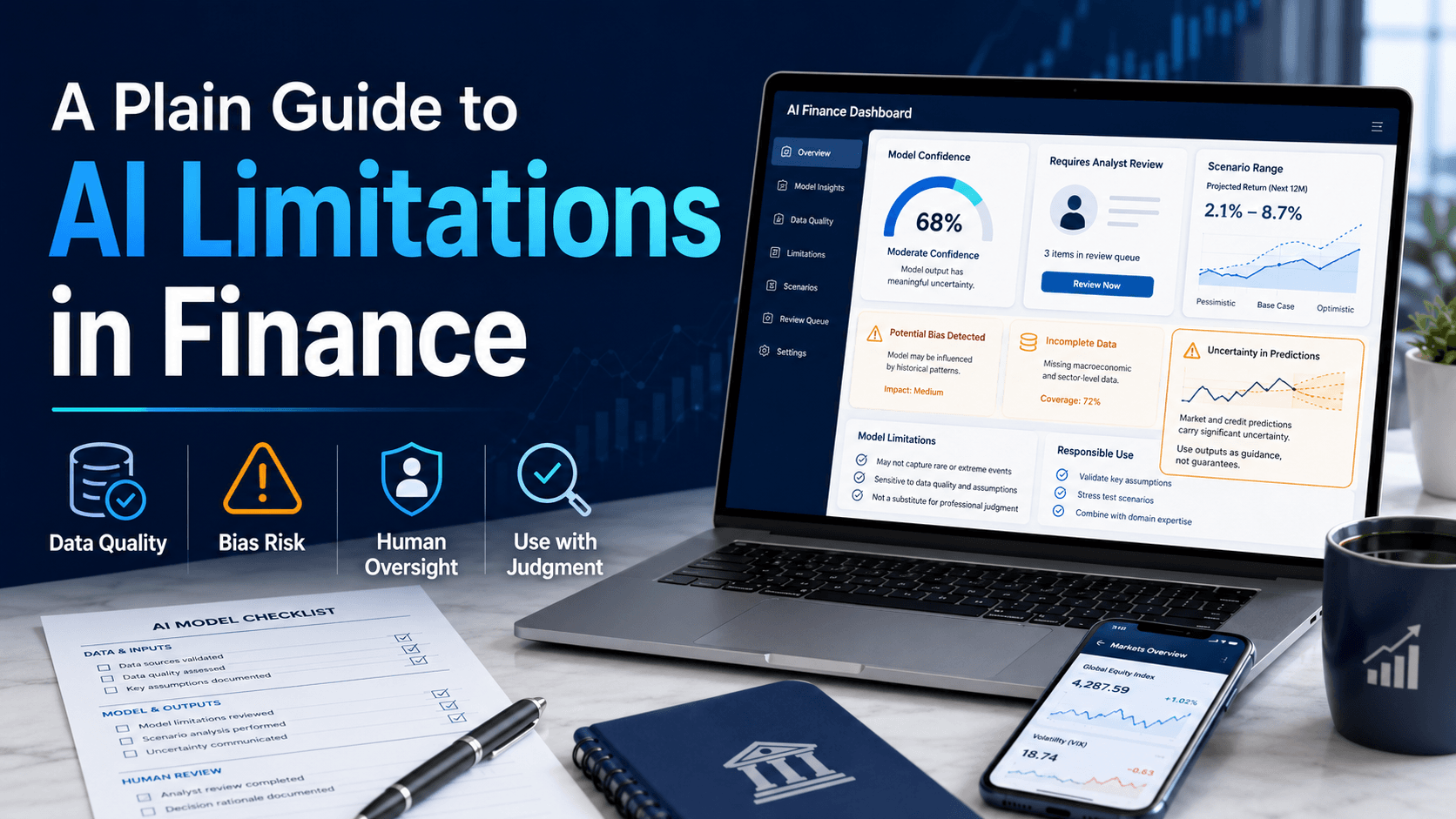
An algorithm optimises for what it can measure, but life is full of things it cannot: a career change you are weighing, a family situation, your real appetite for risk. AI financial planning can crunch the numbers, but it does not understand your life, and it cannot weigh what truly matters to you.
This is the gap that matters most. Numbers can tell you what looks optimal on paper, but only you can weigh how a decision sits with your values, your family, and your tolerance for risk — and those are usually the factors that decide whether a plan is actually right.
It can be confidently wrong
Like any AI tool, these can produce output that looks authoritative but rests on flawed assumptions or bad data. The CFPB has warned that automated financial tools built on these technologies can provide inaccurate information, so a confident projection is not the same as a correct one.
It struggles with the unusual
Models are built on typical patterns, so they handle ordinary situations well and unusual ones poorly. Irregular income, a one-off windfall, or a complex tax position can throw off projections. The further your life sits from the average the model assumes, the more cautious you should be with what AI financial planning tells you.
A good rule is that the more your circumstances differ from a textbook case, the more you should treat the output as a rough sketch. Where the stakes are high and your situation is unusual, that is precisely where a second, human opinion earns its keep.
AI financial planning vs a human planner
This is not really an either-or, but it helps to see how the two compare. Each is strong exactly where the other is weak.
Software wins on cost, speed, availability, and tireless tracking. A human planner wins on judgement, accountability, handling complexity, and the emotional side of money — talking you out of a panic sale, or weighing a decision that has no clean numerical answer. A human can also carry a formal duty to act in your interest, which an app does not.
None of this makes either option the obvious winner. It simply means they are suited to different jobs, and the mistake is expecting software to do the human part, or paying a human to do the part software does for free.
| Strength | AI planning | Human planner |
|---|---|---|
| Cost | Low or free | Higher |
| Availability | Always on | By appointment |
| Judgement on complex life calls | Limited | Strong |
| Tireless tracking | Strong | Limited |
For many people the sensible answer is a blend: let software handle the day-to-day tracking and projections, and bring in a human for the big, irreversible decisions. Our guide to an AI financial advisor versus a human digs deeper into where that line sits.
Is AI financial planning safe?
Safety here has two sides: your data, and the advice itself. Both deserve a clear-eyed look before you connect an app to your financial life.
Your data
These tools often need access to your accounts, which means your financial data sits with a third party. Reputable providers use bank-level encryption and read-only connections, but you should still check how your data is stored, shared, and sold. Treat data practices as a deciding factor, not an afterthought, when choosing a tool.
It is worth reading the privacy policy, however tedious, before connecting anything. Look in particular for whether your data is sold or shared with third parties, since a tool that is free to you may be funding itself by monetising exactly the information you are handing over.
The advice itself
The second risk is relying on output that is wrong or too generic for your situation. Regulators have flagged concerns about how automated financial technologies communicate with consumers; the CFPB’s work on AI chatbots in banking notes they can frustrate users and give unhelpful or inaccurate responses. Treat suggestions as a starting point to check, not gospel.
This guide is educational and general — it is not financial advice, and AI financial planning tools are not a substitute for personalised, professional advice. These tools can be inaccurate, generic, or wrong for your circumstances, and no projection is assured. For decisions that materially affect your money, consider a qualified, regulated financial professional who can review your full situation.
How to use AI financial planning well
The tools are most valuable when you treat them as a capable assistant rather than an oracle. A few habits keep them working for you.
Check the inputs
Because everything rests on the data you feed it, make sure accounts are connected correctly and figures are current. A projection built on stale or incomplete data is worse than no projection, because it looks trustworthy. Garbage in, confident garbage out.
Make a habit of glancing at the underlying figures now and then, not just the headline projection. A quick reality check — does this balance look right, is that goal date plausible — catches most problems long before they lead you to a poor decision.
Treat output as a draft
Use what AI financial planning produces as a well-informed first draft, not a final answer. Sense-check projections against your own knowledge, and be especially wary when a suggestion conflicts with common sense or your particular circumstances. The tool does not know what it does not know.
Keep a human in the loop for big calls
Let the software run the routine tracking, but pause before acting on any large, irreversible decision — a major investment, a pension choice, a property move. Those are exactly the moments where judgement beats computation, and where a second human opinion is worth its cost.
The cost of a one-off professional review is small next to the cost of getting a major, irreversible decision wrong. AI financial planning can prepare the ground and lay out the options, but the final call on the big ones is worth pausing over.
AI financial planning tools
AI financial planning is not a single product but a feature woven through several kinds of app. Knowing the categories helps you pick the right one for the job.
Budgeting apps focus on spending, forecasting, and goal tracking. Robo-advisers focus on investing, building and rebalancing a portfolio toward a goal. Some all-in-one platforms attempt both. Each leans on AI financial planning for the projection-and-nudge layer, but they differ widely in what they actually manage and how much they charge.
It also pays to start narrow rather than handing one tool your entire financial life at once. Trying a single feature first lets you judge whether the projections are sensible and the experience is trustworthy before you rely on it more heavily.
The right choice depends on what you need planned. If it is day-to-day money, a budgeting app fits; if it is long-term investing, a robo-adviser does. Our reviews of AI budgeting apps and AI investing tools compare the leading options so you can match a tool to your actual goal rather than the loudest marketing.
AI financial planning FAQ
What is AI financial planning in simple terms?
It is software that takes your financial information — income, spending, debts, and goals — and builds a forward-looking plan, with projections and suggestions that update over time. It aims to sit between a simple calculator and a human adviser, automating the routine parts of managing money toward your goals.
Is AI financial planning accurate?
It is only as accurate as the data you give it and the assumptions built into the model. For ordinary situations it can be quite useful, but it can also be confidently wrong, especially with unusual circumstances. Treat its projections as informed estimates to sense-check, not assured outcomes.
Can AI replace a financial adviser?
Not fully. AI financial planning handles tracking, projections, and routine nudges well, but it lacks judgement, accountability, and an understanding of your wider life. For complex or high-stakes decisions, a human adviser still adds value. Many people use both, letting each do what it does most reliably.
Is it safe to connect my bank to these tools?
Reputable tools use encryption and read-only connections, but you are still sharing financial data with a third party. Check how each provider stores, shares, and protects your data before connecting an account, and favour established names with clear, transparent privacy practices over obscure new apps.
Does AI financial planning cost money?
It varies. Some budgeting and planning features are free or built into apps you already use, while robo-advisers and premium tools charge a fee, often a small percentage of assets or a monthly subscription. Compare the cost against the value, and remember free tools may monetise your data instead.
What can AI financial planning not do?
It cannot understand your life, weigh decisions that have no clean numerical answer, or take responsibility for outcomes. It struggles with unusual situations and can present flawed output confidently. The judgement, emotional, and accountability sides of money remain firmly human territory.
How do I choose a tool?
Start with what you need planned — spending or investing — then compare options on cost, security, and how well they fit your situation. Read independent reviews rather than marketing, check the data practices, and start with a small or free tier while you judge whether the tool actually helps.
Should I trust its projections?
Trust them as a useful guide, not a promise. Projections rest on assumptions that may not hold, and markets and life are unpredictable. Use them to compare options and spot problems early, but never treat a confident forecast as a certainty you can bank on without your own judgement.
The bottom line on AI financial planning
AI financial planning is a genuinely useful tool for the routine, number-heavy parts of managing money: tracking, projecting, and nudging you toward your goals at low cost and high availability. Its weaknesses are equally real — no judgement, occasional confident errors, and trouble with the unusual. Used as a capable assistant whose work you check, rather than an oracle you obey, it earns its place in a modern approach to money without replacing the human judgement that the biggest decisions still demand.
Think of it as raising the floor, not the ceiling. It makes competent, organised money management available to almost anyone, which is a real gain — but the ceiling, the genuinely wise decisions, still rests on judgement that no model yet supplies.
AI financial planning uses software to turn your financial data into projections and nudges toward your goals. It excels at tireless tracking, instant scenarios, and low-cost availability, but lacks judgement, can be confidently wrong, and struggles with unusual situations. Check its inputs, treat its output as a draft, protect your data, and keep a human in the loop for big, irreversible decisions.
If you take one thing from this guide, let it be that AI financial planning is an assistant, not an authority. For the wider picture, read our AI in personal finance guide, and our guides on whether AI financial tools are safe and how an AI advisor compares with a human. Last reviewed: June 2026.
Continue exploring Ladabo
Pick what’s most useful for you next
Educational content only. This AI financial planning guide is general education, not personalised financial advice. AI tools can be inaccurate or unsuited to your circumstances, and no projection is assured. Ladabo may earn commissions when you sign up to tools via our affiliate links, but our guidance reflects research and established principles, not commission rates. For decisions specific to your circumstances, consult a qualified financial professional. Review methodology · Full disclosure.