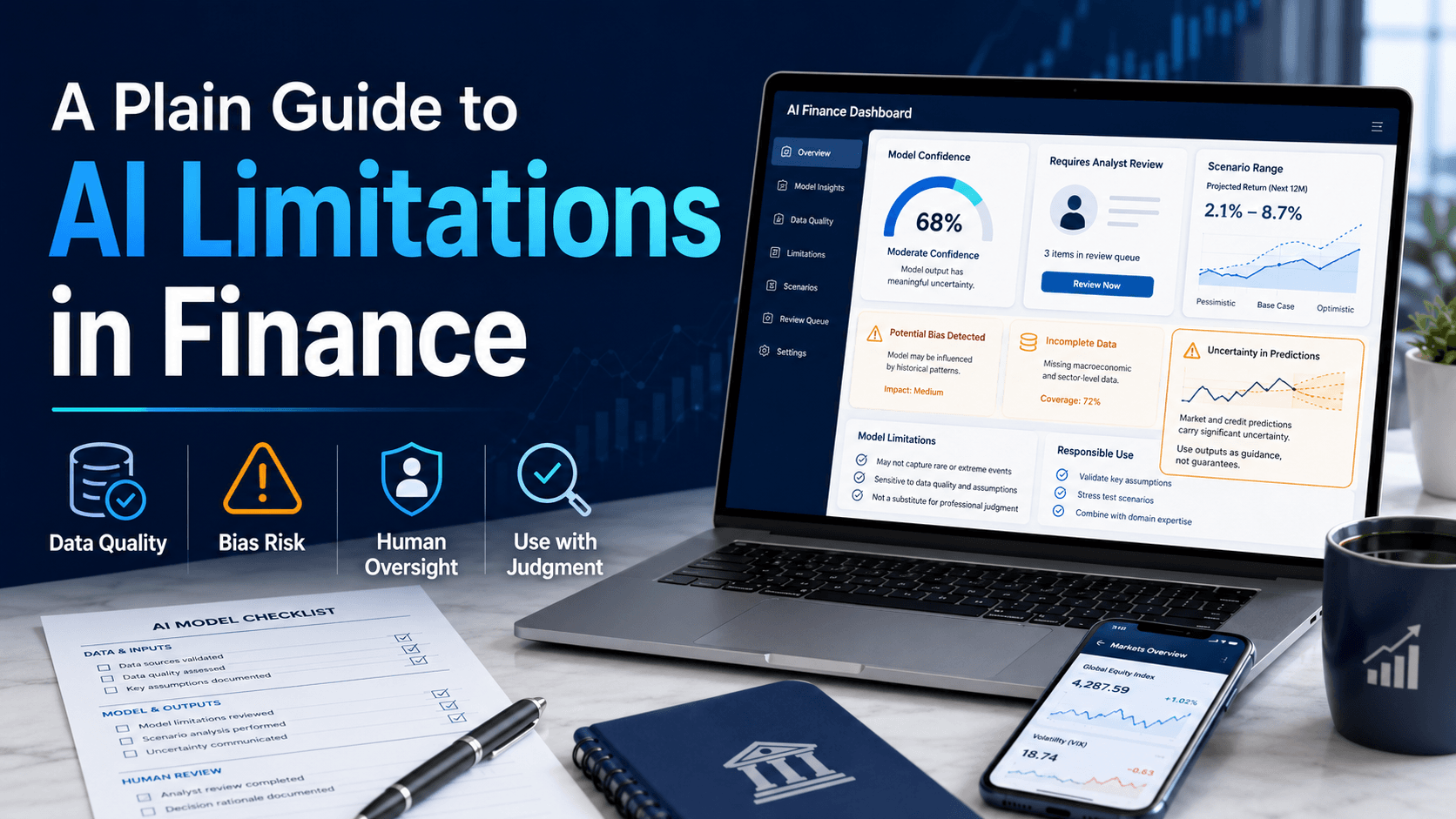
A Plain Guide to AI Limitations in Finance
Artificial intelligence is powerful, but it is far from perfect. This plain-English guide explains the AI limitations that matter most when it comes to your money.
Artificial intelligence has arrived in personal finance with remarkable speed, promising to budget, advise, detect fraud, prepare taxes, and more. Used well, these tools can genuinely help. But there is a quieter, equally important story: AI is not magic, and it has real limitations that matter enormously when your money is involved. Understanding these AI limitations is not about dismissing the technology; it is about using it wisely, knowing what to trust, what to check, and when to turn to a human instead. This guide pulls together the key AI limitations that everyone using these tools in finance should understand.
This guide explains AI limitations in plain, general terms. It covers why AI can be wrong, the limits of its understanding, the problems of bias and fairness, the privacy and data concerns, and how to work with these limitations sensibly. The aim is balanced understanding, not financial advice; the goal is to help you get the benefits of these tools while protecting yourself from their very real shortcomings.
- What AI limitations means in finance
- Why AI can be wrong
- The limits of AI’s understanding
- Bias and fairness problems
- Privacy and data concerns
- How to work with these limitations sensibly
What AI limitations means in finance
AI limitations refers to the inherent shortcomings of artificial intelligence: the things it cannot do well, the ways it can fail, and the reasons it should not be trusted blindly. In finance, where the stakes are high and mistakes can be costly, understanding these AI limitations is essential to using the technology safely rather than naively.
The central point is that AI, however impressive, is a tool with real boundaries. It is not all-knowing, not infallible, and not a substitute for human judgement in the ways that matter most. Recognising AI limitations is what separates someone who uses these tools wisely from someone who hands over trust they have not earned.
Powerful but not perfect
It is worth holding two ideas at once: AI can be genuinely useful, and AI has serious limitations. These are not contradictory. The same tool that saves you time on a routine task can also be confidently wrong about something important, which is why appreciating AI limitations is part of using the technology well, not a reason to reject it.
Why this matters with money
AI limitations matter everywhere, but they matter especially with money, because financial mistakes can be expensive, hard to reverse, and stressful. A wrong answer about a trivia question is harmless; a wrong answer that shapes a financial decision is not. This raised stake is why caution around AI limitations is so important in finance specifically.
Why AI can be wrong
One of the most important AI limitations to grasp is simply that AI can be wrong, sometimes confidently and convincingly so. Understanding why helps you stay appropriately sceptical of what these tools tell you.
It can produce false information
A well-known limitation is that AI can generate information that is plainly incorrect, yet present it with complete confidence. Because the output looks authoritative and fluent, errors are easy to accept without question. In finance, acting on confidently wrong information can lead directly to poor decisions, which is why verification matters.
GUIDE AI in Personal Finance A broader look at how AI is being used across personal finance.It depends on its data
AI is only as good as the data it learned from, and another of the key AI limitations is that flawed, incomplete, or out-of-date data produces flawed output. If the information behind a tool is wrong or no longer current, its answers can be wrong too, often in ways that are hard for a user to detect.
It can be confidently mistaken
Perhaps the most dangerous of these AI limitations is the combination of confidence and error: AI does not signal uncertainty the way a careful human expert might. It can deliver a wrong answer in exactly the same assured tone as a right one, which makes it easy to be misled if you are not actively checking.
This guide is general educational content, not financial, legal, or technical advice. The whole point of this guide is that AI has real limitations: it can be confidently wrong, lack the context of your life, reflect bias, and mishandle sensitive data. AI tools are not a substitute for your own judgement or for a qualified professional, especially for decisions that matter. Always verify important information, never act on AI output blindly, protect your sensitive data, and consult a qualified professional and authoritative sources for anything significant involving your money.
The limits of AI’s understanding
Beyond simple errors, a deeper set of AI limitations concerns what AI genuinely understands, which is far less than it can appear. This gap matters enormously in finance.
It does not know your situation
A fundamental limitation is that AI does not truly know you, your circumstances, your goals, your fears, or the full context of your life. It works from the information it is given and general patterns, so it can easily misjudge what is right for you specifically, however confident its general-purpose answer sounds.
It lacks real judgement
Among the most important AI limitations is the absence of genuine judgement and wisdom. AI can process information and follow patterns, but it does not weigh values, exercise common sense, or understand consequences the way a thoughtful human does. For nuanced financial decisions, this missing judgement is a serious shortcoming.
GUIDE AI Financial Tools Understanding what these tools are helps you see where their limits lie.It struggles with the unusual
AI tends to handle common, well-represented situations better than rare or unusual ones. One of the practical AI limitations is that the more your circumstances depart from the ordinary, the less reliable a general tool becomes. Unusual situations are precisely where human expertise tends to matter most and where AI is least dependable.
It cannot take responsibility
A subtle but crucial limitation is that AI cannot be accountable for its mistakes. If an AI tool steers you wrong, it bears no consequences, you do. This asymmetry is one of the most important AI limitations to internalise, because it means the ultimate responsibility for any decision always rests with you, never with the tool.
This is why treating AI output as a starting point rather than a final verdict is so important. A human adviser can be questioned, held to account, and expected to stand behind their guidance; a tool simply produces an answer and moves on. Keeping that difference in mind helps you give AI’s confident-sounding output exactly as much weight as it deserves, and no more.
It does not understand meaning the way people do
A deeper point underlying many AI limitations is that these systems work by recognising and reproducing patterns, not by understanding meaning the way a person does. They can produce text that reads as though it grasps your situation, while having no genuine comprehension of what any of it means for your actual life.
This matters because it explains why AI can sound so convincing and still be hollow underneath. The fluency is real; the understanding is not. Bearing this in mind helps explain several of the AI limitations already discussed, the confident errors, the missing judgement, the blindness to your particular circumstances, all of which flow from a system that processes patterns rather than truly understanding the money, the stakes, or the person in front of it.
Bias and fairness: deeper AI limitations
Some of the most troubling AI limitations involve bias and fairness, issues that can have real consequences for people’s financial lives, often invisibly.
Bias hidden in the data
Because AI learns from data, it can absorb and repeat biases present in that data. One of the more insidious AI limitations is that a system can produce unfair outcomes, disadvantaging certain groups, without anyone intending it, simply because the patterns it learned reflected past unfairness. The bias hides in the data rather than in any obvious rule.
It can be hard to detect
A particular danger of these AI limitations is that bias and errors can be difficult to spot, both for users and sometimes even for those who build the systems. When a process is opaque, an unfair or wrong outcome may simply look like a neutral decision, which makes these problems hard to challenge or correct.
GUIDE Financial Data Privacy Bias and privacy are closely linked among the limitations of AI in finance.Why oversight matters
Because of these fairness-related AI limitations, there is wide agreement that AI in finance needs oversight, testing, and appropriate regulation. As an individual, knowing that bias is a real possibility means you can stay alert to outcomes that seem unfair and question them, rather than assuming a machine’s decision must be objective and correct.
Privacy and data: more AI limitations
Another important category of AI limitations concerns privacy and data, because using AI in finance often means sharing sensitive information. This creates real risks worth weighing.
It depends on your data
Many AI financial tools need access to sensitive personal and financial information to work, and this dependence is itself one of the practical AI limitations. The benefit of the tool comes bundled with the exposure of your data, a trade-off that should be made consciously rather than by default.
Data can be misused or breached
Whenever sensitive data is shared, there is a risk it could be misused, shared further, or exposed in a breach. These data-related AI limitations mean that the convenience of a tool always carries some privacy cost, and that understanding how a tool handles your information is an important part of using it responsibly.
You should stay in control
A sensible response to these AI limitations is to stay deliberate about your data: sharing only what is needed, favouring tools that are transparent and careful, and remembering that sensitive financial information deserves protection. Convenience is valuable, but not at the cost of carelessly exposing the most private details of your financial life.
The limits of any single safeguard
It is also worth recognising that no single safeguard fully removes these data-related AI limitations. Even a careful, reputable tool cannot promise that data will never be exposed, because breaches and misuse can happen anywhere that sensitive information is held. Reducing risk is realistic; eliminating it entirely is not, and it is healthier to plan around that reality than to assume any tool is perfectly safe.
The practical conclusion is one of proportion: share sensitive financial data only where the benefit genuinely justifies the exposure, keep an eye on what you have connected, and treat any promise of total security with mild scepticism. Acknowledging these AI limitations around data is not about fear, but about making deliberate, informed choices rather than assuming the question has been settled on your behalf.
Working with AI limitations sensibly
Understanding AI limitations is only useful if it changes how you act. The good news is that a handful of sensible habits let you enjoy the benefits of these tools while guarding against their shortcomings.
Verify what matters
The single most valuable habit in light of AI limitations is to verify important information rather than trusting it blindly. For anything that affects your money in a meaningful way, check AI output against authoritative sources or a qualified professional before acting. Treat what a tool tells you as a starting point, not a final answer.
Keep humans in the loop
Because of the AI limitations around judgement and context, keeping a human in the loop, often yourself, and a professional for big decisions, is essential. AI can inform and assist, but the meaningful decisions, and the responsibility for them, should remain with people who can exercise real judgement and be accountable.
Use AI for what it is good at
The smartest approach to AI limitations is to use these tools for what they genuinely do well, organising, summarising, automating routine tasks, while being cautious about leaning on them for judgement, prediction, or advice that requires real understanding of your situation. Matching the tool to the task respects its strengths and its limits.
Stay sceptical and informed
Finally, a healthy scepticism is your strongest protection against AI limitations. Be wary of confident-sounding output, bold claims, and anything that seems too good to be true, and keep learning enough to ask good questions. An informed, slightly sceptical user gets the benefits of AI while avoiding most of the traps its limitations create.
None of this requires technical expertise, only a mindset: that AI is a helpful but fallible tool, not an oracle. People who hold that mindset tend to use these tools to genuine advantage, letting them handle the routine and the tedious while reserving real decisions for human judgement. People who forget it, and trust AI uncritically with important matters, are the ones most likely to be let down by exactly the limitations this guide has described.
Frequently asked questions
What are AI limitations in simple terms?
AI limitations are the inherent shortcomings of artificial intelligence: the things it cannot do well, the ways it can fail, and the reasons it should not be trusted blindly. In finance these include being confidently wrong, lacking the context of your life and real judgement, reflecting bias, and depending on sensitive data. Understanding them is what lets you use AI tools safely rather than naively.
Why can AI be confidently wrong?
AI can generate incorrect information yet present it in the same fluent, assured tone as correct information, without signalling uncertainty the way a careful human expert might. Its answers also depend entirely on the data it learned from, so flawed or out-of-date data produces flawed output. This combination of confidence and error is one of the most important AI limitations to keep in mind.
Can AI understand my personal financial situation?
Not fully. A fundamental limitation is that AI does not truly know you, your goals, fears, or full circumstances. It works from the information it is given and general patterns, so it can misjudge what is right for you specifically. It also lacks genuine judgement and struggles with unusual situations, which is exactly where personal context and human expertise matter most.
Is AI biased?
It can be. Because AI learns from data, it can absorb and repeat biases in that data, producing unfair outcomes without anyone intending it. These biases can be hard to detect, especially when a system is opaque, which makes them difficult to challenge. This is why oversight matters, and why staying alert to outcomes that seem unfair, and questioning them, is sensible.
What are the privacy risks of AI in finance?
Many AI financial tools need access to sensitive personal and financial data to work, and whenever such data is shared, there is a risk it could be misused, shared further, or exposed in a breach. The convenience of a tool always carries some privacy cost. Staying deliberate, sharing only what is needed and favouring transparent, careful tools, helps manage these data-related limitations.
How can I use AI safely despite its limitations?
Verify important information against authoritative sources or a professional rather than trusting it blindly; keep humans in the loop for meaningful decisions; use AI for what it does well, like organising and automating routine tasks, while being cautious about judgement and advice; and stay sceptical and informed. These habits let you enjoy the benefits while guarding against the shortcomings.
Should I trust AI for financial decisions?
Not blindly, and not for significant decisions on its own. AI can inform and assist, but it lacks judgement, context, and accountability, and it can be confidently wrong. For meaningful financial decisions, treat AI output as one input to check, keep a human in the loop, and consult a qualified professional. The ultimate responsibility for any decision always rests with you, never the tool.
The bottom line on AI limitations
AI limitations are not a reason to avoid these tools, but a reason to use them wisely. Artificial intelligence in finance can be genuinely helpful, yet it is powerful and imperfect at the same time: it can be confidently wrong, it depends entirely on its data, it lacks true understanding of your situation and real judgement, it can absorb and repeat bias, and it depends on access to sensitive data. None of these shortcomings disappears just because a tool is slick and convincing.
The way to benefit from AI while protecting yourself is to keep its limitations firmly in mind: verify what matters, keep humans in the loop for decisions that count, use AI for the routine tasks it genuinely does well, protect your data, and stay sceptical of confident-sounding output. Above all, remember that AI cannot take responsibility for its mistakes, you can, so the final judgement on anything important must always remain yours, supported by authoritative sources and a qualified professional. Held in that balanced way, AI becomes a useful assistant rather than a risky crutch.
This sits alongside the rest of our coverage in the AI in personal finance guide. For a neutral, broader reference on finance concepts, Investopedia is a useful starting point, but for any decision that affects your own money, a qualified professional and authoritative sources are what count.
AI limitations are a reason to use these tools wisely, not avoid them. AI in finance is powerful but imperfect: it can be confidently wrong, lacks your context and real judgement, can be biased, and depends on sensitive data. Verify what matters, keep humans in the loop, use AI for routine tasks, protect your data, and stay sceptical, since responsibility always rests with you.
Educational content only, not financial advice. Ladabo publishes research-based guides to help you understand AI limitations and make your own informed decisions; we do not provide individual financial, legal, or technical advice. AI tools can be confidently wrong, biased, and limited, and they do not remove your own responsibility. Read our review methodology and disclaimer for how this content is produced and its limits.
Last reviewed: June 2026