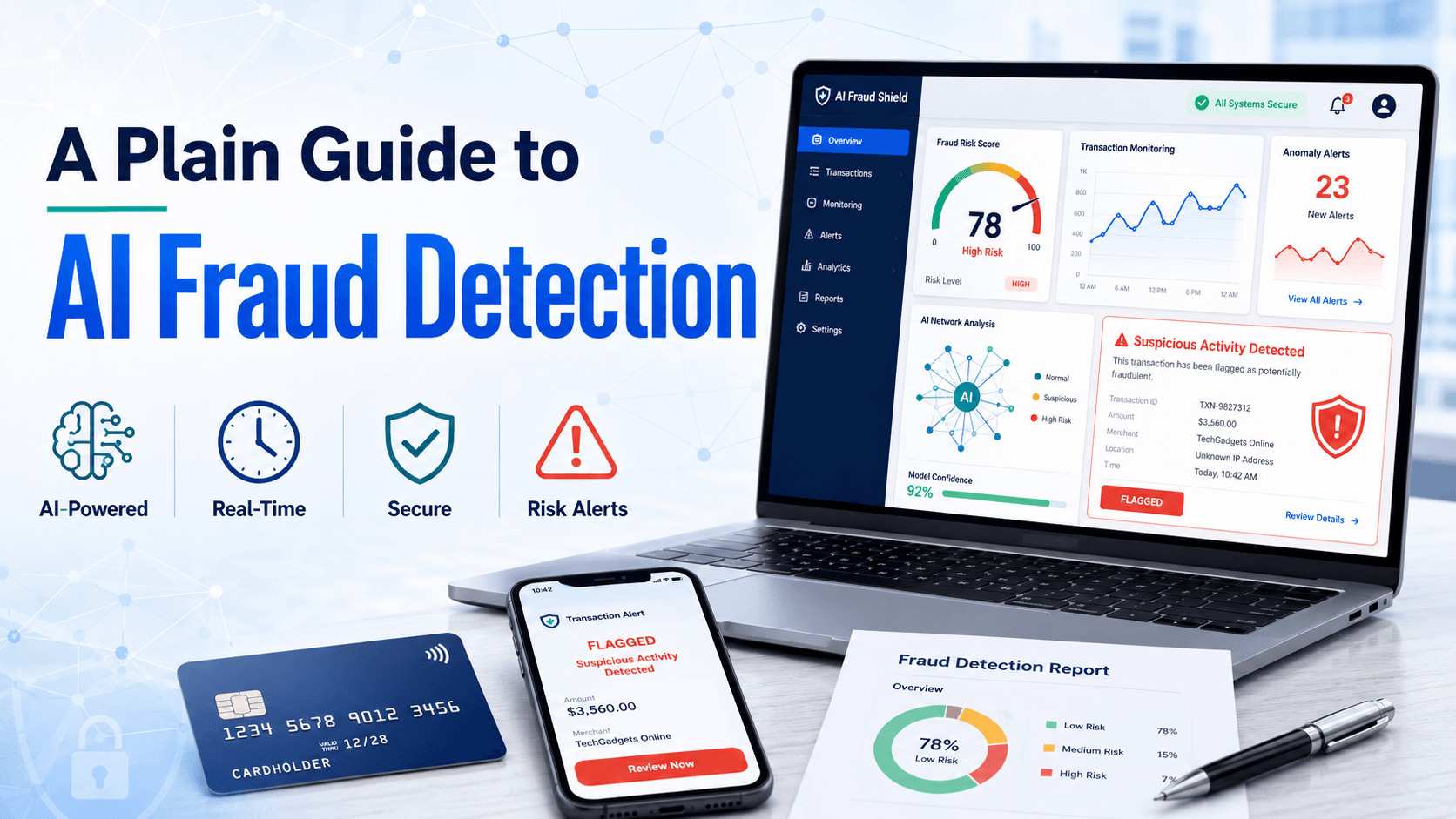
A Plain Guide to AI Fraud Detection
Behind the scenes, artificial intelligence quietly watches over financial transactions for signs of fraud. This plain-English guide explains AI fraud detection and what it means for you.
Every time you tap a card, transfer money, or log in to a financial account, systems are quietly checking whether the activity looks genuine or suspicious. Increasingly, that checking is done by artificial intelligence, working invisibly to spot the patterns that signal fraud. AI fraud detection has become one of the most widespread and useful applications of the technology in finance, helping protect people and institutions from theft. But it is not perfect, and understanding how it works, what it does well, and where it falls short helps you make sense of moments like a card being unexpectedly declined.
This guide explains AI fraud detection in plain, general terms. It covers what it is, how it works, where it is used, its real benefits, its limitations, and what it means for you as someone whose transactions are being watched over. The aim is balanced understanding, not technical or security advice, and the goal is to demystify a system that quietly shapes everyday financial life for almost everyone.
- What AI fraud detection is
- How it works
- Where it is used
- Its real benefits
- Its limitations
- What it means for you
What AI fraud detection is
AI fraud detection is the use of artificial intelligence to identify potentially fraudulent activity in financial transactions and accounts. Instead of relying only on fixed rules or human review, these systems analyse activity and flag anything that looks suspicious, aiming to catch fraud quickly, often before it can cause serious harm.
The basic idea behind AI fraud detection is pattern recognition. By learning what normal activity looks like and what fraud tends to look like, the system can spot transactions that do not fit, an unusual purchase, an odd login, a pattern that resembles known scams. This watchful, automated layer now sits behind much of modern finance.
A quiet, constant guardian
Most of the time, AI fraud detection works invisibly, approving the vast majority of genuine activity without you ever noticing. You only become aware of it when something is flagged, a declined transaction or a verification request. This invisibility is a sign it is working smoothly, not a reason to forget it is there.
More than simple rules
Older fraud checks often used simple, fixed rules, such as flagging any transaction above a set size. AI fraud detection goes further, learning subtler patterns and adapting over time, which lets it catch more sophisticated fraud that rigid rules would miss. This flexibility is much of what makes it powerful.
How AI fraud detection works
Understanding roughly how AI fraud detection works helps make sense of why it sometimes flags genuine activity, and why it is so useful. The broad approach is consistent even where the details are kept secret to stay ahead of fraudsters.
Learning what is normal
A core part of AI fraud detection is learning what normal behaviour looks like, for transactions generally and sometimes for you specifically. By understanding your usual patterns, where you shop, how much you spend, when you log in, the system can recognise when something departs from them in a way that might signal fraud.
GUIDE Financial Data Privacy AI fraud detection relies on your data, which raises privacy questions worth understanding.Spotting anomalies and known patterns
AI fraud detection then watches for two broad signals: activity that is anomalous, departing from the normal pattern, and activity that matches the known shapes of fraud. A transaction in an unexpected place, a sudden flurry of activity, or behaviour resembling past scams can all trigger a closer look.
Scoring and acting on risk
When AI fraud detection spots something suspicious, it typically assigns a level of risk and acts accordingly, perhaps approving, declining, or pausing a transaction for verification. Higher-risk activity may be blocked or challenged, while borderline cases might prompt a quick check, such as a confirmation message, before proceeding.
This guide is general educational content, not security, financial, or legal advice. AI fraud detection is helpful but imperfect: it can wrongly flag genuine activity (a “false positive”), miss some real fraud, and behave in ways that are not transparent to you. It does not remove your own responsibility to protect your accounts and stay alert to scams. How these systems work and what protections you have vary by institution and country. If you are affected by fraud or a flagged transaction, contact your bank or provider directly through official channels, and rely on their guidance rather than the general principles described here.
Where AI fraud detection is used
AI fraud detection has spread across much of the financial world, working behind the scenes in many of the services people use daily. Knowing where it operates shows just how pervasive it has become.
Card and payment transactions
One of the most familiar uses is in card and payment systems, where AI fraud detection assesses transactions in real time to catch unauthorised use. This is why a card might be declined or queried when used in an unusual way, the system is protecting against possible theft, even if the activity is genuine.
Banking and account security
Banks use AI fraud detection to monitor accounts for suspicious activity, such as unusual transfers or logins from unexpected places. This helps catch account takeovers and other fraud, adding a layer of protection beyond passwords, and is part of why unfamiliar activity can trigger alerts or verification requests.
GUIDE AI Financial Tools Fraud detection is one of several ways AI now works inside financial services.Across the wider financial system
Beyond cards and banking, AI fraud detection appears in many other corners of finance, from online services to applications for credit and beyond. Wherever money moves and fraud is a risk, this kind of automated monitoring has increasingly been adopted, making it one of the most widespread uses of AI in the whole financial system.
An arms race with fraudsters
One reason AI fraud detection keeps spreading is that fraud itself never stands still. As defences improve, those committing fraud adapt their methods to slip past them, which in turn pushes the detection systems to keep learning and evolving. The result is a continual back-and-forth, with each side responding to the other.
This dynamic helps explain why these systems are rarely “finished.” A detection approach that works well today may be less effective in a year as tactics shift, so providers update and retrain them constantly. For you, the practical implication is simply that AI fraud detection is a moving target on both sides, and no system, however current, can be assumed to be permanently ahead of every new trick.
The benefits of AI fraud detection
The reason AI fraud detection has been so widely adopted is that its benefits are real and substantial. Understanding them shows why, despite its flaws, it has become so central to financial security.
Speed and scale
A major strength of AI fraud detection is its ability to assess enormous numbers of transactions almost instantly. Fraud often needs to be caught in the moment, and no human team could review activity at the speed and scale these systems manage, which is why automation has become essential to modern fraud prevention.
Catching sophisticated fraud
Because it can learn subtle and evolving patterns, AI fraud detection can catch sophisticated fraud that simple rules would miss. As fraudsters change tactics, adaptable systems have a better chance of keeping up than rigid checks, which is increasingly important as scams grow more cunning and varied.
Protecting people and money
Ultimately, the benefit of AI fraud detection is protection: stopping theft before it succeeds, limiting losses, and sparing people the distress and disruption of fraud. For all its imperfections, this quiet shield prevents a great deal of harm that would otherwise fall on ordinary people and the institutions that serve them.
Reducing friction for genuine activity
A less obvious benefit of good AI fraud detection is that, when it works well, it actually makes legitimate activity smoother, not just safer. By confidently recognising genuine transactions as genuine, a well-tuned system can wave them through without unnecessary checks, reserving its interventions for the cases that truly warrant a second look.
This matters because the alternative, heavy-handed blanket rules, tends to inconvenience honest customers far more often. The aim of sophisticated AI fraud detection is to strike a better balance: catching more real fraud while bothering genuine users less. It does not always achieve that balance perfectly, as the experience of an unexpected decline shows, but the underlying goal is fewer false alarms alongside stronger protection.
The limitations of AI fraud detection
For all its value, AI fraud detection is far from perfect, and its limitations have real effects on people’s lives. Understanding them explains some frustrating experiences and keeps expectations realistic.
False positives
The most familiar limitation of AI fraud detection is the “false positive”: flagging genuine activity as suspicious. A declined card on holiday or a blocked legitimate purchase is the system being cautious, but it can be inconvenient or even distressing. Reducing false positives without missing real fraud is a constant balancing act.
Missing some real fraud
Just as it can flag genuine activity, AI fraud detection can also miss some real fraud, especially new tactics it has not learned. No system catches everything, which is why these tools reduce fraud rather than eliminate it, and why your own vigilance remains an essential part of staying safe.
GUIDE AI in Personal Finance Fraud detection is one part of the wider role AI now plays in personal finance.Opacity and inconvenience
AI fraud detection can also be opaque: when activity is flagged, the reason is often not explained, which can be frustrating when a genuine transaction is blocked. The inconvenience of resolving a false alarm, calling to verify, having a card reissued, is a real cost, even when the system is ultimately doing its job.
It does not replace your own care
Perhaps the most important limitation to understand is that AI fraud detection, however capable, does not remove your own responsibility to stay alert. These systems are a powerful safety net, but they are not a guarantee, and treating them as one can lead to dangerous complacency about your own security habits.
Plenty of fraud succeeds not by defeating the technology but by tricking the account holder directly, through scams that persuade people to authorise payments or hand over details themselves. No fraud detection system can fully protect someone who has been manipulated into approving a transaction. Your own caution, scepticism, and good security habits remain the front line, with AI fraud detection as a valuable backup rather than a replacement.
What AI fraud detection means for you
Beyond the theory, AI fraud detection has practical implications for everyday financial life. A few points help you work with it rather than being surprised by it.
Why your card sometimes gets declined
If a card is declined or a transaction queried despite being genuine, AI fraud detection is very often the reason: the activity looked unusual and the system erred on the side of caution. Understanding this makes such moments less baffling, and knowing a quick verification usually resolves them takes some of the sting out.
Helping the system help you
You can sometimes reduce false alarms by keeping your provider informed, for example about travel, and by responding promptly to genuine verification requests. Working with AI fraud detection in this way helps it protect you with less friction, though you should always be sure that a request really comes from your provider.
Staying alert to scams
Because AI fraud detection cannot catch everything, and because much fraud works by deceiving people directly, your own vigilance is vital. Being sceptical of unexpected requests, never sharing security details, and verifying through official channels protect you in ways no automated system can, complementing the technology rather than relying on it.
Beware fake fraud alerts
A cruel irony worth knowing is that scammers often impersonate the very fraud-prevention systems meant to protect you, sending fake alerts or calls claiming to be your bank’s security team. These messages try to panic you into handing over details or moving money “to keep it safe,” which is itself the fraud.
The safe habit is never to act on an unexpected fraud alert by clicking a link, calling a number it provides, or following its instructions directly. Instead, contact your bank or provider independently, through the number on your card or their official app or website, and confirm whether the alert was genuine. Real institutions will not mind you checking, and this simple discipline defeats one of the most common ways people are tricked, even with capable AI fraud detection running in the background.
Frequently asked questions
What is AI fraud detection in simple terms?
AI fraud detection is the use of artificial intelligence to spot potentially fraudulent activity in financial transactions and accounts. Instead of relying only on fixed rules or human review, it learns what normal activity looks like and what fraud tends to look like, then flags anything suspicious, aiming to catch theft quickly, often before it can cause serious harm. It works quietly behind much of modern finance.
How does AI fraud detection work?
It learns what normal behaviour looks like, sometimes for you specifically, then watches for two signals: activity that departs from that normal pattern, and activity matching the known shapes of fraud. When it spots something suspicious, it assigns a level of risk and acts, perhaps approving, declining, or pausing a transaction for verification. The exact methods are often kept secret to stay ahead of fraudsters.
Why was my card declined when the purchase was genuine?
Very often the reason is AI fraud detection: the activity looked unusual, so the system erred on the side of caution and flagged or blocked it. This is called a “false positive,” genuine activity wrongly treated as suspicious. It can be inconvenient, but it reflects the system protecting you, and a quick verification with your provider usually resolves it.
Where is AI fraud detection used?
It is widespread across finance. Familiar uses include card and payment systems, where transactions are assessed in real time, and banking, where accounts are monitored for suspicious transfers or logins. It also appears in online services, credit applications, and many other corners of the financial system. Wherever money moves and fraud is a risk, this kind of automated monitoring has increasingly been adopted.
Can AI fraud detection stop all fraud?
No. It significantly reduces fraud but does not eliminate it. It can miss new tactics it has not learned, and much fraud succeeds by tricking the account holder directly into authorising payments or sharing details, which no detection system can fully prevent. It is a powerful safety net, not a guarantee, so your own vigilance remains an essential part of staying safe.
Is AI fraud detection always right?
No. It can produce false positives, flagging genuine activity as suspicious, and it can miss some real fraud. It can also be opaque, blocking a transaction without explaining why, which is frustrating when the activity was legitimate. These limitations are why resolving the occasional false alarm, and staying alert yourself, remain part of the picture even with capable systems running.
How can I avoid being tricked by fake fraud alerts?
Never act on an unexpected fraud alert by clicking its link, calling a number it provides, or following its instructions. Scammers impersonate banks’ security teams to panic you into handing over details or moving money. Instead, contact your bank independently using the number on your card or their official app, and confirm whether the alert was real. Genuine institutions will not mind you checking.
The bottom line on AI fraud detection
AI fraud detection is one of the most widespread and genuinely useful applications of artificial intelligence in finance. By learning what normal activity looks like and recognising the patterns of fraud, it watches over card payments, bank accounts, and much of the wider financial system, assessing vast numbers of transactions almost instantly and catching sophisticated theft that simple rules would miss. Most of the time it works invisibly, quietly protecting people and money from a great deal of harm.
But it is not perfect. It produces false positives that block genuine activity, it can miss new forms of fraud, it is often opaque about why it acts, and, crucially, it cannot protect someone who has been manipulated into authorising fraud themselves. The sensible view is to appreciate AI fraud detection as a powerful safety net while remembering it is not a guarantee: keep your provider informed, respond to genuine checks, stay sceptical of scams and fake alerts, and verify anything suspicious through official channels. Your own vigilance and good habits remain the front line, with the technology as a valuable backup.
This sits alongside the wider context in our financial data privacy guide. For a neutral, broader reference on finance and security concepts, Investopedia is a useful starting point, but for anything involving your own accounts or a suspected fraud, your bank or provider, contacted through official channels, is the source that counts.
AI fraud detection uses AI to spot suspicious financial activity, watching over cards, accounts, and much of finance at huge speed and scale. It is powerful but imperfect: it produces false positives, misses some fraud, is often opaque, and cannot stop scams that trick you directly. Treat it as a safety net, not a guarantee, and stay vigilant, verifying anything suspicious through official channels.
Educational content only, not security or financial advice. Ladabo publishes research-based guides to help you understand AI fraud detection and make your own informed decisions; we do not provide individual security, financial, or legal advice. AI systems are imperfect and do not remove your own responsibility to stay alert. Read our review methodology and disclaimer for how this content is produced and its limits.
Last reviewed: June 2026