
How Much Can You Borrow in Australia — Complete Borrowing Power Guide
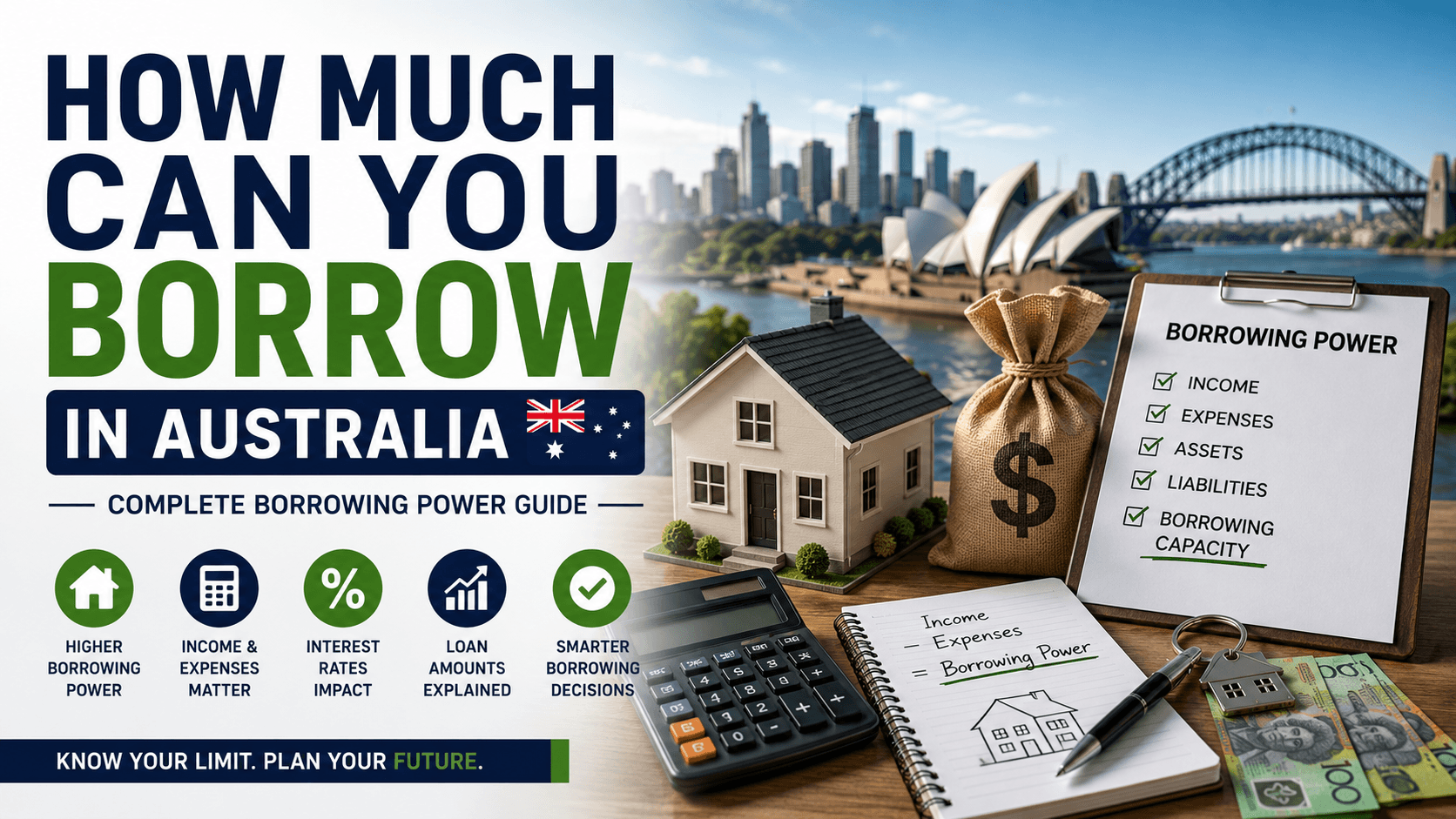
How much can you borrow in Australia? It is the most important question to answer before applying for any loan. Whether you are looking at a home loan, personal loan or car loan, how much you can borrow in Australia depends on your income, expenses, existing debts, credit score and the lender’s assessment criteria. This complete guide explains exactly how lenders calculate how much you can borrow in Australia — and how to maximise your borrowing power.
⚡ Quick Summary — How Much Can You Borrow in Australia?
- Home loans: How much can you borrow in Australia for a home loan? Typically 4–6x your gross annual income — but the full picture matters more than income alone
- Personal loans: How much can you borrow in Australia for a personal loan? Typically $2,000–$75,000 depending on income, credit score and existing debts
- Car loans: How much can you borrow in Australia for a car loan? Generally $5,000–$150,000 depending on income and the vehicle value
- Key factors: Income, living expenses, existing debts, credit score, employment type and the lender’s assessment buffer all affect how much you can borrow in Australia
- Buffer rate: Lenders must assess how much you can borrow in Australia at 3% above the actual loan rate — this significantly reduces your borrowing power
- Free tool: Use our Borrowing Power Calculator to instantly estimate how much you can borrow in Australia for your specific situation
📋 Table of Contents
- What Affects How Much You Can Borrow in Australia?
- How Much Can You Borrow for a Home Loan in Australia?
- How Much Can You Borrow for a Personal Loan in Australia?
- How Much Can You Borrow for a Car Loan in Australia?
- How Much Can You Borrow in Australia by Income Level?
- The Buffer Rate — How It Reduces How Much You Can Borrow
- How to Increase How Much You Can Borrow in Australia
- Free Borrowing Power Calculators
- Frequently Asked Questions
- Conclusion
What Affects How Much Can You Borrow in Australia?
How much can you borrow in Australia is not a single fixed number — it is a calculation that every lender performs differently based on your unique financial profile. Understanding the key factors that determine how much you can borrow in Australia is the first step to taking control of your borrowing capacity before you apply.
1. Income — The Starting Point for How Much You Can Borrow in Australia
Your gross income is the primary driver of how much you can borrow in Australia. Lenders consider all verifiable income sources — salary, wages, rental income, investment returns, business income and in some cases Centrelink payments. The higher your confirmed income, the more you can borrow in Australia, as more income creates more capacity to service loan repayments each month.
Employment type significantly affects how much you can borrow in Australia. Full-time permanent employees typically have the strongest borrowing power — income is consistent and easily verified. Casual workers, self-employed borrowers and contractors may find their assessed income is lower than their actual earnings, reducing how much they can borrow in Australia versus a permanent employee on the same gross income.
2. Living Expenses — The Biggest Hidden Reducer of How Much You Can Borrow
How much you can borrow in Australia is heavily influenced by your living expenses. Since the Banking Royal Commission reforms, Australian lenders are required to verify living expenses rigorously using bank statement analysis alongside the Household Expenditure Measure (HEM) benchmark. The higher of your declared expenses or the HEM is used — meaning you cannot simply declare low expenses to increase how much you can borrow in Australia. Genuinely reducing discretionary spending in the months before applying is the only reliable way to move this number.
3. Existing Debts — Direct Reducers of How Much You Can Borrow in Australia
Every existing financial commitment reduces how much you can borrow in Australia. Credit card limits — even on cards with zero balance — are assessed at approximately 3% of the total limit per month by most Australian lenders. Car loan repayments, personal loan repayments, HECS-HELP debt and BNPL commitments all reduce your assessed surplus income and directly reduce how much you can borrow in Australia for any new loan application.
4. Credit Score
Your credit score affects both your approval chances and the interest rate you are offered — and a higher rate means higher assessed repayments, which reduces how much you can borrow in Australia at an affordable level. Borrowers with excellent credit scores (750+) access the lowest rates and most favourable assessment terms, maximising how much they can borrow in Australia. See our guide on how to improve your credit score in Australia.
5. The 3% Assessment Buffer Rate
APRA requires all Australian lenders to assess how much you can borrow in Australia at a minimum 3% buffer above the actual loan rate. If the loan rate is 6.25%, lenders test whether you can service repayments at 9.25%. This buffer alone reduces how much you can borrow in Australia by approximately 20%–25% versus what repayments at the actual rate would suggest. We cover this in full detail in the buffer rate section below.
How Much Can You Borrow for a Home Loan in Australia?
How much can you borrow for a home loan in Australia? As a general guide, most Australian lenders will allow you to borrow approximately 4–6 times your gross annual income — but this is a rough rule of thumb only. The actual figure lenders will approve depends on your full financial picture. Use our free Borrowing Power Calculator to find out exactly how much you can borrow in Australia for a home loan.
Home Loan Borrowing Estimates by Income in Australia
The table below shows estimated maximum home loan borrowing amounts in Australia at different income levels — assuming standard living expenses, no existing debts, a 6.25% loan rate and 30-year term. How much you can borrow in Australia for a home loan will vary significantly based on your individual financial profile.
| Gross Annual Income | Max Borrowing — No Debts | Max Borrowing — $10k CC Limit | Monthly Repayment at Max |
|---|---|---|---|
| $60,000 | ~$320,000 | ~$270,000 | ~$1,970 |
| $80,000 | ~$440,000 | ~$390,000 | ~$2,710 |
| $100,000 | ~$560,000 | ~$510,000 | ~$3,450 |
| $120,000 | ~$680,000 | ~$630,000 | ~$4,190 |
| $150,000 | ~$860,000 | ~$810,000 | ~$5,300 |
| $200,000 | ~$1,170,000 | ~$1,100,000 | ~$7,200 |
| $150,000 combined | ~$860,000 | ~$780,000 | ~$5,300 |
| $200,000 combined | ~$1,170,000 | ~$1,060,000 | ~$7,200 |
Estimates only. Based on standard living expenses, no dependants, 6.25% rate + 3% buffer, 30-year term. How much you can borrow in Australia will vary by lender and circumstances.
What Reduces How Much You Can Borrow for a Home Loan in Australia
- Credit card limits: A $10,000 credit card limit reduces how much you can borrow in Australia for a home loan by approximately $50,000–$70,000 — even if the card has a zero balance
- Personal loan repayments: A $500/month personal loan repayment reduces how much you can borrow in Australia by approximately $80,000–$100,000
- HECS-HELP obligations: Repayment obligations reduce assessed surplus income and therefore how much you can borrow in Australia for a home loan
- Dependants: Each dependant increases assessed living expenses and reduces how much you can borrow in Australia
- Car loan repayments: Every committed monthly debt obligation reduces how much you can borrow in Australia
How Much Can You Borrow for a Personal Loan in Australia?
How much can you borrow for a personal loan in Australia? Most Australians can borrow between $2,000 and $75,000 for a personal loan — with the specific amount depending on income, credit score, existing debts and the lender. Understanding exactly how much you can borrow in Australia for a personal loan helps you apply for the right amount with the right lender.
Personal Loan Borrowing Limits by Income in Australia
| Gross Annual Income | How Much You Can Borrow — Good Credit | How Much You Can Borrow — Average Credit | Max Term |
|---|---|---|---|
| $40,000–$60,000 | $15,000–$25,000 | $5,000–$15,000 | 5 years |
| $60,000–$80,000 | $25,000–$40,000 | $10,000–$25,000 | 7 years |
| $80,000–$100,000 | $40,000–$60,000 | $20,000–$40,000 | 7 years |
| $100,000+ | Up to $75,000 | $30,000–$50,000 | 7 years |
Estimates only. How much you can borrow in Australia for a personal loan varies significantly by lender, credit profile and existing financial commitments.
How much you can borrow in Australia for a personal loan is primarily driven by your net income after tax and existing commitments — and the lender’s maximum debt-to-income ratio. Most personal loan lenders in Australia require total monthly repayments not exceed 30%–35% of net monthly income. Use our Personal Loan Calculator to model repayments at different amounts before applying.
How Much Can You Borrow for a Car Loan in Australia?
How much can you borrow for a car loan in Australia? Car loan amounts typically range from $5,000 to $150,000, with the vehicle serving as security. Because car loans are secured against the vehicle, lenders can be somewhat more flexible about how much you can borrow in Australia for car finance than for unsecured personal loans — the asset security reduces their risk.
Car Loan Borrowing Estimates in Australia
| Vehicle Price | Typical Deposit | How Much You Can Borrow in Australia | Monthly Repayment (7%, 5yr) |
|---|---|---|---|
| $20,000 | $0–$2,000 | Up to $20,000 | ~$396 |
| $35,000 | $0–$5,000 | Up to $35,000 | ~$693 |
| $60,000 | $5,000–$10,000 | Up to $55,000 | ~$1,089 |
| $100,000 | $10,000–$20,000 | Up to $90,000 | ~$1,782 |
Estimates only. How much you can borrow in Australia for a car loan also depends on income, credit score and lender policy.
How much you can borrow in Australia for a car loan is also affected by the vehicle’s age. Most lenders will not finance vehicles older than 10–12 years at loan end — meaning a 7-year-old vehicle on a 5-year loan may be restricted. Use our Car Loan Calculator to model repayments at different amounts and terms.
How Much Can You Borrow in Australia by Income Level?
The most common question Australians ask is: how much can you borrow in Australia on my salary? The table below gives a practical quick-reference guide to how much you can borrow in Australia across all major loan types at different income levels — a useful starting point before using our detailed calculators.
| Annual Income | Home Loan — How Much You Can Borrow | Personal Loan — How Much You Can Borrow | Car Loan — How Much You Can Borrow |
|---|---|---|---|
| $50,000 | $250,000–$320,000 | $10,000–$20,000 | $20,000–$30,000 |
| $70,000 | $380,000–$450,000 | $20,000–$35,000 | $30,000–$50,000 |
| $90,000 | $500,000–$580,000 | $30,000–$50,000 | $40,000–$65,000 |
| $120,000 | $670,000–$750,000 | $40,000–$65,000 | $55,000–$80,000 |
| $150,000 | $850,000–$950,000 | $50,000–$75,000 | $70,000–$100,000 |
| $200,000 | $1,100,000–$1,300,000 | Up to $75,000 | Up to $150,000 |
General estimates of how much you can borrow in Australia at each income level. Individual results vary based on expenses, debts, credit score and lender. Use our Borrowing Power Calculator for a personalised figure.
The Buffer Rate — How It Reduces How Much You Can Borrow in Australia
One of the least understood but most important factors in how much you can borrow in Australia is the serviceability buffer rate. APRA requires all Australian lenders to assess how much you can borrow in Australia at a minimum 3% above the actual loan rate — meaning lenders must test your ability to repay at a rate significantly higher than what you will actually pay.
How the Buffer Rate Affects How Much You Can Borrow in Australia
If you apply for a home loan at 6.25% p.a., the lender must assess how much you can borrow in Australia by testing whether you can afford repayments at 9.25% p.a. This single requirement reduces how much you can borrow in Australia by approximately 20%–25% compared to what repayments at the actual rate would suggest.
| Actual Loan Rate | Assessment Rate Used | Reduction in How Much You Can Borrow in Australia |
|---|---|---|
| 5.50% p.a. | 8.50% p.a. | Reduces borrowing capacity by ~20%–25% |
| 6.00% p.a. | 9.00% p.a. | Reduces borrowing capacity by ~20%–25% |
| 6.25% p.a. | 9.25% p.a. | Reduces borrowing capacity by ~20%–25% |
| 6.50% p.a. | 9.50% p.a. | Reduces borrowing capacity by ~20%–25% |
Why the Buffer Rate Limits How Much You Can Borrow in Australia
The buffer rate was introduced after the Banking Royal Commission to protect Australian borrowers from over-extending at current low rates — ensuring that how much you can borrow in Australia leaves capacity to absorb interest rate increases without triggering mortgage stress. This is why many Australians find that how much they can borrow in Australia has decreased as interest rates have risen — the buffer compounds the already significant effect of rate increases on assessed borrowing capacity.
How to Increase How Much You Can Borrow in Australia
1. Cancel or Reduce Unused Credit Cards
This is the single most impactful action to increase how much you can borrow in Australia for a home loan. Every $10,000 of credit card limit reduces how much you can borrow in Australia by approximately $50,000–$70,000 — regardless of whether the card carries a balance. Cancel unused credit cards or reduce their limits to the minimum you actually need well before you apply for any loan in Australia.
2. Pay Down Existing Debts Before Applying
Paying off existing personal loan and car loan balances before applying directly increases how much you can borrow in Australia. Eliminating a $400/month personal loan repayment before applying for a home loan can increase how much you can borrow in Australia by $60,000–$90,000 depending on the lender’s assessment methodology.
3. Increase Your Income
Any verifiable, sustainable income increase directly increases how much you can borrow in Australia. Salary increases, a second income stream, rental income or adding a partner’s income to the application all increase how much you can borrow in Australia. Each additional $10,000 in annual income typically increases how much you can borrow in Australia for a home loan by $50,000–$70,000.
4. Reduce Living Expenses Before Applying
Lenders assess your declared expenses against the HEM benchmark — using the higher figure. Genuinely reducing discretionary spending — subscriptions, dining, entertainment — in the 3–6 months before you apply increases assessed surplus income and therefore how much you can borrow in Australia. Lenders review your recent bank statements, so the reduction must be genuine and maintained.
5. Improve Your Credit Score
A higher credit score improves approval likelihood and the interest rate offered. A lower rate means lower assessed repayments at the buffer rate — directly increasing how much you can borrow in Australia. See our guide on how to improve your credit score in Australia for practical steps to raise your score before applying.
6. Compare Lenders With a Mortgage Broker
How much you can borrow in Australia varies significantly between lenders — each has different assessment models, income shading policies and living expense benchmarks. A mortgage broker can identify which lender’s criteria best suit your specific profile, maximising how much you can borrow in Australia without requiring multiple individual applications. See our guide on mortgage broker vs bank in Australia.
Free Calculators — Find Out How Much You Can Borrow in Australia
Use these free tools to calculate exactly how much you can borrow in Australia for any loan type — and model different scenarios to maximise your borrowing power before you apply.
Borrowing Power Calculator
Find out exactly how much you can borrow in Australia for a home loan based on your income, expenses and debts
Personal Loan Calculator
Calculate how much you can borrow in Australia for a personal loan and compare repayments at different rates and terms
Car Loan Calculator
Work out how much you can borrow in Australia for a car loan and see full amortisation schedules instantly
Home Loan Repayment Calculator
Once you know how much you can borrow in Australia, calculate exact monthly, fortnightly or weekly repayments
Frequently Asked Questions — How Much Can You Borrow in Australia?
Related Guides
Conclusion — How Much Can You Borrow in Australia?
How much can you borrow in Australia is one of the most important questions in personal finance — and the answer changes based on your income, living expenses, existing debts, credit score, employment type and the current interest rate environment. There is no single universal answer to how much you can borrow in Australia, but understanding the key drivers gives you the power to take action to improve your borrowing capacity before you apply.
As a practical starting point: on a $100,000 single income with no existing debts, how much you can borrow in Australia is typically around $560,000 for a home loan, $50,000 for a personal loan and $50,000–$65,000 for a car loan. Combining incomes, reducing credit card limits and paying down existing debts are the most impactful immediate actions to increase how much you can borrow in Australia across all loan types.
Use our free Borrowing Power Calculator to get a personalised estimate of how much you can borrow in Australia based on your specific income, expenses and debt profile. For home loans, speak with a licensed mortgage broker who can assess how much you can borrow in Australia across multiple lenders simultaneously and identify the best fit for your specific situation.
For independent guidance, visit ASIC MoneySmart — Australia’s official free financial information service on borrowing and credit.
Ready to Find Out How Much You Can Borrow in Australia?
Use our free calculators to get an instant personalised estimate of your borrowing power across all loan types in Australia.