

- What Are Fixed vs Variable Home Loans?
- How Do Fixed Home Loans Work?
- How Do Variable Home Loans Work?
- Fixed vs Variable Home Loans: Key Differences at a Glance
- Pros and Cons of Fixed vs Variable Home Loans
- What Is a Split Home Loan?
- Fixed vs Variable Home Loans: Which Is Better in a Rising Rate Environment?
- Fixed vs Variable Home Loans: Which Is Better in a Falling Rate Environment?
- How to Choose Between Fixed vs Variable Home Loans
- Rates and Fees: What to Compare in Fixed vs Variable Home Loans
- Common Mistakes to Avoid When Choosing Fixed vs Variable Home Loans
- Alternatives to Choosing Between Fixed vs Variable Home Loans
- Frequently Asked Questions: Fixed vs Variable Home Loans
- Conclusion: Fixed vs Variable Home Loans — Which Is Right for You?
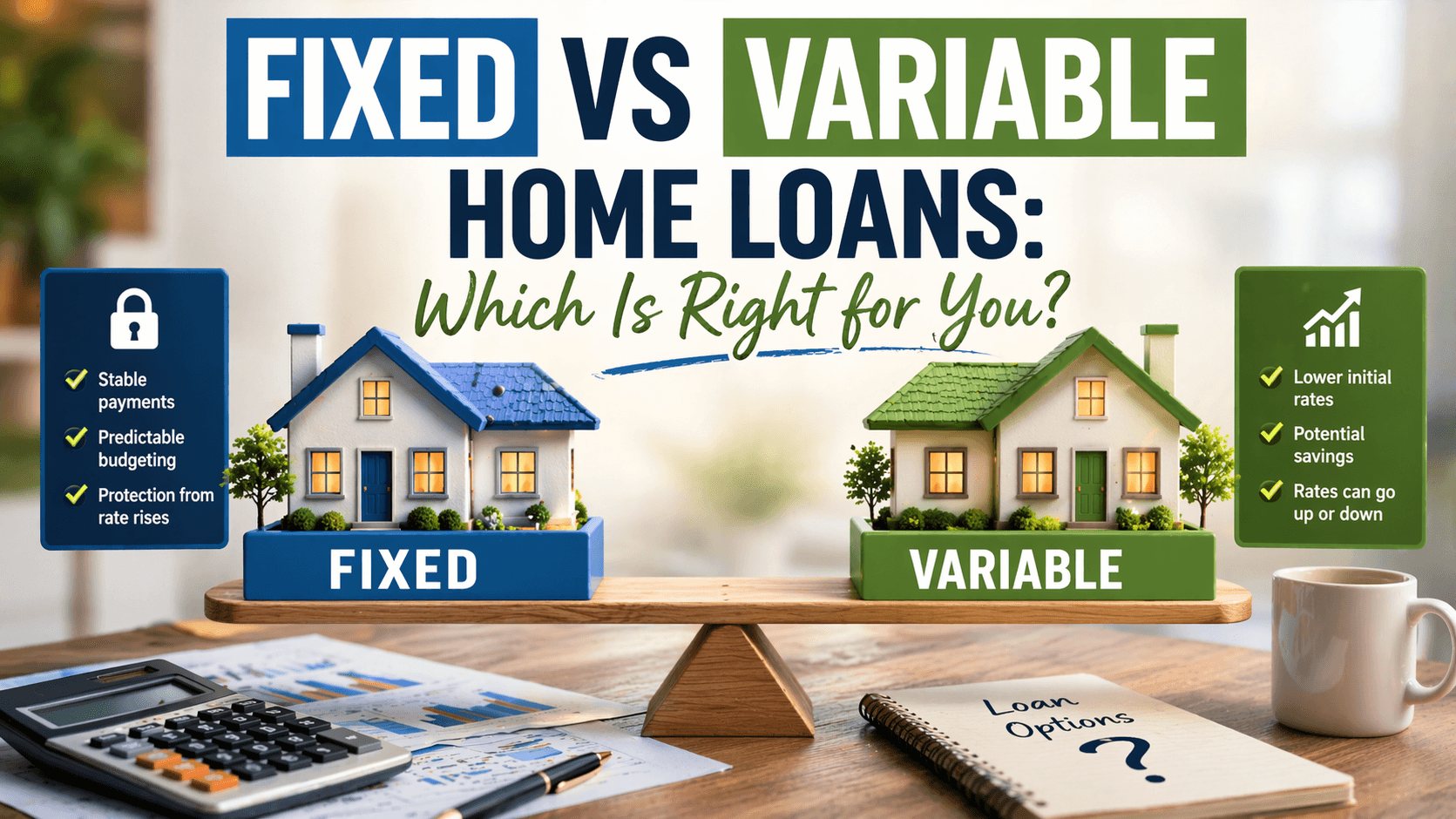
One of the first and most important decisions you will face when taking out a home loan in Australia is choosing between fixed vs variable home loans. It is a question that comes up for first home buyers, refinancers, and experienced property investors alike — and the right answer is different for everyone.
Understanding the difference between fixed vs variable home loans is essential before you sign anything. Each option comes with its own set of advantages, risks, costs, and ideal borrower profiles. Get this decision right, and it can save you thousands of dollars over the life of your loan. Get it wrong, and you could end up locked into a product that does not suit your financial situation or goals.
This guide breaks down everything you need to know about fixed vs variable home loans in plain Australian English — so you can compare your options with confidence and choose the loan structure that is truly right for you.
Disclaimer: This article is general and educational in nature. It does not constitute financial advice. Always speak with a licensed mortgage broker or financial adviser before making any borrowing decisions.
What Are Fixed vs Variable Home Loans?
Before diving into the details, it helps to understand the fundamental difference between fixed vs variable home loans in Australia.
A fixed rate home loan is a mortgage where the interest rate is locked in at a set level for a defined period — typically between one and five years. During this fixed term, your interest rate and repayments do not change, regardless of what happens to interest rates in the broader market.
A variable rate home loan is a mortgage where the interest rate can move up or down over time. The rate is influenced by your lender’s own decisions as well as the Reserve Bank of Australia’s (RBA) official cash rate. When the cash rate moves, variable rate home loan repayments typically follow.
The debate between fixed vs variable home loans has been a constant in Australian home buying for decades — and both options remain genuinely popular today. Understanding the mechanics of each is the starting point for making the right choice for your individual situation.
How Do Fixed Home Loans Work?
When you choose a fixed rate loan in the fixed vs variable home loans comparison, here is what happens:
- Your rate is locked in at the time you take out the loan — or sometimes at the time of approval, depending on the lender.
- Your repayments stay the same every month for the entire fixed period — whether that is one year, two years, three years, or five years.
- At the end of the fixed term, your loan typically rolls over to the lender’s standard variable rate automatically, unless you choose to refix or refinance.
- Extra repayments are limited — most lenders cap how much extra you can repay on a fixed rate loan, and some do not allow extra repayments at all during the fixed period.
- Break costs apply if you want to exit the loan, refinance, or sell your property during the fixed term. These costs can be significant and are calculated based on wholesale interest rates at the time — always ask your lender to estimate the break cost before making any decisions.
How Do Variable Home Loans Work?
On the other side of the fixed vs variable home loans comparison, here is how a variable rate loan works:
- Your interest rate can move at any time — up or down — in line with your lender’s standard variable rate, which is influenced by the RBA cash rate and the lender’s own funding costs and policies.
- Your repayments change when your rate changes. If rates fall, your repayments go down. If rates rise, your repayments go up.
- Extra repayments are generally unlimited on most variable rate loans — you can pay more than the minimum at any time without penalty, which can significantly reduce the total interest you pay over the life of the loan.
- Redraw facilities and offset accounts are commonly available on variable rate home loans, giving you more flexibility and ways to reduce your interest costs.
- No break costs — you can switch lenders, refinance, or sell your property at any time without paying an exit penalty on a standard variable rate loan.
Fixed vs Variable Home Loans: Key Differences at a Glance
Here is a side-by-side comparison of fixed vs variable home loans across the features that matter most to Australian borrowers:
| Feature | Fixed Rate Home Loan | Variable Rate Home Loan |
|---|---|---|
| Interest rate | Locked in for a set period | Can move up or down at any time |
| Repayment certainty | High — repayments stay the same | Lower — repayments change with rate movements |
| Extra repayments | Usually capped or restricted | Generally unlimited |
| Offset account | Rarely available | Commonly available |
| Redraw facility | Rarely available | Commonly available |
| Break costs | Yes — can be very significant | No — exit at any time |
| Rate flexibility | None during fixed period | Full — benefits from rate cuts |
| Budgeting ease | Very easy — repayments are predictable | Harder — repayments can vary |
| Suits rate rises | Yes — you are protected from rises | No — repayments increase if rates rise |
| Suits rate falls | No — you miss out on savings | Yes — repayments fall automatically |
Pros and Cons of Fixed vs Variable Home Loans
Fixed Rate Home Loans — Pros
- Repayment certainty: You know exactly what you will pay every month for the fixed period — making budgeting simple and stress-free
- Protection from rate rises: If the RBA raises the cash rate during your fixed term, your repayments stay exactly the same
- Peace of mind: Particularly valuable for first home buyers managing a tight budget in the early years of homeownership
- Easier financial planning: Fixed repayments make it easier to plan for other financial goals alongside your mortgage
Fixed Rate Home Loans — Cons
- You miss out on rate cuts: If the RBA cuts rates during your fixed term, your repayments stay the same while variable borrowers benefit from lower repayments
- Break costs can be very high: Exiting a fixed rate loan early — due to selling, refinancing, or financial hardship — can trigger substantial break costs that are difficult to predict in advance
- Limited extra repayments: Most fixed rate loans cap extra repayments, limiting your ability to pay down the loan faster
- Less flexibility overall: Fixed rate loans generally lack offset accounts, redraw facilities, and the flexibility that variable loans offer
- Reversion rate risk: When the fixed term ends, the loan rolls to the standard variable rate — which may be higher than competitive variable rates offered by other lenders at the time
Variable Rate Home Loans — Pros
- Benefits from rate cuts: When the RBA lowers the cash rate and your lender passes on the cut, your repayments reduce automatically
- Maximum flexibility: Unlimited extra repayments, offset accounts, and redraw facilities give you powerful tools to reduce your interest costs and pay off your loan faster
- No break costs: You can refinance, sell, or switch loans at any time without paying an exit penalty
- Access to better features: Offset accounts are widely available on variable rate loans, which can save a significant amount of interest over the life of the loan
- Wide choice of lenders and products: The variable rate home loan market in Australia is highly competitive, giving you more options to compare
Variable Rate Home Loans — Cons
- Rate uncertainty: If rates rise, your repayments increase — which can create financial pressure if you have not budgeted for rate movements
- Harder to budget precisely: Variable repayments require you to maintain a buffer in case rates move upward
- Potential for payment shock: Rapid or repeated rate rises — such as those seen in 2022–2023 — can significantly increase monthly repayments on variable rate loans
What Is a Split Home Loan?
If you are struggling to decide between fixed vs variable home loans, there is a third option worth considering — a split rate home loan.
A split loan divides your mortgage into two portions: one on a fixed rate and one on a variable rate. For example, you might fix 60% of your loan for three years and keep the remaining 40% on a variable rate. This gives you repayment certainty on part of your loan while retaining flexibility and the ability to make extra repayments on the variable portion.
Split loans are a popular middle ground in the fixed vs variable home loans debate for borrowers who want the best of both worlds. They are not perfect — you still face break costs on the fixed portion if you exit early — but they offer a practical balance that suits many Australian borrowers.
Fixed vs Variable Home Loans: Which Is Better in a Rising Rate Environment?
In a rising interest rate environment — where the RBA is increasing the cash rate — fixed rate loans generally offer an advantage in the fixed vs variable home loans comparison. By locking in your rate before rates rise, you protect yourself from higher repayments for the duration of your fixed term.
However, this benefit only materialises if you fix at the right time. By the time most borrowers consider fixing, lenders have typically already priced anticipated rate rises into their fixed rate products. This means fixed rates often rise before the RBA actually moves the cash rate — so the window of opportunity to lock in a genuinely low fixed rate can be narrow.
Fixed vs Variable Home Loans: Which Is Better in a Falling Rate Environment?
In a falling rate environment — where the RBA is cutting the cash rate — variable rate loans offer a clear advantage in the fixed vs variable home loans comparison. As rates fall and lenders pass on cuts, variable borrowers benefit from lower repayments automatically.
Borrowers locked into fixed rate loans during a period of falling rates miss out on these savings entirely — and may even face significant break costs if they try to exit their fixed loan early to take advantage of lower variable rates.
How to Choose Between Fixed vs Variable Home Loans
When deciding between fixed vs variable home loans, consider the following questions:
- How important is repayment certainty to you? If you are on a tight budget and need to know exactly what you will pay each month, a fixed rate loan offers valuable peace of mind. If you have financial flexibility and a buffer, a variable rate loan may be more suitable.
- Do you plan to make extra repayments? If you intend to pay off your loan faster by making extra repayments, a variable rate loan is generally better — most fixed loans cap or restrict this. When comparing fixed vs variable home loans, this is one of the most important factors for borrowers focused on paying off their debt faster.
- Do you need an offset account? Offset accounts are a powerful tool for reducing interest costs and are widely available on variable rate loans but rarely on fixed rate loans. If you maintain a solid savings balance, the interest savings from an offset account can be substantial.
- Are you likely to sell or refinance in the near term? If there is a reasonable chance you will sell your property or refinance within the next few years, a fixed rate loan could expose you to significant break costs. In this scenario, a variable rate loan is usually a safer choice in the fixed vs variable home loans debate.
- What is your view on the interest rate outlook? While no one can predict interest rate movements with certainty, your own assessment of whether rates are more likely to rise or fall can inform your decision between fixed vs variable home loans.
- What does your mortgage broker recommend? A licensed mortgage broker can assess your personal financial situation, goals, and risk tolerance and provide tailored guidance on the fixed vs variable home loans question based on current market conditions.
Rates and Fees: What to Compare in Fixed vs Variable Home Loans
When comparing fixed vs variable home loans, never focus on the interest rate alone. Always compare:
- The comparison rate: The comparison rate combines the interest rate with most fees and charges into a single annual percentage. It gives you a far more accurate picture of the true cost of each loan when comparing fixed vs variable home loans. By law, all Australian lenders must display the comparison rate alongside their advertised rate.
- Application and establishment fees: One-off charges to set up the loan
- Ongoing monthly or annual fees: Regular service or package fees
- Break costs: Critical to understand on fixed rate loans — always ask your lender for an estimate before committing
- Redraw fees: Some lenders charge a fee to access extra repayments on variable loans
- Discharge fees: Charged when you pay off your loan or refinance to another lender
The Moneysmart home loans guide is a free and reliable resource to help you understand all the costs involved when comparing fixed vs variable home loans in Australia.
Common Mistakes to Avoid When Choosing Fixed vs Variable Home Loans
- Choosing based only on the interest rate: The lowest advertised rate is not always the cheapest loan overall. Always compare using the comparison rate when evaluating fixed vs variable home loans.
- Not considering break costs on fixed loans: Many borrowers fix their rate without fully understanding how costly it can be to exit the loan early. Always ask for a break cost estimate before choosing a fixed rate in the fixed vs variable home loans comparison.
- Fixing for too long: Locking in a fixed rate for five years provides certainty — but also locks you in for a long time. If your circumstances change or rates fall significantly, you could be stuck paying above-market rates with no easy way out.
- Not accounting for reversion rates: When a fixed term ends, the loan reverts to the lender’s standard variable rate — which may be much higher than the best variable rates on the market at that time. Always factor in what happens after the fixed period when comparing fixed vs variable home loans.
- Ignoring the value of offset accounts: Borrowers who choose a fixed rate purely for certainty sometimes overlook the long-term interest savings available through an offset account on a variable rate loan.
- Making a decision based on emotion rather than facts: The fixed vs variable home loans decision should be based on your financial situation, goals, and risk tolerance — not on fear of rate rises or excitement about a low fixed rate teaser offer.
Alternatives to Choosing Between Fixed vs Variable Home Loans
If you genuinely cannot decide between fixed vs variable home loans, here are some alternatives worth exploring:
- Split rate loan: Divide your loan into fixed and variable portions — the most popular middle-ground solution in the fixed vs variable home loans debate
- Speak with a licensed mortgage broker: A broker can assess your specific situation and recommend the most suitable structure from a wide range of lenders and products
- Start variable and review annually: Some borrowers start on a variable rate and regularly review whether fixing makes sense as market conditions change
- Use an offset account on a variable loan: If the flexibility and interest-saving potential of a variable loan with offset account appeals to you, this can be a highly effective long-term strategy
For independent guidance on all aspects of home loans in Australia, the Australian Financial Complaints Authority (AFCA) and Moneysmart are both excellent free resources.
Frequently Asked Questions: Fixed vs Variable Home Loans
What is the main difference between fixed vs variable home loans?
The main difference in the fixed vs variable home loans comparison is how the interest rate is set. A fixed rate loan locks in your rate for a set period, giving you repayment certainty. A variable rate loan has a rate that moves up or down over time in line with market and RBA conditions.
Which is better — fixed or variable home loans in Australia?
There is no single right answer in the fixed vs variable home loans debate — it depends entirely on your personal financial situation, goals, and risk tolerance. Fixed suits borrowers who want certainty and are worried about rate rises. Variable suits borrowers who want flexibility and want to benefit from rate cuts or use an offset account.
Can I switch from fixed to variable home loans?
Yes, but it will typically trigger break costs if you switch during the fixed term. These costs can be significant. Always request a break cost estimate from your lender before deciding to switch in the fixed vs variable home loans comparison.
What happens when my fixed rate period ends?
When your fixed term ends, your loan automatically rolls to the lender’s standard variable rate — which may be higher than the best variable rates available elsewhere. This is known as the reversion rate. It is important to review your loan options as you approach the end of your fixed term and consider whether refinancing or refixing makes sense.
Can I make extra repayments on a fixed rate home loan?
Most fixed rate home loans cap or restrict extra repayments — typically to around $10,000 per year. This is one of the key differences in the fixed vs variable home loans comparison. Variable rate loans generally allow unlimited extra repayments without penalty.
Do fixed rate home loans have offset accounts?
Offset accounts are rarely available on fixed rate home loans. They are a feature much more commonly associated with variable rate loans. This is an important consideration when comparing fixed vs variable home loans for borrowers who maintain a healthy savings balance.
What are break costs on a fixed home loan?
Break costs are fees charged by the lender when you exit a fixed rate loan before the fixed term ends — for example, by selling your property, refinancing, or paying the loan off early. They are calculated based on the difference between your fixed rate and current wholesale interest rates, and can sometimes run into tens of thousands of dollars. Always clarify break costs before choosing the fixed side of the fixed vs variable home loans comparison.
What is a split home loan?
A split home loan divides your mortgage into a fixed rate portion and a variable rate portion. It is a popular compromise in the fixed vs variable home loans debate — giving you some repayment certainty on the fixed part while retaining flexibility and offset account access on the variable part.
How does the RBA cash rate affect fixed vs variable home loans?
The RBA cash rate directly influences variable rate home loans — when the RBA raises or lowers the cash rate, most lenders adjust their variable rates accordingly. Fixed rates are set by lenders based on their own cost of funds and future rate expectations, so they can move independently of the RBA cash rate. Understanding this relationship is essential when making the fixed vs variable home loans decision.
Should I fix my rate right now?
This depends entirely on your personal situation and view of the interest rate environment. No one can predict rate movements with certainty. The best approach when considering fixed vs variable home loans is to speak with a licensed mortgage broker who can assess your specific circumstances and provide personalised guidance based on current market conditions.
Conclusion: Fixed vs Variable Home Loans — Which Is Right for You?
The fixed vs variable home loans decision is one of the most personal in the home loan process. There is no universally correct answer — only the answer that is right for your financial situation, your goals, and your risk tolerance.
If repayment certainty and protection from rate rises matter most to you, a fixed rate loan is worth considering. If flexibility, the ability to make extra repayments, access to an offset account, and the ability to benefit from rate cuts are your priorities, a variable rate loan is likely the better fit. And if you genuinely want elements of both, a split loan offers a practical middle ground in the fixed vs variable home loans debate.
Whatever you choose, always compare the comparison rate — not just the headline rate — read the Key Facts Sheet carefully, and speak with a licensed mortgage broker before making your final decision.
Ladabo.com is here to help you navigate the fixed vs variable home loans decision and all aspects of home borrowing in Australia — in plain English, with no pressure and no sales spin. Compare your options and borrow with confidence.
Suggested Internal Links:
- Top 10 Home Loans for First Home Buyers Australia
- What Is Lenders Mortgage Insurance (LMI) and How Can You Avoid It?
- First Home Guarantee Explained: How to Buy With a 5% Deposit in Australia
- How to Improve Your Credit Score Before Applying for a Home Loan in Australia
- Home Loan Pre-Approval in Australia: A Step-by-Step Guide for First Home Buyers
Explore our blog for expert tips, loan guides, and practical advice on managing money in Australia.








Leave a Reply
You must be logged in to post a comment.